In 2009, I became extremely concerned with the concept of Unique Identity for various reasons. Connected with many like minded highly educated people who were all concerned.
On 18th May 2010, I started this Blog to capture anything and everything I came across on the topic. This blog with its million hits is a testament to my concerns about loss of privacy and fear of the ID being misused and possible Criminal activities it could lead to.
In 2017 the Supreme Court of India gave its verdict after one of the longest hearings on any issue. I did my bit and appealed to the Supreme Court Judges too through an On Line Petition.
In 2019 the Aadhaar Legislation has been revised and passed by the two houses of the Parliament of India making it Legal. I am no Legal Eagle so my Opinion carries no weight except with people opposed to the very concept.
In 2019, this Blog now just captures on a Daily Basis list of Articles Published on anything to do with Aadhaar as obtained from Daily Google Searches and nothing more. Cannot burn the midnight candle any longer.
"In Matters of Conscience, the Law of Majority has no place"- Mahatma Gandhi
Ram Krishnaswamy
Sydney, Australia.

Aadhaar

The UIDAI has taken two successive governments in India and the entire world for a ride. It identifies nothing. It is not unique. The entire UID data has never been verified and audited. The UID cannot be used for governance, financial databases or anything. It’s use is the biggest threat to national security since independence. – Anupam Saraph 2018

When I opposed Aadhaar in 2010 , I was called a BJP stooge. In 2016 I am still opposing Aadhaar for the same reasons and I am told I am a Congress die hard. No one wants to see why I oppose Aadhaar as it is too difficult. Plus Aadhaar is FREE so why not get one ? Ram Krishnaswamy

First they ignore you, then they laugh at you, then they fight you, then you win.-Mahatma Gandhi

In matters of conscience, the law of the majority has no place.Mahatma Gandhi

“The invasion of privacy is of no consequence because privacy is not a fundamental right and has no meaning under Article 21. The right to privacy is not a guaranteed under the constitution, because privacy is not a fundamental right.” Article 21 of the Indian constitution refers to the right to life and liberty -Attorney General Mukul Rohatgi

“There is merit in the complaints. You are unwittingly allowing snooping, harassment and commercial exploitation. The information about an individual obtained by the UIDAI while issuing an Aadhaar card shall not be used for any other purpose, save as above, except as may be directed by a court for the purpose of criminal investigation.”-A three judge bench headed by Justice J Chelameswar said in an interim order.

Legal scholar Usha Ramanathan describes UID as an inverse of sunshine laws like the Right to Information. While the RTI makes the state transparent to the citizen, the UID does the inverse: it makes the citizen transparent to the state, she says.

Good idea gone bad
I have written earlier that UID/Aadhaar was a poorly designed, unreliable and expensive solution to the really good idea of providing national identification for over a billion Indians. My petition contends that UID in its current form violates the right to privacy of a citizen, guaranteed under Article 21 of the Constitution. This is because sensitive biometric and demographic information of citizens are with enrolment agencies, registrars and sub-registrars who have no legal liability for any misuse of this data. This petition has opened up the larger discussion on privacy rights for Indians. The current Article 21 interpretation by the Supreme Court was done decades ago, before the advent of internet and today’s technology and all the new privacy challenges that have arisen as a consequence.

Rajeev Chandrasekhar, MP Rajya Sabha

“What is Aadhaar? There is enormous confusion. That Aadhaar will identify people who are entitled for subsidy. No. Aadhaar doesn’t determine who is eligible and who isn’t,” Jairam Ramesh

But Aadhaar has been mythologised during the previous government by its creators into some technology super force that will transform governance in a miraculous manner. I even read an article recently that compared Aadhaar to some revolution and quoted a 1930s historian, Will Durant.Rajeev Chandrasekhar, Rajya Sabha MP

“I know you will say that it is not mandatory. But, it is compulsorily mandatorily voluntary,” Jairam Ramesh, Rajya Saba April 2017.

August 24, 2017: The nine-judge Constitution Bench rules that right to privacy is “intrinsic to life and liberty”and is inherently protected under the various fundamental freedoms enshrined under Part III of the Indian Constitution

"Never doubt that a small group of thoughtful, committed citizens can change the World; indeed it's the only thing that ever has"

“Arguing that you don’t care about the right to privacy because you have nothing to hide is no different than saying you don’t care about free speech because you have nothing to say.” -Edward Snowden

In the Supreme Court, Meenakshi Arora, one of the senior counsel in the case, compared it to living under a general, perpetual, nation-wide criminal warrant.

Had never thought of it that way, but living in the Aadhaar universe is like living in a prison. All of us are treated like criminals with barely any rights or recourse and gatekeepers have absolute power on you and your life.

Announcing the launch of the # BreakAadhaarChainscampaign, culminating with events in multiple cities on 12th Jan. This is the last opportunity to make your voice heard before the Supreme Court hearings start on 17th Jan 2018. In collaboration with @no2uidand@rozi_roti.

UIDAI's security seems to be founded on four time tested pillars of security idiocy

1) Denial

2) Issue fiats and point finger

3) Shoot messenger

4) Bury head in sand.

God Save India

Showing posts with label Ajay Bhushan Pandey-Director General- UIDAI. Show all posts

Thursday, December 8, 2016

10565 - UIDAI Seeks to Ensure None Left Behind in Aadhaar Campaign - Find Biometrics

Posted on October 27, 2016

The Unique Identification Authority of India (UIDAI) is working to ensure that no one is left behind when it comes to registration in the nation’s biometric ID program, Aadhaar. 

Earlier this month, the UIDAI launched a campaign to register any last voters in 22 states in which Aadhaar registration has already reached virtually 100 percent.

Any individuals in the targeted states who haven’t yet been registered for Aadhaar will be given priority processing once they have submitted their applications. As UIDAI CEO Dr. Ajay Bhushan Pandey explained in a statement announcing the initiative, it’s “in furtherance of our enrolment [sic.] exercise to achieve universal coverage for Aadhaar across the country.”


The UIDAI says there are currently over 1.066 billion citizens enrolled in the program, which is used in the administration of a growing range of civil services. Not only is Aadhaar used to verify individuals for government subsidy access and for banking, it’s also being considered for more niche applications such as vetting organ donors to disrupt illegal trafficking. And with authorities now starting to assign Aadhaar numbers to newborns, a new generation will grow up with their biometrics tied to a huge range of civic activities. Meanwhile, the UIDAI is clearly making every effort to ensure that all adults are brought onboard, too.

Tuesday, December 6, 2016

10539 - Govt to keep Aadhaar records for 7 yrs, prompts fears of surveillance - Hindustan Times

INDIA Updated: Oct 17, 2016 08:56 Ist


Aloke Tikku 
Hindustan Times

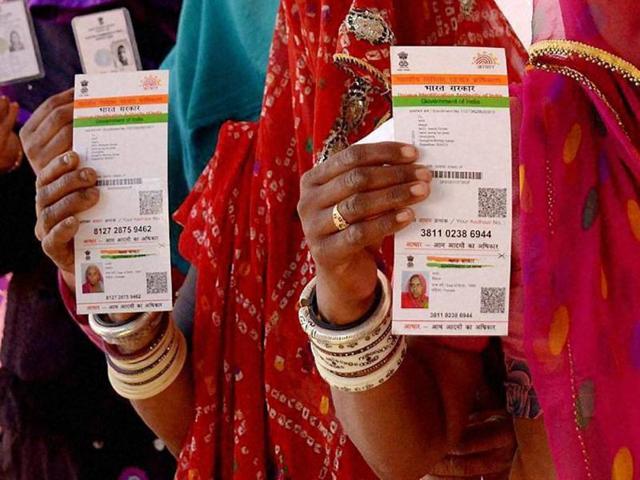
Women show their Aadhaar cards while standing in a queue at a poll booth in Ajmer. (PTI File Photo)

The government will keep a record of all the services and benefits availed using the Aadhaar number for seven years, say new rules, prompting fears that the database could be used for surveillance.

The Unique Identification Authority of India (UIDAI), which issues the 12-digit biometric identity to all Indian residents, will be required to preserve its record of verification of an Aadhaar number for the duration.

“This is an unprecedented centralised data retention provision,” said Sunil Abraham, director of the Bengaluru-based think tank, Centre for Internet and Society.

UIDAI chief executive officer ABP Pandey said the concerns were exaggerated. The agency was keeping records in case a dispute arose over a transaction.


The information will be retained online for two years and another five years in the offline archives, say the rules notified in September.

Users will be able to check the records but only for two years.
This restriction won’t apply to security agencies. Pandey, however, said the records would not be available to them without a district judge’s permission.

But, Hindustan Times found that the rules allow designated joint secretary-level officers at the Centre to order access to information on the grounds of national security.

“Once Aadhaar becomes mandatory for all services, it can be used by benign and malignant actors to conduct a 360-degree surveillance on any individual,” Abraham said.

This is how the system, which will need millions of fingerprint-reading machines, works.

Every time a person fingerprints and quotes the Aadhaar number, the agency concerned sends the data to UIDAI to crosscheck the particulars.

The UIDAI authenticates about five million Aadhaar numbers, which are quoted to avail LPG subsidy, cheap ration and even passport, a day against a capacity to verify 100 million requests daily.
“You can think of it as Natgrid Plus,” Abraham said, a reference to the National Intelligence Grid being built by the government.
A one-stop database for counter-terrorism agencies, Natgrid will collate information real time from databases of various agencies such as bank, rail and airline networks.

“…we do not record the purpose for which an authentication request was received but only the details of the agency that sent it,” UIDAI’s Pandey said.

But seven years is a long time. Only a select category of government files are kept for longer than five years.
Asked about two-year deadline for users, Pandey said it would have been a logistic nightmare to let people access the records once the information was offline.

The Supreme Court has a ruled that Aadhaar is not a must for availing welfare schemes and is to decide if collecting biometric data for the 12-digit number infringed an individual’s privacy.

Tuesday, October 4, 2016

10490 - Government presses on with Aadhaar in ration system despite glitches, delayed food law - Scroll.In

Published Sep 25, 2016 · 07:30 am.   


By March 2017, Aadhaar will be mandatory for food benefits even as fingerprint authentication problems persist, and rules on grievance redress are missing

Image credit:  Anumeha Yadav

The National Democratic Alliance government has asked the states and Central ministries to link the details of all beneficiaries of its social welfare schemes with Aadhaar, a biometric-based unique identity number, by March 2017.

On September 14, the Unique Identity Authority of India – the agency that manages the centralised Aadhaar database – sent circulars to the ministries to specify the schemes, benefits and services for which the 12-digit number will now be mandatory.
One of the biggest such schemes to be linked will be the public distribution system under the National Food Security Act, 2013 – which provides a legal entitlement to subsidised foodgrains to 67% of the country’s population through a network of fair price shops.

“The public distribution system has the largest database of beneficiaries at over 85 crore,” said Ajay Bhushan Pandey, chief executive officer of the Unique Identity Authority of India. “It is much larger than the 13 crore users of subsidised liquefied petroleum gas, or the 1.5 crore students who receive government scholarships.”

He said the agency would help the Ministry of Consumer Affairs, Food and Public Distribution prepare a notification to make Aadhaar mandatory for food benefits.

"You [food ministry] should now be the main agency to register the residual population to be covered under Aadhaar,” he added at a conference of states organised by the ministry on September 16.

There are currently 105 crore Aadhaar holders in India, or 82% of its population.

Activists of the Right to Food campaign, however, criticised the move to make Aadhaar mandatory in the public distribution system. They said that even three years after it had been passed, the National Food Security Act was yet to be fully enacted by several states. And state governments were still to create grievance redressal mechanisms mandated by the law. This, they pointed out, would leave beneficiaries with no place to take their complaints if they faced Aadhaar authentication failures, as were being reported in various states.

Fingerprint snags
The Unique Identity Authority of India does not publish data on Aadhaar authentication failures in schemes where it is already being used, or instances where Aadhaar authentication worked only after multiple attempts.

But data from the states shows that Aadhaar authentication – a process where a beneficiary places his finger on a machine that uses real-time internet connectivity to verify his biometric data against that stored in the central database – is not working well in all states.

Andhra Pradesh, the first state to introduce Aadhaar in all ration shops, has a fingerprint authentication failure rate of up to 5%, said G Ravi Babu, additional secretary, food and civil supplies.
But in Rajasthan – the second state to adopt the process – fingerprint authentication does not work for 37% of enrolled households even nine months after it was introduced in December 2015.

Subodh Agarwal, principal secretary in the state’s food and civil supplies department, said 63.5 lakh transactions were recorded in August where beneficiaries received their 5 kilos of subsidised wheat after fingerprint authentication. This means the system works for 63%, or a little less than two-thirds, of the 99.7 lakh beneficiary families, mostly made up of small farmers.

Babu Singh, a construction worker, and Punni Devi who has polio and their four children cannot get rations after Aadhaar biometric authentication was made compulsory in Jawaja, Rajasthan. Punni Devi did not receive her Aadhaar number. The machine does not recognise the fingerprints of Singh or his 8-year-old son.

Agarwal said beneficiaries are allowed to take their grains after recording their names in registers kept at the ration shops, but this “manual” system will be phased out after September.

Jharkhand began Aadhaar authentication in ration shops in Ranchi district in July. An analysis of state data for July and August by economist Jean Dreze shows that only 49% got their grains in these two months, leaving out half the beneficiaries. Authentication failures were recorded both because of fingerprints not working on the point of sale devices and data entry errors in linking Aadhaar with their ration card details.
Despite these problems, VK Choubey, principal secretary in the state’s food and civil supplies department, said Aadhaar authentication will be implemented in all 24 districts by October.
Choubey's counterpart in Gujarat, MR Das, said the government has introduced Aadhaar authentication at 90% of ration shops. “At first, we had a 20% failure rate in fingerprint authentication, but it has now come down to about 6%,” said Das.

Delayed implementation of food law
The Central government is rushing states to link all ration cards to Aadhaar by March 2017. But this switch to the Aadhaar authentication system comes at a time when most states have not yet notified the rules for compensation or appointed two-tier grievance redressal authorities at the district and state levels, as mandated by the National Food Security Act 2013.

The Food Act was to be implemented within a year of its enactment by 2014, but this deadline has already been extended thrice by the food ministry’s executive orders, the last time in March 2015. Several states have not yet notified crucial parts of the law, including on compensation and grievance redressal, even three years after the Act was passed.

“Several states have appointed food department officials as district grievance redressal officials, which does not satisfy the requirement of the law to have an independent authority for this,” said Dipa Sinha, a social activist with the Right to Food Campaign. “If a beneficiary is denied rations because of fingerprint failures or data entry errors, they will be asked to approach the same food department officials who may be responsible for those errors in the first place.”

As per ministry data, only nine states have appointed food department officials as district grievance redressal officials. Twenty states have designated an existing commission to additionally act as the state-level food commission, while three states have not formed a state-level commission at all.
A toll-free grievance redressal facility – the 1967 helpline – has not been implemented in 10 states, including Rajasthan, Jharkhand and Uttar Pradesh.

The Act provides for compensation in case of denial of foodgrains, but only seven states have notified these rules.
“The rules specify what compensation will be provided in case of denial of food entitlements, the process of applying for compensation, the time limit within which an authority responds, but most states are yet to frame and notify these rules,” said Aditya Shrivastava, a lawyer.

Ministry officials said no one will be denied foodgrains because of Aadhaar errors. “In states like Rajasthan, which are reporting high rates of Aadhaar errors, the manual system is still being allowed and no one is being denied their entitlements,” said Vrinda Sarup, secretary, Ministry of consumer affairs, food and public distribution.

We welcome your comments at letters@scroll.in.

Sunday, September 11, 2016

10402 - World Bank Wants India To Share Its Experiences On Implementing Aadhaar With Other Countries - India Times


September 9, 2016

The World Bank has approached the Unique Identification Authority of India (UIDAI) to share its experiences on the implementation of Aadhaar biometric identification of citizens with other countries. 

BCCL

Nigeria recently became the first country to send a team to India under the World Bank aegis to study the UIDAI model and a team from Tanzania is expected this month, UIDAI chief executive Ajay Bhushan Pandey told ET. 

"This is happening under the World Bank's Identification for Development (ID4D) initiative. We will offer all help to visiting countries by way of knowledge exchange," Pandey said. 

The World Bank confirmed this to ET. "ID4D has sought the experience and lessons from UIDAI implementation to share learnings with interested countries," the multilateral development lender said in an emailed response to ET's queries. 

The world show's interest in the Indian model

Many other countries have also sought UIDAI's help independently, the UIDAI CEO said. These include India's close diplomatic partners in the neighbourhood, Afghanistan and Bangladesh, whose teams have come to see the UIDAI model. 

A senior government official, on the condition of anonymity, told ET that the international interest in Aadhaar stems from the fact that India now has the biggest biometric identity database and has "leapfrogged" over the efforts of many other countries in Africa and Asia who do have a database of citizens, but in the form of paper-based register records. "Countries are eager to know how a 104 crore-strong biometric database was built and will be used for determining identity," this official said.

UIDAI is taking care to not share the intricate security and IT details of the Aadhaar project with the foreign countries who intend to replicate the same. "We are only sharing the broad framework and architecture of the Aadhaar project, the enrolment and authentication strategy followed by us and the update process. UIDAI cannot execute the project for any foreign country as we are bound by the Aadhaar Act which applies only to India," a senior official said. 

The World Bank said ID4D is a cross-sectoral initiative of the World Bank Group with the objective of "making everyone count" by providing an identity and fostering digital identification for all. 

"The initiative looks to share knowledge and identify good practices across countries interested in digital identification, recognising the transformational potential of 21st century ID systems for the delivery of basic services to the poor," it said in the email to ET. 

As per details available on the World Bank website on ID4D, there are an estimated 1.5 billion people world-wide, majority of them living in Africa and Asia, who do not have an official, government-issued recognised document as a proof of their legal identity.

Originally published in Economic Times

Saturday, April 23, 2016

9868 - "The system is becoming more and more reliable" - Business Today

Ajay Bhushan Pandey, DG and Mission Director, UIDAI, spoke to Business Today on Aadhaar enrolment crossing the one- billion mark.
By Joe C. Mathew   New Delhi     Print Edition: May 8, 2016

Ajay Bhushan Pandey, Director General & Mission Director, UIDAI

Ajay Bhushan Pandey, DG and Mission Director, UIDAI, spoke to Business Today on Aadhaar enrolment crossing the one- billion mark. Pandey asserted that all privacy concerns have been taken care of in the new Act and the government is all set to introduce Aadhaar in more number of schemes and programmes.

How do we address the privacy issue?
We have an Act now, which says that every data, right from the enrolment time, is encrypted. So this data is not available to anyone without the permission of the person concerned. It will be in our data centre and it will remain encrypted except for a fraction of microsecond, when data is used for de-duplication and Aadhaar generation. Only for that time, it is decrypted, and thereafter, it is again encrypted. Tomorrow, let us say this data is leaked. The stolen data will be in the encrypted form. Our encryption is so strong that if anyone tries to break it, it will take the age of universe to break one set. Your data will be given without your consent only in two cases: First, if the court orders us. Secondly, in the extreme cases of national security, where a committee headed by the Cabinet Secretary authorises that the disclosure is required. So, there is a very strong privacy clause.

Is it purely voluntary?
Section 7 of the new Act says that the Central or state government can say that for this subsidy or for this programme, the funds for which is out of Consolidated Fund of India, will require an Aadhaar card. Once the Act is passed, the Central government can say that if you want scholarship, you have to give your Aadhaar number. If you want LPG subsidy, you have to give Aadhaar number.

We have seen cases where machines are not recognising fingerprint verification, especially in the case of NREGA payment. Have you been able to sort out this problem?
We have tackled this issue. That is why we have issued 100 crore cards. The other possibility is that in the entire process, somewhere in the link, there could be some glitch. And that is possible. For that one has to establish an alternate system to meet such exigencies. We have improved on this front. And the system is becoming more and more reliable. But if it is still not reliable, people should not suffer. This should be identified through some other means and benefits should be given.

How many persons are involved in the Aadhaar mission?
We have more than 320,000 operators who are certified. All of them may not be working, as there are only 40,000 enrolment centres at the moment. If more people are required, these are trained people who would be available. This will be an ongoing programme as people's faces will change, biometric will also need to be captured more than once. Their names will change, addresses will change, so updating needs to be continuous.


Thursday, April 14, 2016

9810 - UIDAI cautions e-comm players, public against sharing Aadhaar information - Economic Times

By Neha Alawadhi, ET Bureau | 11 Apr, 2016, 03.31PM IST

It also cautioned general public against sharing their personal information, who are being asked to pay anywhere between Rs 50 to Rs 200 on a plastic card in the name of smart card

NEW DELHI: The Unique Identification Authority of India cautioned e-commerce companies such as E-Bay, Flipkart, Amazon not to allow their merchants to collect Aadhaar information from general public for printing Aadhaar cards. 

It also cautioned general public against sharing their personal information, who are being asked to pay anywhere between Rs 50 to Rs 200 on a plastic card in the name of smart card, the Ministry of Communications and IT said in a statement. 

"The Aadhaar card or the downloaded Aadhaar card printed on ordinary paper is perfectly valid for all uses," said Director General of UIDAI, Dr. Ajay Bhushan Pandey. "If a person has a paper Aadhaar card, there is absolutely no need to get his/her Aadhaar card laminated or obtain a plastic Aadhaar card or so called SMART Aadhaar card by paying money. There is no concept such as smart Aadhaar card," he added. 


In addition, referring to e-commerce portals allowing merchants to ask for Aadhaar card details the statement said "collecting information related to Aadhaar card or its unauthorized printing or aiding such persons in any manner may amount to a criminal offence punishable with imprisonment under Indian Penal Code and also Chapter VI of The Aadhaar (Targeted Delivery of Financial and Other Subsidies, Benefits and Services) Act, 2016".

Tuesday, April 5, 2016

9743 - Aadhaar to cross 100 crore mark, may help redesign government schemes - Economic Times

By Surabhi Agarwal, ET Bureau | 4 Apr, 2016, 11.23AM IST


After the Parliament passed a legislation giving sanctity to government's unique identity project, Aadhaar is set to cross another major milestone of touching the 100 crore mark by Monday.


NEW DELHI: After the Parliament passed a legislation giving sanctity to the government's ambitious and much-controversial unique identity project, Aadhaar is set to cross another major milestone of touching the 100 crore mark by Monday. 

In an interview, director general of the Unique Identification Authority of India (UIDAI), AB Pandey told ET that with the Act in place, the government will not only be able to streamline existing subsidies but can also come up with new schemes and sub-schemes that are more targeted, as Aadhaar allows for new ways of beneficiary verification and identification, which were not possible earlier. 

The Authority will soon get a chairperson, a position that has been vacant since Nandan Nilekani, founder chairman of UIDAI, left office in 2014 to contest elections. 

"A chairperson will be appointed within the next 4-5 days," said Pandey without divulging details about who is being considered for the position. The Aadhaar Bill, which was passed in the Parliament as a Money Bill in March, mandates the appointment of a chairman of the authority. 

In an earlier ruling, the Supreme Court had restricted the use of Aadhaar to just a handful of government schemes, but after the bill has been passed, the government is now in the process of restarting linkage with schemes that were halted earlier. Work is also on to identify existing schemes of the government that can be linked to Aadhaar and brought on the Direct Benefits Transfer platform. 

Pandey said that while work is ongoing on this front, in the future, the linkage with Aadhaar could give birth to various new kinds o schemes. He added that using the UID number, the government could carry out authentication in new ways for beneficiaries, and customise and modify schemes accordingly, so that "benefits reach directly to the people." 

He gave an example of the new mandate by the government to withdraw cooking gas subsidy for those earning over Rs 10 lakh annually . "This is a new form of the LPG subsidy, which has been made possible because of Aadhaar," he said. 

Pandey also added that linking of all welfare payments with Aadhaar will give the government a new kind of data and enable it to design schemes for different target audiences within the same scheme. For instance, the government may decide to increase old age pension for a particular person who doesn't have a family after looking at his PDS data, which is also linked to the Aadhaar platform. 

"Several new possibilities, which we have not even thought of right now, will emerge," said Pandey. 

ET had reported earlier that all Central government schemes in volving transfer of benefits in cash or kind are expected to transition to the Direct Benefit Transfer (DBT) platform from April. All Central government payments will soon be on the electronic platform. 

Ministries are geared up after directions were issued last month for the transition of all Central schemes to the DBT platform, which was to be achieved by April 1. Many ministries have already identified such schemes and fasttracked their transition since. 


The scope of DBT now stands enlarged to cover all central sector schemes and centrally-sponsored schemes across all ministries and departments.

Friday, March 25, 2016

9640 - Aadhaar law has good data protection & privacy provisions: A B P Pandey Business Standard


Interview with DG & Mission Director, UIDAI
March 22, 2016 Last Updated at 00:28 IST


Dr A B P Pandey

Dr A B P Pandey, Director General and Mission Director of UIDAI speaks to Nitin Sethi on how the efficacy of Aadhaar will be monitored and what challenges it faces as it reaches the 100 crore enrolment mark.


Once the law is notified, then one be the procedural challenge. Government will have to notify necessary rules under the law and UIDAI will have to frame all the regulations which will govern the jobs we are doing. This is a unique case. Usually what happens first a law is passed and thereafter the institutions are built and operations start. Here it has happened the other way around. The operations - the enrolment - is almost complete. The organisation is also there and has been working under executive orders. Now everything has to be kind of retrofitted in to the acts and the regulations.

How much time do you foresee this process taking?

I foresee it will take maybe 4-5 weeks after the Act is notified to create this whole structure in terms of regulations and other things.

What changes would it entail for UIDAI?

At this time I would say that this Act has a very strong data protection and privacy provisions. So, what we shall have to do is obtain the consent of every individual and that consent has to be informed consent. So we have to go through this process of obtaining informed consent.

For all the 100 crore people enrolled?

No, for the people who will be enrolling in future.

But the consent of those who have already enrolled?

It is not required because the Act validates all the actions done earlier. So this will apply to the new enrolments. Similar thing will happen for the authentication. When the people come for authentication again the process of informed consent will have to be carried out. The agencies that are involved in this job of authenticate, they will have to do it. This is very important from the people's point of view as it will assure them that their data is secure and will be used only for the purpose it was obtained and not handed over to anyone else without their consent.

That will require back-end tweaking?

That is correct. First the policy and regulations are to be put in place. Then, we have entered into various agreements with our partners - those agreements will have to be changed. Next, all these things have to be reflected in the field, for example it could require changing a form to be filled - that has to be done. Some electronic processes for doing such tasks may also require modifications.

You are saying all this can be done in four weeks?

No, in four weeks we can come out some kind of the draft regulations. We will need some more time. But we need a time deadline. There can't be a situation where you have an act passed by the Parliament and just because the regulations are not formed we can't implement the act.

Compliance with law…

Compliance and the urgency with which the Parliament has passed this act, this emergency is also to be reflected in our operations.

Once this architecture is in place, what new ventures or tasks have the government tasked the UIDAI to do?

You see, where all Aadhaar can be used is primarily dependent on the concerned departments or agencies of the government. It will be their domain to decide which areas they want to implement it. So say if the government decides Aadhaar will be made mandatory under section 7 for LPG they can do that. But, that department has to assess the readiness of their organisations.

For average citizens if you can explain, once the line department says they want to use Aadhaar for some scheme, how much time does it take you to tweak your systems for the service?

Actually it wouldn't take time. The Act provides that when Aadhaar is made mandatory for a particular service or benefit of subsidy the person may go for an Aadhaar authentication. If the government department chooses to go purely through this authentication route then that department has to provide this facility at all service points. The department has to make the preparations. If the department is not 100% ready and all service points do not have Aadhaar authentication facility, till then at some of the centres they have the option of accepting the proof of Aadhaar number and that can be done by accepting the paper copy of Aadhar card.

..till the biometric system is in place?

Right, so the appropriate mix of these strategies will help the departments roll out use of Aadhaar for their services faster.

There is research being done now through your centre at how biometrics can be used more efficiently in India. Do you foresee Iris data being used more for authentication along with the fingerprints?

As of today we are already using three sets of biometrics - fingerprints, Iris and photographs. As on today this meets our requirements for the next few years. But yes, particularly for infants - children below 5 years of age - there is an issue of how well formed are the fingerprints. But, I am told that some research is going on where the print of heels of infants are perhaps more well-formed than the fingerprints. Perhaps after few years, supposing if that technological development comes we should be in the position to including that in our system. If more development comes to find another biometric that is less obtrusive - we would also like to use only those biometrics that are less obtrusive and cost effective and provide some use that is not met by current biometrics, we should be able to use it. We will not collect biometrics just for the sake of collection. Our principle from beginning has been to capture the most minimal data required for de-duplication and identification.

There have been reports of how in some places where biometric is being used, like in Rajasthan for PDS, the rate of failure of fingerprint authentication is much higher than expected..

At certain places if the fingerprint fails they have an option. Either they can go for Iris or if the mobile number is registered then through the OTP system that can always be done. But say even that doesn't work say because of connectivity problems…

Electricity or internet connection…

Yes, the government should always have an exception system in place where based on the paper Aadhaar card services can be given and an entry could be made for those exceptional cases. In such exceptional cases where electricity was not working or internet connectivity was bad or some location without connectivity or where fingerprint has not come up correctly, in such cases we should always see what are the alternatives and those can be used.

So will mobile-based authentication towards which UIDAI is set to progress?

Yes I see it moving. Our systems should have the options. One has to know for what kind of transaction you have to collect biometrics for confirmation of identity or for what purpose you can use the confirmation through the mobile phones or go for both in a combination. There could be some very sensitive transactions where someone would want to go for both Iris and mobile OTP. It all depends on the nature of transaction. Hypothetically someone wants to enter a high-value transaction. Then the department can decide it shall go for multi-factor authentication. In Aadhaar we have multi-factor authentication system. It could be any combination of three options we have provided - fingerprints, Iris as well as mobile OTP.

Are you able to monitor how Aadhaar is being used and what is its efficacy - where it is working or failing, say if biometric identification through fingerprints is working or not?

One thing is clear. From Aadhaar side we will not have any data on purpose or location of authentication. For what purpose this aadhar is being used and from where the transaction has originated. This is something we have stated repeatedly in our affidavits in Supreme Court and also reflected in the law. So people are assured that their data we will not keep. But yet, of course we shall have to have information of what kind of people are failing those transactions - whether there is some problem with their biometrics or whether the biometrics need to be updated, or the machines they are working all right or in case someone is attacking us. So, we shall need that kind of data. But we won't need data about say what transaction is being done, whether you are withdrawing or depositing money or for what purpose - not that kind. Say somebody has authentication - we will not have information if it's being used for PDS or MNREGA. So will not have, keep or accept that information in to our systems.

Is there a system already in place for monitoring the efficacy of Aadhaar? Say, if I came to you six months down the line and asked how is the biometric system working? Would you be able to provide that authentication worked in 85% of cases or not? Are you regularly collecting this kind of data?

We monitor this. Say in one day, say, we get 2 million requests. Out of that we naturally have the information that so many have failed or so many has passed. The failure could be because of various reasons. Someone could have tried to falsify an identity, it could be a finger print failure. We also try to monitor the failure rate.

Would I as a citizen or a journalist have access to this data on the efficacy of Aadhaar?

At this stage we don't know how much of the data will be put in public domain. We will have to understand what the security implications are and how much data we need to put in public.

Second thing, how would you monitor that the authentication through Aadhaar has been done legally and only for the purpose that one was permitted to use the authentication system. Who monitors that?

We will have a process laid down, an agreement. Now that we have a law, certain responsibility will be cast on the people who are doing the enrolment or authentication when they handle sensitive personal data. Then there is an obligation cast on them that they use it for specific purpose. We will have our system that we shall have some kind of audit of who we call authentication user agency to see to what extent they are compliant.

Are the protocols in place for you to share periodically with public how the user agencies used the data, in how many instances did they breach the law?

It all depends upon what kind of audit mechanism we have…

At the time we don't have one in place?

Right, we also have to realise the sheer number of agencies we work with. We shall have to work out a workable arrangement as to how it is be done or if it's to be based on self-certification. Some kind of judgement call will have to be taken. It shouldn't happen that we start doing very closely tied audit of every transaction.

Say by CAG?

CAG audits only what the government does and here there will be whole lot of government and those outside the government will be using it and are dealing with a 125 crore number. Therefore what would be the form of audit, whether it would be an audit by some independent auditors etc - those things will have to be thought through and we shall come out with an appropriate response.

Do you forsee that the CAG will be able to audit not just UIDAI but the work of all its private partners?

So far as UIDAI is concerned, it's a government agency, and CAG will have full access to audit every aspect of work that UIDAI does directly. Then, Aadhaar will be used by various government agencies to ensure that services, benefits and subsidies from Consolidated Fund of India is directed to the deserving people. CAG perhaps tomorrow could consider including this aspect also in their audit when they audit such departments.

And audit of the services that the private sector provides for the UIDAI?

There are two categories. One where private sector is doing the UIDAI's job - like running our data centre, the CAG can go in to the question of how they are doing it, whether they are doing it efficiently, whether we are paying them more or less - the CAG can always go in to those aspects. But, supposing we have authorised an agency to do authentication which they are using for their own purpose. Say SEBI has permitted all companies and entities to use Aadhaar for KYC and SEBI is authenticating the genuineness of Aadhaar number. I am not sure to what extent the CAG can go and audit those private entities. This is something on which the CAG will have to take a call.

But these audit processes will take at least few months to be drafted and put in place?

Exactly.

Once the systems are all in place what is the next task for UIDAI as it reaches the 100 crore mark

We are soon going to touch the 100 crore enrolment mark. So, one is it brings that kind of confidence to us. Now we have a creditable mechanism to accurately identify people for providing benefits. At the same time, there is also a challenge. There could still be some people who could be left out in the certain remote localities or especially among the old or the infirm. The government will have to ensure those persons are not denied the benefits because they don't possess an Aadhaar. We have a provision in the law under section 7 when an Aadhaar number is not assigned the person shall be given the benefit through some alternative and viable means of identification. The concerned agencies have to establish this system. Then, even if Aadhaar number is given and because of connectivity or some technical problem or say if the finger print is not matching - to take care of such exceptions, process have to be built in to the system so benefits should not get interrupted.


Friday, December 11, 2015

9153 - ‘Aadhaar is becoming the fulcrum of many govt projects’ - The Hindu

December 10, 2015

‘Aadhaar is becoming the fulcrum of many govt projects’

Dr. Ajay Bhushan Pandey, director general and mission director, UIDAI, speaks about how the government is working towards enhanced security and the future of the project:

How would you explain Aadhaar to a common man?
Aadhaar is a 12-digit identity number which provides a robust online, hassle-free platform of proving one’s identity and delivering services and benefits (both government and non-government) to millions across the country.

You recently enhanced the security cover for information collected under Aadhaar. Could you tell us about it?
There are two aspects of security and privacy. One is the fear of breach of privacy and the other is not securing collected data. We want to reassure the public that personal data is immediately encrypted with a 2,048-bit encryption key even before it is saved on a disk so that it cannot be accessed by any one except authorised persons. So far as fear of breach of privacy is concerned, one need not worry as no personal data is shared with anyone without the consent of the resident, which is obtained through a rigorous method of Aadhaar authentication. Recently, we also brought in an information security audit and consultancy firm to build an additional layer of protection by reviewing the security of the entire system, along with that of other government departments and private agencies such as banks, which engage with Aadhaar.

Where does Aadhaar stand today? And what is your vision for the future?
Aadhaar is becoming the fulcrum for many government projects. So far, it has covered more than 94 crore Indians. We have, however, realised that there is a gap in enrolments particularly for children in the age group 0-5 and 5-18. We have started a special plan to enrol children through camps at anganwadis and schools. Here, adults who have been left over can also get enrolled. We are aggressively looking at bringing in Aadhaar for everyone.


Wednesday, September 23, 2015

8730 - Aadhaar authority develops Android app for easier registration of infants - dna

Monday, 21 September 2015 - 7:50am IST | Place: Mumbai | Agency: dna | From the print edition
Your child will soon get a few visitors, if s/he is below five. The Unique Identification Authority of India (UIDAI) plans to register infants for Aadhaar cards in maternity hospitals, anganwadis and nurseries, instead of making you go to them.

The authority has launched an Android tab to register children below the age of five. The figures below explain why.

Of the 90.76 crore people registered for Aadhaar cards in the country, only 1.16 crore are below five years of age. The population of children below the age of five in India is 11.28 crore. Meaning, only 10% from this age category has registered for Aadhaar cards.

The UIDAI knows the reason. The long queues at enrollment centres are the main culprit. The prospect of a long queue inhibits parents from registering their infants. The Android app will address that issue now.

"We have come out with an Android tab-based machine which costs less than Rs 10,000, compared with the usual machine that costs lakhs. This will be used for enrolling children below five years of age," Ajay Bhushan Pandey, director general, UIDAI, told dna. Since they are portable, it is easier to carry them around, he said.

"It will be used to photograph children and collect their fingerprints and the Aadhaar numbers of the parents," said Pandey. "We have developed the software. Now the state governments can procure the tabs," said Pandey.

Maharashtra is among the first to jump on to the bandwagon. 

"The state has already deployed 120 tabs and plans to increase it up to 500," said M Sankaranarayanan, state director (information technology). He said the tabs would be procured by citizen service centres and handed over to village level entrepreneurs (VLEs) for deployment. Of the 120 tabs, 20 each are meant for Mumbai, Pune and Aurangabad and 40 for Nagpur.

The UIDAI recently held a national-level workshop and a pilot project with the Aadhaar-based application was implemented in Thane. "Enrolling more children will result in our coverage going up," said a UIDAI official.

Instead of stressing on proof of identity and proof of address, the system will seek a proof of relationship between the parents and the child, Sankaranarayanan said.

"The thumb impression of the parent will be checked real time (for authentication of identity)," he said. The lesser time taken for registration means one tab can enrol up to 100 children daily. The packet will be uploaded online instantly and the kits are less cumbersome than the conventional kits, ensuring better portability.

How the numbers stack up
In India, 91% of those above 18 years have enrolled for Aadhaar. The percentage of those between the age of five and 18 years is 59%. The Aadhaar coverage for the country is 75%. However, in the left-out population, about 77%, or around 23.58 crore of 30.32 crore, are below 18 years of age.

In Maharashtra, around 88% has enrolled for Aadhaar. The percentage of registration below six years of age is 19% -- slightly higher than the national average. The left-out population as on August-end is around 1.40 crore and the state plans to cover it by the year-end.

Though districts like Mumbai (90.19%), Ahmednagar (90.75%), Wardha (97.82%), Satara (91.10%) and Sindhudurg (90.70%) have seen the registration of over 90% of people, some like Nanded (80%), Solapur (81.09%), Yavatmal (83.15%) and Latur (84.44%) have performed below expectations.

Maharashtra has a population of 11.23 crore, according to the 2011 census

The state government plans to attain 100% coverage by year-end by focusing on schools and anganwadis to cover children.