In 2009, I became extremely concerned with the concept of Unique Identity for various reasons. Connected with many like minded highly educated people who were all concerned.
On 18th May 2010, I started this Blog to capture anything and everything I came across on the topic. This blog with its million hits is a testament to my concerns about loss of privacy and fear of the ID being misused and possible Criminal activities it could lead to.
In 2017 the Supreme Court of India gave its verdict after one of the longest hearings on any issue. I did my bit and appealed to the Supreme Court Judges too through an On Line Petition.
In 2019 the Aadhaar Legislation has been revised and passed by the two houses of the Parliament of India making it Legal. I am no Legal Eagle so my Opinion carries no weight except with people opposed to the very concept.
In 2019, this Blog now just captures on a Daily Basis list of Articles Published on anything to do with Aadhaar as obtained from Daily Google Searches and nothing more. Cannot burn the midnight candle any longer.
"In Matters of Conscience, the Law of Majority has no place"- Mahatma Gandhi
Ram Krishnaswamy
Sydney, Australia.

Aadhaar

The UIDAI has taken two successive governments in India and the entire world for a ride. It identifies nothing. It is not unique. The entire UID data has never been verified and audited. The UID cannot be used for governance, financial databases or anything. It’s use is the biggest threat to national security since independence. – Anupam Saraph 2018

When I opposed Aadhaar in 2010 , I was called a BJP stooge. In 2016 I am still opposing Aadhaar for the same reasons and I am told I am a Congress die hard. No one wants to see why I oppose Aadhaar as it is too difficult. Plus Aadhaar is FREE so why not get one ? Ram Krishnaswamy

First they ignore you, then they laugh at you, then they fight you, then you win.-Mahatma Gandhi

In matters of conscience, the law of the majority has no place.Mahatma Gandhi

“The invasion of privacy is of no consequence because privacy is not a fundamental right and has no meaning under Article 21. The right to privacy is not a guaranteed under the constitution, because privacy is not a fundamental right.” Article 21 of the Indian constitution refers to the right to life and liberty -Attorney General Mukul Rohatgi

“There is merit in the complaints. You are unwittingly allowing snooping, harassment and commercial exploitation. The information about an individual obtained by the UIDAI while issuing an Aadhaar card shall not be used for any other purpose, save as above, except as may be directed by a court for the purpose of criminal investigation.”-A three judge bench headed by Justice J Chelameswar said in an interim order.

Legal scholar Usha Ramanathan describes UID as an inverse of sunshine laws like the Right to Information. While the RTI makes the state transparent to the citizen, the UID does the inverse: it makes the citizen transparent to the state, she says.

Good idea gone bad
I have written earlier that UID/Aadhaar was a poorly designed, unreliable and expensive solution to the really good idea of providing national identification for over a billion Indians. My petition contends that UID in its current form violates the right to privacy of a citizen, guaranteed under Article 21 of the Constitution. This is because sensitive biometric and demographic information of citizens are with enrolment agencies, registrars and sub-registrars who have no legal liability for any misuse of this data. This petition has opened up the larger discussion on privacy rights for Indians. The current Article 21 interpretation by the Supreme Court was done decades ago, before the advent of internet and today’s technology and all the new privacy challenges that have arisen as a consequence.

Rajeev Chandrasekhar, MP Rajya Sabha

“What is Aadhaar? There is enormous confusion. That Aadhaar will identify people who are entitled for subsidy. No. Aadhaar doesn’t determine who is eligible and who isn’t,” Jairam Ramesh

But Aadhaar has been mythologised during the previous government by its creators into some technology super force that will transform governance in a miraculous manner. I even read an article recently that compared Aadhaar to some revolution and quoted a 1930s historian, Will Durant.Rajeev Chandrasekhar, Rajya Sabha MP

“I know you will say that it is not mandatory. But, it is compulsorily mandatorily voluntary,” Jairam Ramesh, Rajya Saba April 2017.

August 24, 2017: The nine-judge Constitution Bench rules that right to privacy is “intrinsic to life and liberty”and is inherently protected under the various fundamental freedoms enshrined under Part III of the Indian Constitution

"Never doubt that a small group of thoughtful, committed citizens can change the World; indeed it's the only thing that ever has"

“Arguing that you don’t care about the right to privacy because you have nothing to hide is no different than saying you don’t care about free speech because you have nothing to say.” -Edward Snowden

In the Supreme Court, Meenakshi Arora, one of the senior counsel in the case, compared it to living under a general, perpetual, nation-wide criminal warrant.

Had never thought of it that way, but living in the Aadhaar universe is like living in a prison. All of us are treated like criminals with barely any rights or recourse and gatekeepers have absolute power on you and your life.

Announcing the launch of the # BreakAadhaarChainscampaign, culminating with events in multiple cities on 12th Jan. This is the last opportunity to make your voice heard before the Supreme Court hearings start on 17th Jan 2018. In collaboration with @no2uidand@rozi_roti.

UIDAI's security seems to be founded on four time tested pillars of security idiocy

1) Denial

2) Issue fiats and point finger

3) Shoot messenger

4) Bury head in sand.

God Save India

Showing posts with label Ram Shewak Sharma. Show all posts

Monday, August 13, 2018

13850 - Truth fears no trolls - Indian Express


Nothing was hacked and no harm done because I gave out my Aadhaar number. There is a concerted effort to discredit Aadhaar.

Written by R. S. Sharma | Updated: August 9, 2018 12:07:58 am


                      (Illustration: CR Sasikumar)

The Twitterati have had a long run since I responded to a challenge to reveal my Aadhaar number. It was a challenge I could not have declined without accepting that Aadhaar is vulnerable to attacks. The social media, television and print media have had time to weigh in with their perceptions. It’s time to take stock of what really happened last week.

Knowledgeable people have expressed viewpoints, on both sides of the debate. Unfortunately, finer points about technology, law or public policy were lost in the cacophony of trolls. What has emerged is a distorted, collective viewpoint aggregating the loudest voices of those who understood the least. That’s not the outcome we want from debates. Do we?

The lesson is that social media is not the place to discuss complex issues, especially when the atmosphere is vitiated and emotionally charged. As we reflect upon the wreckage of the twitterstorm, the first question is the harm which arose from the disclosure of the Aadhaar number itself and not from the drama that unfolded.


Related News

The first claim of harm was the breakthrough discovery of my mobile number. You can get the last three digits of the mobile number from UIDAI as a hint to the Aadhaar holder about their number. After that, it requires brute force to fill in the remaining digits. Instead of going through the millions of combinations, it is easier to find someone’s mobile number from other places where he may have provided it. Mine was found by searching the internet, as revealed by “the finders” on Twitter.

The second claim was the publication of a photograph of mine with my daughter, taken from my WhatsApp account. Everyone who includes a photograph in their profile on WhatsApp or in other social media runs the same risk. You don’t need Aadhaar for that (most people don’t look too good in their Aadhaar photograph anyway).

Next, some hackers claim to have deposited money in my bank accounts. That has been possible since the early days of banking, and this never requires the account holder’s consent. Though making deposits have now become easier thanks to an innovation called UPI. You can pay using Aadhaar number, or bank account number or telephone number or by scanning a barcode. Businesses too can present an invoice using the same system, making banking frictionless. This is a great achievement of the banking sector in India. 

Billions of rupees have been credited to beneficiaries’ account as Direct Benefit Transfer (DBT) through the Aadhaar-Enabled Payment Services (AEPS) and Aadhaar Payment Bridge (APB). This has empowered the poor and the needy by eliminating middlemen and other rent-seekers. Actual harm would have been if someone had taken money out of my account. The hackers did try with “collect requests”, but in such cases, our banks appropriately require the account holder’s approval.


Next comes publication of my bank account details. I’m not sure of the methods used, but the list of accounts and even the banks is incorrect. A more reliable way to find account numbers is from the account holder’s cheques on which the bank prints it clearly.
Interestingly, a smart alec got my Air India frequent flyer number and provided the transcript of the interaction on Twitter. Air India too has independently mailed the transcript to me. People do forget their frequent flyer numbers and airlines are helpful in such cases: They ask a few basic questions to verify you are indeed who you claim to be and tell you the number. 

That’s what happened, only this time it was an imposter. If the airline wanted to secure that information better, they could have sent an OTP or used the Aadhaar authentication service. Indeed, when an imposter tried to book a first class ticket to New York, the airline demanded stronger proof of identity and the attempt failed.

People tried to buy or subscribe to things on my behalf. I received OTP and confirmation requests from Zestmoney, Mobikwik, Bankbazar, Snapdeal, Amazon, Flipkart, Hotelbids, Joister, Treebo, Behrouz Biryani, Freecharge, Xiaomi, Redbus and Polbuz etc. I just ignored the OTPs and the transaction did not materialise.

Aadhaar offers both demographic and biometric authentication. The hackers have made more than 500 authentication attempts against my Aadhaar number thus far. These efforts have come to nought as the OTP comes on my mobile and it is impossible to correctly guess and plug a six-digit number, that too in 30 minutes.

Though unrelated to Aadhaar, the hackers claimed to have discovered a subscription to some “right-wing” magazine in my name. I am unable to recall subscribing to any magazine, nor is it being delivered to me. I do wish to know more details about it so that I can either get the service started or ask for a refund.

Another incident included a mail sent to my daughter on her official email ID. It has been marked to some journalists too. It has nothing to do with Aadhaar nor is it an example of hacking. It is a criminal act borne of sheer desperation.

From all that is recounted and has happened, the conclusion is that nothing was hacked and no harm caused because some people got hold of my Aadhaar number. Whatever they could obtain is information available on various websites. The inconvenience caused did not arise from any vulnerability in Aadhaar. It was caused by people feeling vulnerable in their stand against Aadhaar, who resorted to absurd, unethical and downright criminal acts, proving nothing but the hollowness of their claims. There is a concerted effort to discredit Aadhaar by vested interests.

This episode highlights that basic precautions are necessary in the digital world. For instance, if you haven’t secured your email account with a strong password and by a second-factor of authentication, you could come in harm’s way.

I was trolled for a week. When the so-called hackers failed to get anything using Aadhaar, they tried other means, all foul. In their frustration they resorted to threatening my family, asking for ransom, impersonation and mud-slinging. Personally, I believe that words like “hacker” or “security researcher” would be too honorific a description for them.

Ultimately, the truth prevailed, which cannot be hacked or trolled — certainly not for long.
It stands reaffirmed that Aadhaar is a safe and secure public utility: Do not be afraid to share your Aadhaar number, whenever and wherever needed. No harm can come to you due to this. To dispel such doubts, the Press Information Bureau has released a video recently, informing people of the truth.
Finally, to those who question this challenge emanating from a public servant, I swear to acting on my conscience and conviction, consistent with my allegiance to the Constitution of this great country.

13849 - I won the Aadhaar challenge, no harm caused to me: Trai chief RS Sharma - Hindustan Times

I won the Aadhaar challenge, no harm caused to me: Trai chief RS Sharma

Outgoing Telecom Regulatory Authority of India chairman RS Sharma said he won the ‘Aadhaar challenge’ he threw on Twitter, claiming that no harm has come to him from revealing his number.
INDIA Updated: Aug 09, 2018 09:20 Ist

Nakul Sridhar 
Hindustan Times, New Delhi

Trai chief RS Sharma had come under severe criticism from Aadhaar and privacy experts for throwing such a challenge, which many people replicated on Twitter. (HT File Photo)

Outgoing Telecom Regulatory Authority of India chairman RS Sharma said he won the ‘Aadhaar challenge’ he threw on Twitter, claiming that no harm has come to him from revealing his number.

“I have won the Aadhaar challenge as no harm has been caused to me with my Aadhaar number yet,” Sharma said 11 days after he asked people to show him one way they could cause him ‘real harm’ with the knowledge of his number.

Sharma had come under severe criticism from Aadhaar and privacy experts for throwing such a challenge, which many people replicated on Twitter.

The former founding chief executive of UIDAI said he threw the challenge to allay fears against the 12-digit unique ‘Aadhaar’ number’s susceptibility to cause personal harm.


“I reiterate that sharing Aadhaar number does not increase your digital vulnerabilities. Aadhaar has no flaws. What people needed is an assurance that sharing your Aadhaar number will not make people more digitally vulnerable than they already are. That’s the idea,” Sharma said.

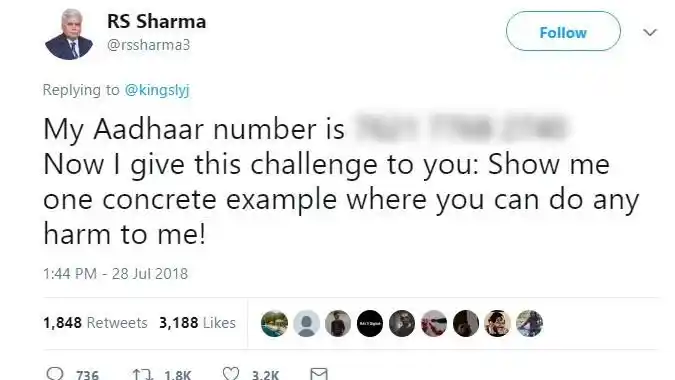
On July 28, Sharma published his Aadhaar number on social media website Twitter, challenging people to show how they could cause ‘real harm’ by merely knowing his Aadhaar number.
Although Twitter users revealed his email ID and password, bank account details, phone number, home address, UIDAI had said all the information was in fact available online. The Authority later also issued an advisory warning people not to make their Aadhaar numbers public.

Sharma said TRAI would not take any steps to intervene in lynchings caused by fake news over WhatsApp. “TRAI doesn’t regulate content. It is not within my remit,” he said, adding TRAI maintains that browsers, applications and operating systems like‘pipes’, in the sense they are the telecom network through which content is exchanged. TRAI would not regulate the content of these pipes or the pipes themselves.

“We are only regulators, we don’t do anything,” he said.

After a stand-off between TRAI and iPhone-maker Apple on the latter’s refusal to include TRAI’s application allowing users to report and block unsolicited calls and messages simmered last week, reports said Apple agreed to include the features in its operating system.

“TRAI is not into app development. Our regulation clearly says you can use either the TRAI app, any third party app, or even the operating system can provide the functionality,” he said. “So don’t view this as a prestige issue between TRAI and some operator... It has been resolved.”

First Published: Aug 09, 2018 07:10 Ist

13848 - Telecom Watchdog Whose Aadhaar Dare Went Viral Gets Extension - NDTV


RS Sharma, who was appointed as telecom watchdog TRAI chief in 2015 on a three-year term, has been given an extension till September 2020.
All India | Edited by Aloke Tikku | Updated: August 09, 2018 17:35 IST

TRAI Chairman RS Sharma had put out his Aadhaar number and challenged people to do him harm

NEW DELHI: Ram Sewak Sharma, the telecom regulator who recently revealed his Aadhaar number and challenged critics of the identification programme to do him "any harm", has been given two more years as head of the Telecom Regulatory Authority of India, or TRAI.

Mr Sharma's term was to end this week.

A government order said Mr Sharma will continue as the telecom regulator till September 2020 when he turns 65. The NDA government first appointed him as a telecom regulator in 2015 well before he was to retire.

A former IAS officer had recently made headlines when he disclosed his Aadhaar number on the microblogging site and challenged everyone to show how mere knowledge of the unique number could be used to harm him.

The challenge and its fallout caused a flutter on social media and in parliament, where opposition parties have repeatedly raised questions about the security of citizen's data. Congress lawmaker Pratap Singh Bajwa sought his apology for making people insecure about their Aadhaar data. Left leader D Raja demanded an investigation.

The outspoken bureaucrat, who had once led UIDAI that runs the Aadhaar identification programme, intended to demonstrate that mere knowledge of the unique number could be used to harm him. Mr Sharma insists that no harm had come to him. He insists that no harm had come to him.

The UIDAI had initially backed him but later, reportedly on the government's nudge, put out a statement that appeared to frown at his challenge. UIDAI, or the Unique Identification Authority of India, also asked other people not to emulate him.
Aadhaar was launched by the previous UPA in 2009-10 to reduce the government's subsidy bill and improve the delivery of services.

Campaigners and experts have raised concerns about privacy and the safety of the data, the susceptibility of biometrics to failure, and the misuse of data for profiling or increased surveillance.

Mr Sharma was also associated with the drafting of the data protection framework and a draft legislation.


Thursday, August 9, 2018

13844 - Hacker claims he can crack eAadhaar password in under 3 seconds - India Today


Aadhaar has become quite the buzzword these days, and particularly since Telecom Regulatory Authority of India (TRAI) chief RS Sharma caused a furor by revealing his Aadhaar number on Twitter. Ever since Sharma pulled the stunt to prove that Aadhaar was safe and secure, people on social media are trying to prove him wrong. In latest such effort, a hacker called Somdev Sangwan has claimed that he can crack the password of eAadhaar in less than 3 seconds. And to prove his point, he has detailed his methodology in a blog post.

Sangwan in a blog post on Noteworthy has claimed that he can crack the eAadhaar password in just 3 seconds! In case you are wondering how he achieves such a feat, the answer, as he says is simple: using some basic mathematics and clever algorithms that can cycle through the possible password combinations very fast.

Sangwan uses the classic brute force password cracking method, but cleverly prunes the dictionary of possible password combinations that his algorithms will use to crack the eAadhaar password to shorten the duration the whole exercise will take.

In his blog post, Sangwan explains that the Aadhaar password is the combination of the first four letters of a person's name in upper case and his year of birth. Given that data, the total number of combinations possible is 2821109907456, which will take around 92 years to for a person to crack a password if one tries 1000 combinations per second.

But no one has that much time. So, Sangwan has come up with a different method. He reduces the duration required to go through the possible password combinations to 53 days by breaking down the password into two strings. But 53 days is a time period too long to dedicate for cracking a password. And so, he further reduces the time duration to 13 hours by eliminating the years that aren't valid for the possible password. For example no one born before 1910 is likely to have Aadhaar number.
To this then he adds a dictionary of popular Indian names, giving the password crunching algorithms even a narrower focus and thereby reduces the time duration to around 2 minutes and 39.8 seconds.
If you think you can't go lower than that, think again as the hacker then goes on to explain how you can crack the password in just 1.73 seconds by further dividing the names into groups based on popularity and religion.
If his calculations are accurate, one should be able to crack eAadhaar password in a blink of an eye (literally).
This is not the first time that hackers have made such claims. Back in March this year, French security researcher Elliot Alderson shared a video demonstrating how it was possible to bypass the protection on Aadhaar's Android app in one minute.


Alderson is one of the strongest critics of Aadhaar and time and again he has pointed out vulnerabilities in the Aadhaar system.

13840 - Aadhaar helpline in Android phones: From Google’s apology to UIDAI’s assurance in 10 points - Live Mint


Although experts have clarified that the uploading of a contact number, that too from UIDAI, doesn’t cause harm, yet the issue has reignited the debate over the security of data of Aadhaar cardholders

Last Published: Mon, Aug 06 2018. 03 51 PM IST


After UIDAI said it has not asked anyone to include 1800-300-1947 or 1947 in the default list of public service numbers on mobile phones, Google apologised for the “inadvertent” act. Photo: Mint

Android phone users were shocked last week by the presence of a Unique Identification Authority of India (UIDAI) helpline number in the contact list. Frightened by WhatsApp forwards warning them of a breach of privacy, scores of smartphone holders deleted the number and ranted on Twitter.

Although experts have clarified that the uploading of a contact number, that too from UIDAI, doesn’t cause harm, yet the issue has reignited the debate over the security of data of Aadhaar cardholders.

Here in 10 points is everything you need to know about the controversy over the Aadhaar helpline number:

1. The controversy began after a French security expert, who goes by the pseudonym Elliot Alderson on Twitter, flagged off the presence of the UIDAI toll-free number 1800-300-1947 in the contact list of Android smartphone users. This sparked a flurry of tweets and WhatsApp messages.

2. Rumours spread fast that Android mobile phone data had been hacked and privacy of mobile phone users compromised by the insertion of the new number.

3. To quell rumours, UIDAI issued a statement saying that no one can steal data by just by adding a helpline number in a mobile’s contact list. It asked people not to panic and said no harm to anyone has been done.

4. Describing instances of people being asked to delete UIDAI helpline numbers as “totally false propaganda”, UIDAI said vested interests were trying to scare people.

5. The French hacker, who has been running an anti-Aadhaar campaign on Twitter, changed his name to—Elliot Alderson aka “Vested Interest”—in retort to UIDAI’s statement.

6. It was later brought to notice that the toll-free number found in mobile phones is no longer in use by UIDAI, which replaced it with a new number—1947— two years ago. It said people can simply delete the number from their list or update it with the new number if they wish to.

7. The French expert said there was no need to panic as the number was just a contact, but he was alarmed that it could be the tip of “an iceberg”.

8. At first, UIDAI clarified that it did not ask anyone to include the number in mobile phones and then mobile phone service providers denied any involvement.

9. The mystery was solved when Google issued a statement saying the helpline number was inadvertently coded into the setup wizard of Android phones in 2014 and remained there. Apologising for the error, Google said it will fix it in the next release of the setup wizard that will be made available over the next few weeks.

10. The row has sparked a fresh debate over the privacy of users’ data after Telecom Regulatory Authority of India (Trai) chairman R.S. Sharma challenged hackers to harm him by using his Aadhaar data. UIDAI had afterwards warned people not to post their Aadhaar numbers on social media.


First Published: Mon, Aug 06 2018. 03 51 PM IST

Wednesday, August 8, 2018

13831 - Aadhaar in time of data theft scare: Activists call for scrapping of UIDAI - Indian Express


While many activists advocate for UIDAI to be shut down to put an end to the debate, the call has had little success over the months.


Published: 06th August 2018 03:17 AM  

Express News Service

COIMBATORE: The introduction of Aadhaar has not gone well with a large section of the masses, given the issue of privacy and date security.

The challenge put forth by TRAI (Telecom Regulatory Authority of India) Chief R S Sharma and the way it backfired only helped spread the apprehensions over Aadhaar and UIDAI’s (Unique Identification Authority of India) ability to hold sensitive information secure.

While many activists advocate for UIDAI to be shut down to put an end to the debate, the call has had little success over the months.

Usha Ramanathan, a Supreme Court lawyer, is a strong advocate of this idea. “The only solution to keep our identity and data safe is to scrap UIDAI,” she tells Express.

Explaining the mechanism behind Aadhaar, she explains that it will use three numbers — Jandhan Yojana (bank account number), Aadhar number and Mobile number (JAM) — to identify someone.

“As these three numbers are linked everywhere and is mandatory in the government system, our data has become insecure,” she claims. She points out that with this information, identity theft would become far more dangerous.

While the Supreme Court has stayed the government order making Aadhaar mandatory for many of its schemes, the Central government has ignored the order and made Aadhaar as the primary identification proof for a lot of services.

“After the court ruled that privacy is a fundamental right, the Centre asked what harm would come of (someone) having your data. They could not accept that creating such a vulnerable system itself was harmful enough and once someone had our information, then it is very easy to play around with it,” she says, citing several incidents of creating bank accounts and fake insurance policies, without even the consent of the person concerned.

Speaking about the system’s vulnerability, a Coimbatore-based member of Cyber Society of India S N Ravichandran says that hackers could even extract money from an individual’s bank account by using their Aadhaar details. “Once the data is out to private partners and other enterprises at the time of registering for a service or getting a SIM card, you cannot protect it anymore,” he says.

Besides, the system of redressal also seems a little out of reach. Even if you were to find out that your bank account was hacked with the help of your Aadhaar details, according to UID Act, it would be the UIDAI and not you who can file a complaint, points out Ravi.

Denying the charges raised by Ravi that the system is vulnerable and could lead to a data breach, Bengaluru-based data scientist G Arvind claims that Aadhaar is completely safe. Any breach in data or incidents of misuse could not have happened without the consent of the individual, he suggests.
While public worry that their data is being passed on to private mobile operators, Arvind clarifies that Aadhaar only gives access to validate the identity number under the Know Your Customer portal and not the individual’s data.

Officials of UIDAI working in South India refused to comment on the aspect of data security.


13830 - I “Dare” My Critic to Criticise Me; Welcome to Post-Truth India - Quint

I “Dare” My Critic to Criticise Me; Welcome to Post-Truth India


Something strange, really strange, happened on last Saturday, 28 July 2018. Our IAS (Indian Administrative Service) policy makers, usually imprisoned in dusty, yellowing, red-taped files, broke away into the aggressive, either-I-will-or-you-will-screw-me arena of WWE showmanship.
The man whose job is to secure our telecom and broadcast infrastructure suddenly wanted to play “cowboy cowboy” in a Wild West bar duel.
He unsheathed his Twitter handle (the 21st century equivalent of the hip-strapped leather holster), and let fly – “here is my Aadhaar (biometric ID) number, you b---dy hackers (synonym of the “n” word in 19th century America); I dare you to harm me now”.

(Photo: Twitter Screengrab) 

No Humility or Grace in Defeat

Much to the IAS fraternity’s chagrin, the response and annihilation was brutal.
The protagonist’s daughter’s email ID, his own demat/bank accounts, airline frequent flyer number, subscription accounts, income tax unique number and demographic details – everything was hacked and manipulated (in a dangerous breach, an unsolicited one rupee was deposited in his savings account) in a matter of hours.
But did he accept defeat with humility and grace? Did he say “oh great, thank you for showing us the path to a million correctives which we shall now develop to ensure that our security features are enhanced”?
No sir. The response was “typically IAS”. They invented a new challenge to somehow win the argument: “but the biometric database has not been breached”.
Hey, the dare was “do me harm”, not “breach the fort”. But now that “harm” had been visibly and demonstrably inflicted, the dare was changed to “try and breach the fort”!

Criticism, Like Pain, Can Heal

I felt very queasy about this fiasco.
Mahatma Gandhi once said that “no school of thought can claim a monopoly of right judgement. We are all liable to err and are often obliged to revise our judgement”.
His arch rival, Winston Churchill, concurred: “criticism may not be agreeable, but it is necessary. It fulfills the same function as pain in the human body. If it is heeded in time, danger may be averted; if it is suppressed, fatal distemper may develop”.
There has to be something “fatal” in our current political environment if a God-fearing 63-year-old bureaucrat with impeccable credentials – a mathematics major from IIT Kanpur and Masters in Computer Science from University of California – suddenly begins to act like a renegade teenager on Tinder.
In 1986, he had written a pioneering DBASE search program to nab 22 firearm thieves in 30 days. But now he had committed a criminal act himself – remember, revealing your Aadhaar number is an offence punishable by three years in jail – why?

A Critic Today is Intimidated, Treated Like an Enemy

Then a revelation struck me in a flash. A critic today is treated like an enemy. He is an adversary who needs to be eliminated.
You do not debate with him on merits. You do not want to convince him on substance. You have no patience for Gandhi’s exhortation that “we owe it to ourselves as to others to try to understand the opponent’s view-point and, if we cannot accept it, respect it as fully as we expect him to respect ours”.
Instead, today’s discourse is defined by intimidation:
  • “Congress kay neta kaan kholkar sun lijiye, agar seemaon ko paar karoge, toh yeh Modi hai, lene ke dene pad jayenge” (Congress leaders, beware; if you cross your limits, then remember, I am Modi, I shall retaliate with disproportionate force) – this statement by Prime Minister Modi at an election rally in Hubli on 6 May 2018 is perhaps the closest a democratic leader can ever come to advocating violence on his opponents.
  • “I want to tell Kashmiri youth that azadi (independence) is not possible. But if you want to fight us, then we will fight you with all our force. Kashmiris have to understand that the security forces haven’t been so brutal – look at Syria and Pakistan. They use tanks and air power in similar situations” – this chilling threat (invoking images of mass genocide) was uttered by Indian Army Chief Bipin Rawat in an interview just 4 days after the Prime Minister, above.
  • Even harmless popular fiction is not spared. Fanney Khan, a simple film about a cab driver and his dreams, featured a song “merey achche din kab aayengey” (when will my good days come). It was a sarcastic take-off on Prime Minister Modi’s 2014 electoral slogan of delivering “achche din” (good days) for all Indians. Within 10 days, the film-makers were forced to change the song to “merey achche din ab aaye re” (my good days have come!).
  • Why, just today, three journalists of ABP News have been forced to quit. Their folly? Criticism of government propaganda.

I’ve Faced Similar Wrath…

On 8 November 2016, when Prime Minister Modi stunned the world by outlawing 86 percent of India’s currency within four hours, people were unsure about the impact of his “demonetisation”.
A few applauded, buying into the “cleansing and windfall gains” theory put out by the government – i.e., that it would nullify the illegal cash and hand the government an extraordinary dividend of Rs four lakh cr (incredibly, this was a legal submission by the government in the Supreme Court!), about three percent of GDP, to lavish on India’s poor. But I had minced no words in debunking these claims. Here are snatches of what I had written in three stinging columns within three weeks of “demonetisation”:
“We pick up the story from where Rambhai is sweating, palpitating and cursing at 8.45 pm on Nov 8, after Prime Minister Modi has concluded his sensational address.
Rambhai is one among a million other minds which are dizzyingly trying to figure out a way to save the Rs 4 lakh crore that are lying in more than a million basements, mattresses, suitcases, lockers, and even in household utensils. Do you think they will just roll over and die, quietly giving up their lifelong “earnings” to a “rapacious taxman”? No sir, they won’t.
They will try every jugaad, any manoeuver - good, bad, ugly, clever, criminal - to salvage their cash…
Here's where the story gets really ironical. This Rs 1 lakh crore will be the good old "speed money" paid to complicit bank branch managers, postmasters, touts, couriers, sundry middlemen, and body contractors. Welcome to Swachh New Bharat (Clean New India)…
The Official Spin: Prime Minister Modi has created “Ram Rajya” (Utopia) for India’s poor… He will now use this money to build more schools, rural roads, hospitals and give what-not to India’s poor.
The Reality: This is very bad news… if “demonetised” cash continues to gush in at this rate – 40 percent of the total hoard in just 10 days - the whole manoeuvre would become a colossal flop.
Why? Because scamsters would have managed to convert all their black money into white, routing the government at its own game!
So the full amount of Rs 15 lakh crore will come back. Period. QED.”
I had predicted this on 1 December 2016. I don’t want to boast, but two years later, it’s clear that I was spot on. Prime Minister Modi has often said that “to criticise, one has to research and find proper facts. Sadly, it does not happen now. What happens instead is allegations”.
Then, by your own yardstick, sir, I should have been feted, right? I had used “research and proper facts”, hadn’t I? Yet I was relentlessly trolled, abused, and never forgiven.
So, dear Prime Minister, unfortunately and sadly, intelligent (and eventually vindicated) criticism continues to be called “allegations” in today’s post-truth India. It’s this very culture of enmity that also encourages a God-fearing, sober bureaucrat to “dare” and damn his critics, instead of embracing and learning from them.
(The Quint is now on WhatsApp. To receive handpicked stories on topics you care about, subscribe to our WhatsApp services. Just go to TheQuint.com/WhatsApp and hit the Subscribe button.)

13828 - The Aadhaar Challenge - The Asian Age

The Aadhaar Challenge
THE ASIAN AGE. | ANUPAM SARAPH
Published : Aug 5, 2018, 6:29 am IST

In an India where every government document had to be attested by a gazetted officer, the pendulum has swung to the other extreme.


 TRAI chairman R. S. Sharma

Instead of examining the harm caused to the country by Aadhaar, R.S. Sharma asked the public to demonstrate the harm it can cause to him. When public officials think about private interests being harmed before protecting public and national interests, they fail to protect either. 

Mr Sharma’s Aadhaar Challenge has exposed the corruption of public policy by self-interest.

On July 28, Telecom Regulatory Authority of India (TRAI) chairman R.S. Sharma put out his Aadhaar number on Twitter and challenged anyone to harm him.

Mr Sharma’s ‘challenge’ underlines not just his ignorance about Aadhaar but also his indifference to public interest, governance, financial integrity of the economy and even national security. Given that he was the director general of the Unique Identification Authority of India (UIDAI) during the conception, design and early implementation of Aadhaar, it is a damning testimony to the project, to put it mildly.

The Aadhaar that Mr Sharma helped build is a twelve-digit number associated with biometric and demographic data that the UIDAI doesn’t certify. It doesn’t verify whether the biometric and demographic data belong to a real individual, whether any individual who filled up the form was identified by a UIDAI official, whether real and verified documents were used as proof of identity (PoI) and proof of address (PoA), or even if any of the data captured is true and correct. The UIDAI doesn’t even have any information about the actual PoI and PoA documents used. In fact, the UIDAI doesn’t even verify if the enrolment operator was even in the village or town where enrolments happened. The UIDAI has never undertaken an audit of its Aadhaar data.

In an India where every government document had to be attested by a gazetted officer, the pendulum has swung to the other extreme. Biometric and demographic data submitted by private operators to the UIDAI is suddenly being used to replace legally valid, legitimate identification documents issued and certified by government officers. Once the Aadhaar replaces existing documents, it causes unprecedented harm to the country as there is no way to distinguish real individuals, on-boarded through careful legal process by government officials, from those added through the Aadhaar database.

Senior bureaucrats who realise this for the first time, are utterly shocked. They have never realised how the Trojan Horse of Aadhaar got into their department or ministry. An uncertified biometric or demographic has no legal value and causes incalculable harm to the country.

The biometric, Mr Sharma and his then-chairman Nandan Nilekani told us, is unique. Neither explained why you need a number to retrieve the data if the biometric is unique. The biometric query should have resulted in a unique record being retrieved. The UIDAI confirms that the biometric can’t retrieve a unique record. In fact, they don’t even know how many unique biometrics exist in the entire database. Astonishingly UIDAI’s affidavit to the Supreme Court in the WP 494 of 2012 and associated matters indicates that at least 600 crore Aadhaar numbers out of 1,200 crore have never been used to authenticate any transaction ever. Clearly, there is no merit in any claim that the biometrics can be the basis for unique entries in the Aadhaar database and the Aadhaar database is free from ghosts and duplicates. From the looks of it, at least 600 crore numbers in the database are ghosts and duplicates.

Mr Sharma’s Aadhaar challenge is the shocking irresponsibility of a public official who sidesteps the questions of the national interest and validity of using the Aadhaar for anything at all. It is indifferent to the harm and implications of using — and replacing — legal and valid IDs issued by government officials with an uncertified, unverified, unaudited and non-unique number.

Mr Sharma’s Aadhaar challenge highlights his non-comprehension about the harm caused by using Aadhaar in government databases on our sovereignty, democracy and republic; our national security; the integrity of our financial transactions and economy; ensuring good governance; and eradicating corruption.

Is there no harm when a nation cannot distinguish its own from imposters? How then can it protect its sovereignty, democracy and republic? After Aadhaar, government departments and private service providers have stopped recognising those whom they knew for decades. This is just like AIDS where the body fails to distinguish the self from non-self and destroys itself. What national or public interest is served in infecting the nation with this disease? What national and public interest is served in protecting the disease as the nation dies a painful death?
It is astonishing that Mr Sharma has failed to reflect on the objections and concerns that the Reserve Bank of India raised to his letters, during his tenure as the DG of UIDAI, to the then RBI governor, Dr Duvvuri Subbarao. Mr Sharma and Mr Nilekani had pressured the RBI to enable Aadhaar as the KYC to open bank accounts and to allow eKYC to allow opening of bank accounts in the absence of the customer solely on the basis of such ridiculous Aadhaar data. Neither he nor the UIDAI have studied, understood, cared or taken responsibility for the consequences they unleashed. If the Airtel Payments Bank alone having opened 37 lakh bank accounts that received `167 crore of LPG subsidy is a matter for concern, then the doubling of bank accounts and doubling of deposits, in just the first five years of use of Aadhaar to open bank accounts, should be a matter of alarm and investigation. No one knows whose money sits in these accounts and who regulates these accounts opened on the basis of uncertified, unverified, unaudited and non-unique numbers.

It is amazing that Sharma is unable to notice the harm that neither the finance ministry nor any other ministry knows who the beneficiaries of government benefits and subsidies are. Even today they continue to claim that uncertified, unverified, unaudited and non-unique numbers have identified and eliminated duplicates and ghosts in non-existent databases.
Does Mr Sharma fail to see the harm that the taskforce on Direct Transfer of Subsidies under the chairmanship of Mr Nilekani of which he was a member caused? Since June 2011, this task force unleashed UIDAI’s colonisation of every relationship and department that delivers subsidies or benefits even though the UIDAI takes no responsibility to ensure the delivery of service. Isn’t it harm, Mr Sharma, when you destroy governance by allowing third parties like the UIDAI and NPCI, who have no skin in the game or consequence of their action, to corrupt the relationship between the people and their government or service providers?

Evidently, Mr Sharma also fails to recognise the harm of exclusion caused to hundreds or crores of people as Aadhaar colonises and corrupts existing databases. Mr Sharma fails to recognise the harm caused by UIDAI by putting at least 85 lakh persons to civil death until 2016 by disabling their Aadhaar. Mr Sharma fails to realise the harm of corruption as, according to Mr Nilekani, Rs 95,000 crore were transferred through Aadhaar payments to uncertified, unverified and unaudited accounts in the last financial year itself.

Mr Sharma, the Aadhaar challenge is not about what harm exposing your Aadhaar number will do to you. It is about ending the harm that the Aadhaar has unleashed on the country and its people. It is about ending the harm caused by colonising, corrupting and destroying people’s relationships with their government and their service providers.


Dr Anupam Saraph, PhD, is a Professor and Future Designer