Why this Blog ? News articles in the Wide World of Web, quite often disappear with time, when they are relocated as archives with a different url. Archives in this blog serve as a library for those who are interested in doing Research on Aadhaar Related Topics. Articles are published with details of original publication date and the url.
Aadhaar
The UIDAI has taken two successive governments in India and the entire world for a ride. It identifies nothing. It is not unique. The entire UID data has never been verified and audited. The UID cannot be used for governance, financial databases or anything. It’s use is the biggest threat to national security since independence. – Anupam Saraph 2018
When I opposed Aadhaar in 2010 , I was called a BJP stooge. In 2016 I am still opposing Aadhaar for the same reasons and I am told I am a Congress die hard. No one wants to see why I oppose Aadhaar as it is too difficult. Plus Aadhaar is FREE so why not get one ? Ram Krishnaswamy
First they ignore you, then they laugh at you, then they fight you, then you win.-Mahatma Gandhi
In matters of conscience, the law of the majority has no place.Mahatma Gandhi
“The invasion of privacy is of no consequence because privacy is not a fundamental right and has no meaning under Article 21. The right to privacy is not a guaranteed under the constitution, because privacy is not a fundamental right.” Article 21 of the Indian constitution refers to the right to life and liberty -Attorney General Mukul Rohatgi
“There is merit in the complaints. You are unwittingly allowing snooping, harassment and commercial exploitation. The information about an individual obtained by the UIDAI while issuing an Aadhaar card shall not be used for any other purpose, save as above, except as may be directed by a court for the purpose of criminal investigation.”-A three judge bench headed by Justice J Chelameswar said in an interim order.
Legal scholar Usha Ramanathan describes UID as an inverse of sunshine laws like the Right to Information. While the RTI makes the state transparent to the citizen, the UID does the inverse: it makes the citizen transparent to the state, she says.
Good idea gone bad
I have written earlier that UID/Aadhaar was a poorly designed, unreliable and expensive solution to the really good idea of providing national identification for over a billion Indians. My petition contends that UID in its current form violates the right to privacy of a citizen, guaranteed under Article 21 of the Constitution. This is because sensitive biometric and demographic information of citizens are with enrolment agencies, registrars and sub-registrars who have no legal liability for any misuse of this data. This petition has opened up the larger discussion on privacy rights for Indians. The current Article 21 interpretation by the Supreme Court was done decades ago, before the advent of internet and today’s technology and all the new privacy challenges that have arisen as a consequence.
Rajeev Chandrasekhar, MP Rajya Sabha
“What is Aadhaar? There is enormous confusion. That Aadhaar will identify people who are entitled for subsidy. No. Aadhaar doesn’t determine who is eligible and who isn’t,” Jairam Ramesh
But Aadhaar has been mythologised during the previous government by its creators into some technology super force that will transform governance in a miraculous manner. I even read an article recently that compared Aadhaar to some revolution and quoted a 1930s historian, Will Durant.Rajeev Chandrasekhar, Rajya Sabha MP
“I know you will say that it is not mandatory. But, it is compulsorily mandatorily voluntary,” Jairam Ramesh, Rajya Saba April 2017.
August 24, 2017: The nine-judge Constitution Bench rules that right to privacy is “intrinsic to life and liberty”and is inherently protected under the various fundamental freedoms enshrined under Part III of the Indian Constitution
"Never doubt that a small group of thoughtful, committed citizens can change the World; indeed it's the only thing that ever has"
“Arguing that you don’t care about the right to privacy because you have nothing to hide is no different than saying you don’t care about free speech because you have nothing to say.” -Edward Snowden
In the Supreme Court, Meenakshi Arora, one of the senior counsel in the case, compared it to living under a general, perpetual, nation-wide criminal warrant.
Had never thought of it that way, but living in the Aadhaar universe is like living in a prison. All of us are treated like criminals with barely any rights or recourse and gatekeepers have absolute power on you and your life.
Announcing the launch of the # BreakAadhaarChainscampaign, culminating with events in multiple cities on 12th Jan. This is the last opportunity to make your voice heard before the Supreme Court hearings start on 17th Jan 2018. In collaboration with @no2uidand@rozi_roti.
UIDAI's security seems to be founded on four time tested pillars of security idiocy
1) Denial
2) Issue fiats and point finger
3) Shoot messenger
4) Bury head in sand.
God Save India
Monday, June 25, 2018
13711 - Privacy advocates seek stronger laws - The Hindu
Wednesday, May 2, 2018
13419 - Exposed: India's own Cambridge Analyticas stealing voter dat - India Today
- Md Hizbullah
- New Delhi
- April 30, 2018
- UPDATED 21:06 IST
- FOLLOW
- EMAIL AUTHOR
- Nitin Jain
- Follow @ojasjain11
- FOLLOW
- EMAIL AUTHOR
- Amit Kumar Chaudhary
- Follow @amit7chaudhary
- FOLLOW
- EMAIL AUTHOR
- Syed Masroor Hasan
- FOLLOW
- EMAIL AUTHOR
- Political consultancies secretly picking voter profiles for parties for targeted messaging during campaigns.
- Agencies caught on camera selling voter data including numbers, emails, PAN, Aadhaar, and even economic details.
- Agencies promise 50 per cent rise in voters.
Saturday, April 28, 2018
13385 - Tale of two whistle-blowers
Tale of two whistle-blowers
Chris Wylie took on a corporation, Facebook, Edward Snowden took on the state. With Aadhaar, we are up against the combined might of both.
- The real beneficiaryAadhaar doesn’t empower people, only the state ..
- Evidence no barDiscussion on Universal Basic Income shows an ignorance of inconvenient facts in our experience with direct benefit transfer and Aadhaar..
- Digging holes, filling them upAs it completes 10 years, there is enough evidence to show that India needs the MGNREGA..
Friday, April 20, 2018
13323 - Tough provisions, SEBI-like regulator in draft data law in a few weeks, says panel chairman - Factor Daily
Thursday, April 19, 2018
13308 - SC red flags threat of Aadhaar data misuse, asks searching questions - TNN
- The SC bench referred to the Cambridge Analytica controversy and said these are not "imaginary apprehensions"
- In the absence of robust data protection law, the issue of misuse of information becomes relevant: SC
- Bench asked UIDAI counsel why authorities were allowing private entities to use the Aadhaar platform
Tuesday, April 17, 2018
13299 - Aadhaar linking must to prevent impersonation, UIDAI tells SC
Tuesday, April 10, 2018
13242 - You’re being watched - National Herald

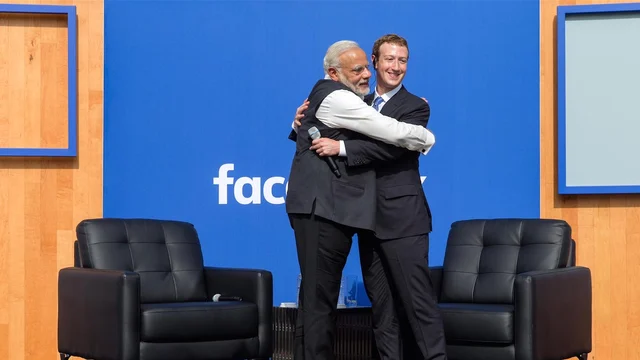
Photo courtesy: social media
File photo of Facebook CEO Mark Zuckerberg and Prime Minister of India Narendra Modi
As virtual life becomes an extension of real life through extensive digitalisation, your government and digital monopolies like Google and Facebook are rendering the word ‘privacy’ meaningless
It has been iterated time and again by the UIDAI that none other than those working with the agency has any access to the Aadhaar database. However, Nandan Nilekani, in an 2010 interview to this writer, while he was the UIDAI chairman, had said, “The UIDAI will partner with agencies such as Central and state departments, banks, insurance companies, Census of India, cellular operators and other agencies who will be ‘registrars’ for the UIDAI. Registrars will process UID applications and connect to the CIDR (Central Identities Data Repository) to de-duplicate resident information and receive UID numbers. These registrars can either be enrollers or will appoint agencies as enrollers who will interface with people seeking UID numbers. The UIDAI will also partner with service providers for authentication (of the data).”
So it is evident that one’s personal details including biometric information not only rests with the UIDAI but with the many ‘registrars’. Things have not changed much since.
Deepti Kapoor, a young lawyer who came back to Mumbai in December 2018 after finishing her studies abroad, had gone to a mobile service operator’s store for a fresh connection. “I was not carrying my Aadhaar card with me and was flatly refused. The next day, when I went with it, they verified its authenticity by taking my finger impression on an electronic thumbpad and by tallying it with the one in the database,” says Kapoor. “How will that be possible if they did not have access to the database?”
The possibility of the scrutiny of one’s personal life is simply endless. “Since banks to mobile service operators still insist on Aadhaar, it is possible for those who have access to the data repository to monitor your financial transactions, call records and even your physical movements as long as you use mobile phone-based applications. It is no rocket science,” says Kenneth Lobo (name changed) who used to work with Qualcomm in the US till 2013.
Monetising your interactions and choices
Writer Nilanjana Bhowmick who penned an opinion piece for The Washington Post on Yogi Adityanath becoming the Uttar Pradesh Chief Minister was used to online trolling and bullying for her critical views. But what she was not ready for was a fictitious Facebook account holder divulging the sector she lived in the Delhi-NCR region and threatening to make her entire address public. “Since I hail from a different city, every document barring Aadhaar had my old residential address. And at that time, I had just moved to a different sector. There is no way he/she could know about it without accessing my Aadhaar information. How are trolls getting access to Aadhaar information? Is this the data security that UIDAI authorities are bragging about,” she wonders.
“The fear of being monitored is not at all unfounded. The Chinese government has just launched a Social Credit Scheme to rate the trustworthiness of its citizens. Aadhaar has all the ingredients to develop into a tool for the same, should the government decide to do so,” says Ritam Ghose, a technology professional with over a decade’s experience.
The entire debate about data security and how personal data is being used by collectors to pass on to third party vendors to influence people’s choices ranging from their votes to consumer preferences has of course been a raging issue following the role of the Cambridge Analytica-Facebook nexus in influencing the US presidential elections and the Brexit polls in the UK came to light.
Former Facebook executive Anthony Garcia Martinez has come out in the open about how Facebook influences the preferences of its users, notwithstanding repeated denials by its founder and CEO Mark Zuckerberg: “For two years I was charged with turning Facebook data into money, by any legal means. If you browse the internet or buy items in physical stores, and then see ads related to those purchases on Facebook, blame me. I helped create the first versions of that, way back in 2012.”
If you live a digital life, have a virtual presence on social media and use plastic instead of cash, every activity of yours can be monitored and analysed. If you are a doting consumer, your information will be processed and the right deals will reach you. If you are a political dissenter, you can be put under constant surveillance. Unless you decide to go off the grid, you can bid privacy goodbye
Your smartphone apps are stalking you
This happened to Tushar Senapati, who works in the development sector as a consultant in Hyderabad. “I was returning home to Bhubaneswar after nearly a year and called up some old friends. We discussed going on a trip to Kerala and created a Facebook group chat for the same. Surprisingly, from the next morning, I was being served details of hotels in Kerala via Facebook ads. My friends had the same experience. It was kind of spooky,” says the man in his late thirties.
That way, Tushar’s experience tallies with that of Hollywood actor Jim Carrey who tweeted on how he felt he was being stalked by his smartphone’s Facebook and Google apps. He decided to take his page off Facebook and dump the stocks he held in the company.
It was only towards the end of March, 2018 that Facebook users around the world discovered that Facebook’s Android app was snooping on extensive call data without them being aware. “When this feature is enabled, uploading your contacts also allows us to use information like when a call or text was made or received. This feature does not collect the content of your calls or text messages,” Facebook said, also saying that users voluntarily opted in when they were prompted. However, did the users understand what they were signing up for?
Garcia Martinez exposes what Zuckerberg has long been denying about Facebook influencing electoral outcomes. “Facebook deploys a political advertising sales team, specialised by political party, and charged with convincing deep-pocketed politicians that they do have the kind of influence needed to alter the outcome of elections…I was at Facebook in 2012, during the previous presidential race. The fact that Facebook could easily throw the election by selectively showing a Get Out the Vote reminder in certain counties of a swing state, for example, was a running joke,” he wrote in The Guardian.
Facebook has eventually admitted that about 126 million people saw Russian-sponsored ads intended to sway the 2016 US election. The company has also admitted that its algorithms recommended content created by Russian operatives. Initially Zuckerberg had rubbished these allegations, saying the idea of Facebook impacting the elections was “crazy.” Now, there has been an obvious climbdown in face of mounting evidence.
“I was returning home to Bhubaneswar after nearly a year and called up some old friends. We discussed going on a trip to Kerala and created a Facebook group chat for the same. Surprisingly, from the next morning, I was being served details of hotels in Kerala via Facebook ads. My friends had the same experience. It was kind of spooky,” Tushar Senapati
Former Rajya Sabha TV Editor-in-chief Gurdeep Singh Sappal wrotes on his Facebook wall: “Today, as I landed in Bangalore, I got a notification from Facebook. It showed several of my Facebook friends and gives details of places they visited in Bangalore in last 2-3 years, along with the month of visit!
I have cross-checked with a couple of friends. They were shocked and confirmed that the details are correct. Both say that didn’t even share it on Facebook. Yet I know it.
So much for privacy!!”
The development of complicated algorithms that decode everything from your consumer preferences to your mental state on one hand and official diktats like making Aadhaar mandatory for nearly all services and schemes on the other have put privacy in peril. In today’s wired world, every piece of digital signature that you leave behind is tracked and stored. Google, for example, stores every location you have been to ever since you started using its service on your phone. Facebook was recently caught storing videos deleted by its users. Of course, the company blamed it on faulty applications and bugs.
The truth lies someplace else. If you live a digital life, have a virtual presence on social media and use plastic instead of cash, every activity of yours can be monitored and analysed. If you are a doting consumer, your information will be processed and the right deals will reach you. If you are a political dissenter, you can be put under constant surveillance. Unless you decide to go off the grid, you can bid privacy goodbye.
Click here to subscribe to National Herald on WhatsApp
Sunday, April 8, 2018
13220 - Over 5 lakh Indian users’ data may have been ‘improperly’ shared with Cambridge Analytica, says Facebook - The Hindu
Sunday, April 1, 2018
13163 - Tip of the Suckerberg - Outlook India
Tip Of The Suckerberg
Cambridge Analytica is a warning sign. And Indians are at risk: the country has no data protection law.

- Qualitative methodology to describe consumers’ psychological attributes.
- Psychographic profile: profiles interests, activities, opinions, lifestyle.
- Does this by looking at consumer behaviour, preferences, web surfing patterns, call records and purchases
- All this is used to classify people.
- Companies use profiles for targeted sales and marketing campaigns.
- Trump presidential campaign used this to influence voters.