In 2009, I became extremely concerned with the concept of Unique Identity for various reasons. Connected with many like minded highly educated people who were all concerned.
On 18th May 2010, I started this Blog to capture anything and everything I came across on the topic. This blog with its million hits is a testament to my concerns about loss of privacy and fear of the ID being misused and possible Criminal activities it could lead to.
In 2017 the Supreme Court of India gave its verdict after one of the longest hearings on any issue. I did my bit and appealed to the Supreme Court Judges too through an On Line Petition.
In 2019 the Aadhaar Legislation has been revised and passed by the two houses of the Parliament of India making it Legal. I am no Legal Eagle so my Opinion carries no weight except with people opposed to the very concept.
In 2019, this Blog now just captures on a Daily Basis list of Articles Published on anything to do with Aadhaar as obtained from Daily Google Searches and nothing more. Cannot burn the midnight candle any longer.
"In Matters of Conscience, the Law of Majority has no place"- Mahatma Gandhi
Ram Krishnaswamy
Sydney, Australia.

Aadhaar

The UIDAI has taken two successive governments in India and the entire world for a ride. It identifies nothing. It is not unique. The entire UID data has never been verified and audited. The UID cannot be used for governance, financial databases or anything. It’s use is the biggest threat to national security since independence. – Anupam Saraph 2018

When I opposed Aadhaar in 2010 , I was called a BJP stooge. In 2016 I am still opposing Aadhaar for the same reasons and I am told I am a Congress die hard. No one wants to see why I oppose Aadhaar as it is too difficult. Plus Aadhaar is FREE so why not get one ? Ram Krishnaswamy

First they ignore you, then they laugh at you, then they fight you, then you win.-Mahatma Gandhi

In matters of conscience, the law of the majority has no place.Mahatma Gandhi

“The invasion of privacy is of no consequence because privacy is not a fundamental right and has no meaning under Article 21. The right to privacy is not a guaranteed under the constitution, because privacy is not a fundamental right.” Article 21 of the Indian constitution refers to the right to life and liberty -Attorney General Mukul Rohatgi

“There is merit in the complaints. You are unwittingly allowing snooping, harassment and commercial exploitation. The information about an individual obtained by the UIDAI while issuing an Aadhaar card shall not be used for any other purpose, save as above, except as may be directed by a court for the purpose of criminal investigation.”-A three judge bench headed by Justice J Chelameswar said in an interim order.

Legal scholar Usha Ramanathan describes UID as an inverse of sunshine laws like the Right to Information. While the RTI makes the state transparent to the citizen, the UID does the inverse: it makes the citizen transparent to the state, she says.

Good idea gone bad
I have written earlier that UID/Aadhaar was a poorly designed, unreliable and expensive solution to the really good idea of providing national identification for over a billion Indians. My petition contends that UID in its current form violates the right to privacy of a citizen, guaranteed under Article 21 of the Constitution. This is because sensitive biometric and demographic information of citizens are with enrolment agencies, registrars and sub-registrars who have no legal liability for any misuse of this data. This petition has opened up the larger discussion on privacy rights for Indians. The current Article 21 interpretation by the Supreme Court was done decades ago, before the advent of internet and today’s technology and all the new privacy challenges that have arisen as a consequence.

Rajeev Chandrasekhar, MP Rajya Sabha

“What is Aadhaar? There is enormous confusion. That Aadhaar will identify people who are entitled for subsidy. No. Aadhaar doesn’t determine who is eligible and who isn’t,” Jairam Ramesh

But Aadhaar has been mythologised during the previous government by its creators into some technology super force that will transform governance in a miraculous manner. I even read an article recently that compared Aadhaar to some revolution and quoted a 1930s historian, Will Durant.Rajeev Chandrasekhar, Rajya Sabha MP

“I know you will say that it is not mandatory. But, it is compulsorily mandatorily voluntary,” Jairam Ramesh, Rajya Saba April 2017.

August 24, 2017: The nine-judge Constitution Bench rules that right to privacy is “intrinsic to life and liberty”and is inherently protected under the various fundamental freedoms enshrined under Part III of the Indian Constitution

"Never doubt that a small group of thoughtful, committed citizens can change the World; indeed it's the only thing that ever has"

“Arguing that you don’t care about the right to privacy because you have nothing to hide is no different than saying you don’t care about free speech because you have nothing to say.” -Edward Snowden

In the Supreme Court, Meenakshi Arora, one of the senior counsel in the case, compared it to living under a general, perpetual, nation-wide criminal warrant.

Had never thought of it that way, but living in the Aadhaar universe is like living in a prison. All of us are treated like criminals with barely any rights or recourse and gatekeepers have absolute power on you and your life.

Announcing the launch of the # BreakAadhaarChainscampaign, culminating with events in multiple cities on 12th Jan. This is the last opportunity to make your voice heard before the Supreme Court hearings start on 17th Jan 2018. In collaboration with @no2uidand@rozi_roti.

UIDAI's security seems to be founded on four time tested pillars of security idiocy

1) Denial

2) Issue fiats and point finger

3) Shoot messenger

4) Bury head in sand.

God Save India

Showing posts with label PAHAL. Show all posts

Wednesday, August 31, 2016

10329 - Stop quibbling, PAHAL has scythed subsidy bill, but glitches remain - First Post


So, how much money did the government save by implementing direct benefit transfer (DBT) in cooking gas – the PAHAL scheme – in 2015-16? 

Is it Rs 9,211 crore, as the Ministry of Petroleum and Natural Gas claims? 
Or Rs 5,107 crore as the oil marketing companies (OMCs) estimate? 
Or Rs 4,813 crore, as the Comptroller and Auditor General (CAG) suggests in its report on the implementation of the scheme?
Should that matter, really?

It’s not as if the Ministry of Petroleum has caused any loss to the exchequer by quoting the higher figure. It’s really all about how the saving was calculated. The Ministry assumed all those who were not part of PAHAL (and hence not entitled to subsidy) would have consumed 12 cylinders a year; the CAG went by the national average consumption of 6.27 cylinders. The OMCs went by the 6.27 usage figures, but considered the subsidy rate of 2014-15; this threw up a higher level of savings because global oil prices had come down sharply in 2015-16. The CAG estimation corrected both these problems and came to a lower figure. There is nothing more to it.

These quibbles aside, is a saving of Rs 4,813 crore something to be scoffed at?

Yet another figure that is thrown up to belittle the success of PAHAL relates to the contribution of falling oil prices. The CAG report notes that the actual subsidy payout in the April-December 2015 period was Rs 12,084 crore against Rs 35,400 crore in the April-December 2014 period – a reduction of Rs 23,316 crore. But only Rs 1,763 crore of this is due to reduced offtake of cylinders, the report points out; a significant Rs 21,552 crore was on account of reduced subsidy rate due to lower oil prices.

But once again, is a reduction of Rs 1,763 crore in the subsidy bill something to be dismissed as insignificant?
Splitting hairs over the extent of savings on account of PAHAL does not take away from the main point – that PAHAL has scythed the subsidy bill. No more proof of concept is required.

The fiscal savings story may be validated, but the leakage/diversion elimination story, unfortunately, is not.

The CAG report found that the sale of non-subsidised domestic LPG cylinders had shot up after the implementation of PAHAL. 

As many as 8,023 domestic consumers used up more than 24 cylinders a year in 2015-16, more than double of 3,070 consumers who did so in 2014-15. Now since subsidy is available for only 12 cylinders a year and the rest have to be bought at market prices, on the face of it, PAHAL appears to have checked diversion of subsidised cylinders.

But that, according to the CAG report, maybe too pat an explanation. There is still, it points out, quite a large price differential between non-subsidised domestic LPG and LPG for commercial use. A commercial cylinder costs at least Rs 233.20 more than a non-subsidised domestic cylinder. In contrast, the price difference between a subsidised and non-subsidised domestic cylinder is only Rs 99.86. So there could still be a risk of domestic cylinders being diverted for commercial use. The CAG is not going out on a limb and saying this is happening but is red-flagging the issue.

How is this possible, given Aadhaar-based subsidy delivery and weeding out of duplicate accounts, one may well ask?

This is where PAHAL does not seem to have helped. The CAG found multiple LPG connections with the same Aadhaar number or same bank account as well as duplicate connections with the same name and address.

In the case of Hindustan Petroleum Corporation Ltd (HPCL), the CAG audit found 1400 LPG connections linked with 700 Aadhaar numbers – a clear case of duplication. Half of these were active consumers. There were also 14,918 consumer IDs lined with 6,614 bank accounts and IFSC numbers. In the case of Indian Oil Corporation (IOC), there were 43,323 LPG consumer IDs linked with 21,504 bank accounts and IFSC numbers.  The CAG audit also threw up cases of multiple connections having the same Aadhaar number across different OMCs - 74,180 LPG consumer IDs linked to 37,090 Aadhaar numbers.

Across OMCs, the CAG audit also found 15,885 consumers with the same name and same address (indicating duplicate connections) with 34,729 LPG connections linked to them. As a result of these various kinds of duplications, the audit found that 8,707 consumers across OMCs had availed of subsidy for more than 12 cylinders in 2015-16, though to PAHAL’s credit this is way below the figure of 37,499 consumers who availed of more than 12 subsidised cylinders in 2014-15 (remember that PAHAL kicked off only in November 2014).

The CAG audit also threw up cases of distributors not linking the Aadhaar numbers of consumers with their LPG connection IDs as well as incorrect seeding, 55,407 LPG connections in the names of minors (which is not allowed).

Clearly technology has its limits – it works when humans handling it do it efficiently or without crooked intent; but it is not too intimidating a bar for those determined to game the system. But it could equally be argued that the Aadhar-based de-duplication system has helped bring these discrepancies to light.

The CAG report on PAHAL, far from being a damning indictment of the scheme as detractors would like to portray it, actually shows that it has helped in generating considerable savings. The government now needs to fix the other problems it has highlighted so that the savings – no matter how they are calculated – can be even higher.

Friday, April 8, 2016

9770 - Corridors of Power: Just issuing 100 crore Aadhaars not enough - Financial Express


Utilisation of Aadhaar in disbursement of subsidies and entitlements has been slow and patchy, and there is hardly any sign of a major change in this in the NDA regime also


By: Santosh Tiwari | April 7, 2016 2:37 AM

Utilisation of Aadhaar in disbursement of subsidies and entitlements has been slow and patchy, and there is hardly any sign of a major change in this in the NDA regime also

April 4, 2016, will be remembered as a landmark day in the Indian reforms history. The Unique Identification Authority of India (UIDAI) generated the 100th crore Aadhaar on this day, after traversing a tumultuous journey of five-and-a-half years. Though the first Aadhaar number was issued on September 29, 2010, that it took so long to reach the 100-crore mark tells its own story.

The project faced opposition from within the government during the UPA regime, before the Congress party projected it as a game-changer scheme. It almost appeared stuck after the party got a drubbing in 2014 polls, but thanks to the political masterstroke of latching on to it by the NDA Prime Minister Narendra Modi, the whole exercise has got a much-needed centre-stage attention now, due to the Jan-Dhan and other flagship schemes of the government like Digital India.

The UIDAI was constituted on January 28, 2009, as an attached office of the erstwhile Planning Commission. Nandan Nilekani, who was appointed its first chairman on July 2, 2009, steered the project despite teething troubles, especially due to its overlap with the National Population Register (NPR) programme and privacy issues, until he decided to fight the 2014 Lok Sabha polls on a Congress ticket. Although the UPA government had launched the Aadhaar-based direct benefit transfer (DBT) scheme on January 1, 2013, in the absence of adequate preparation and the non-UPA states’ reluctance to embrace it, it didn’t yield desired results in the 2014 Lok Sabha elections for the party.

While there is no doubt that the current government has done well by continuing with the Aadhaar project, the pace of implementation of Aadhaar-based identification process in the government schemes and services still remains a big concern area. The government release issued on Monday after Aadhaar enrolment touched the 100-crore mark is self-explanatory. 

Though 93% people above the age of 18 have Aadhaar now—over 90% population in 13 states and Union Territories, and 75-90% in 13 other states, has been covered by Aadhaar—when it comes to the real objective of bringing a systemic change in the way services, subsidies and benefits will be directly delivered to the deserving, the situation is hardly encouraging. The only big success area is DBT in LPG, both in the UPA and the NDA regimes, and that too because of efficient handling by the public sector oil companies and not the government.

According to the government release, the estimated savings through the Pahal scheme (DBT in LPG) are R14,672 crore, while in PDS these are just R2,346 crore across four states—Andhra Pradesh, Telangana, Puducherry and Delhi. The situation in other schemes—in scholarship, the estimated savings are Rs 276 crore across three states of Andhra Pradesh, Telangana and Punjab; in pensions (NSAP), these are Rs 66 crore across Jharkhand, Chandigarh and Puducherry—shows that the objective of saving substantial amount by using Aadhaar-based identification in the about R5 lakh crore annual payments of entitlements and subsidies is far from taking off in any serious manner.

It is true that 25.48 crore bank accounts, over 12.28 crore (71%) LPG connections, more than 11.39 crore (45%) ration cards, over 5.90 crore (60%) NREGA cards, and 45 lakh income-tax returns are now linked to Aadhaar, there is a need to extend the Aadhaar-based payment system in a big way. 

Although the government has claimed that the total number of transactions on the APB (Aadhaar Payment Bridge) was logged at 94.71 crore worth R28,363 crore—a handsome rise compared to the data on May 31, 2014 (7.13 crore APB transactions worth R4,474 crore)—this is far from the required level to have any substantial impact.

The extension of Aadhaar-based DBT to PDS, fertiliser subsidy and also other government schemes and its utilisation has to match the Aadhaar penetration level, and that can only be done through a coordinated national strategy to be implemented with the full participation of states. It will be a good idea to create a separate Aadhaar-based DBT implementation set-up by the Centre, which will coordinate with all the stakeholders—central government ministries and departments, states, banks and other financial institutions, and the UIDAI—to quicken its pace.

The passage of the Aadhaar (Targeted Delivery of Financial and Other Subsidies, Benefits, and Services) Bill 2016 in Parliament in the current session and its notification—providing Aadhaar the badly-needed statutory status—can prove to be a big catalyst in this exercise. As it seeks “to provide for, as a good governance, efficient, transparent, and targeted delivery of subsidies, benefits and services, the expenditure for which is incurred from the Consolidated Fund of India, to individuals residing in India through assigning of unique identity numbers to such individuals”, the central government can use this law now to not only quell the opposition from various quarters in the extensive use of Aadhaar, but also in persuading states to adopt Aadhaar in their schemes and administrative functioning.

The Act clearly states that “the Central Government or, as the case may be, the State Government may, for the purpose of establishing identity of an individual as a condition for receipt of a subsidy, benefit or service for which the expenditure is incurred from, or the receipt there from forms part of, the Consolidated Fund of India, require that such individual undergo authentication, or furnish proof of possession of Aadhaar number or in the case of an individual to whom no Aadhaar number has been assigned, such individual makes an application for enrolment:

Provided that if an Aadhaar number is not assigned to an individual, the individual shall be offered alternate and viable means of identification for delivery of the subsidy, benefit or service.”

Even though the government has tried to ensure that the subsidy and benefits are not denied to anybody not fulfilling the Aadhaar-identification requirement, it is imperative that an efficient national system is put in place to keep track of all transactions and beneficiary data, and this is where the dedicated DBT department of the government can prove to be a game-changer.

Some positive signs of successful Aadhaar use, undoubtedly, are visible in the PM Jan-Dhan Yojana, NREGS, and in the government employee attendance system, but this is not enough—the real celebration for 100 crore Aadhaar cards will be putting them to good use.

santosh.tiwari@expressindia.com


Sunday, March 6, 2016

9392 - Jandhan, Aadhaar, Mobile: For better implementation of Direct Benefit Transfers - New Kerala

26-02-2016 IBNS


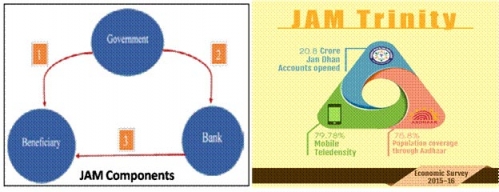
New Delhi, Feb 26 : The Economic Survey 2015-16 presented on Friday in the Parliament by the Union Finance Minister Arun Jaitley stated that the three methods, Jandhan, Aadhaar, and Mobile (JAM or JAM Trinity as mentioned during the presentation) can help the government to implement large-scale, technology-enabled and real-time Direct Benefit Transfers (DBTs) to improve economic lives of India's poor

The Survey said that PAHAL, the scheme of transferring LPG subsidies via DBT has reduced leakages by 24 per cent.

The Economic Survey suggested that while deciding where next to apply JAM, policy makers should consider the challenges of beneficiary identification, distributor opposition and beneficiary financial inclusion. Spreading JAM to other areas will reduce leakages and provide more fiscal space to the government.

JAM components:

Economic Survey divides JAM into three components-

1. Identification or First-Mile: Identification of beneficiaries by government

2. Transfer or Middle-Mile: Transfer of fund to beneficiaries by government

3. Access or Last-Mile: Access of fund by beneficiaries

Identification:

First-mile deals with identification of beneficiary. This layer has issues of ghost and duplicate names due to administrative and political discretion and use of pre-Aadhaar database. It is easier to implement the JAM for universal schemes than targeted ones as identification will be easier. Identification of household-individual connection is important to note here as some schemes target at household level like JDY and some at individual level like Aadhaar. Aadhaar can help in better identification of the beneficiaries.

Transfer:

Middle-mile deals with the challenges of payment where government transfer benefits to the banks. But lack of bank accounts and its information with government hinders the middle-layer connectivity. Main issue in this layer is of within-government coordination and dealing with supply chain interest groups. Jandhan can help beneficiaries to have bank accounts.

Access:

Last-mile layer faces issues of lesser bank penetration, mostly in rural areas. It deals with actual transfer of money from Bank to Beneficiary accounts. It also deals with issues of exclusion of genuine beneficiaries. Mobile can inform about benefits and also allow easier fund transfer.

Where next?

Economic Survey said that policy makers should decide where to apply JAM based on two considerations:

1. Amount of leakages 

2. Control of the central government.

If the leakage amount in a given scheme/area is huge, then it can be the next target for introduction of JAM as subsidies with higher leakages will have larger returns from introducing JAM.

Similarly control of central government will reduce administrative challenges of co-ordination and political challenges of opposition by interest groups.

Based on these two criteria- leakages and central government control-Survey suggested that fertilizer subsidies and within-government transfers as two most promising areas for introduction of the JAM. 

JAM Preparedness Index:

The Economic Survey has formulated JAM-Preparedness Indices for Urban and Rural areas in each state. It uses Aadhaar penetration, basic bank account penetration and Banking Correspondents (BC) density as indicators for the indices.

It has also prepared Biometrically Authenticated Physical Update or BAPU-Preparedness Index, using Aadhaar penetration and Point of Sale machines as indicators, for each state and has compared Rural-JAM Preparedness Index with BAPU-Preparedness Index.

The Survey has found that many states are having higher scores in BAPU-Preparedness Index as compared to Rural JAM-Preparedness Index. Thus it suggests use of BAPU as short-term solution to reduce the leakages in these states, till states are well prepared for introduction of the JAM.

The Economic Survey concluded that introduction of DBT in LPG and MGNREGS have proved that use of JAM can considerably reduce leakages, reduce idle funds, lower corruption and improve ease of doing business with the government.

Despite huge improvements in financial inclusion due to Jandhan, JAM Preparedness indicators suggest that there is still a long way to go.

Center can invest in last-mile financial inclusion via further improving BC networks and promoting the spread of the mobile money. In the meantime models like BAPU can be used as an alternative to reduce the leakages.

Sunday, November 29, 2015

9087 - LPG distributors still insist on Aadhaar card - Deccan Herald

November 21, 2015, Bengaluru, DHNS
Consumers getting SMSes to give unique identification number


The confusion over whether or not to link the Aadhaar card to get LPG cylinder at a subsidised rate under PAHAL or Direct Benefit Transfer Scheme is likely to continue, as LPG distributors have started a ‘drive’ asking consumers to submit their Aadhaar cards, though it is not mandatory.

Senior officials of the three major LPG suppliers - Indane Gas, Hindustan Petroleum Corporation Limited and Bharat Gas - told this newspaper that they had an instruction from their respective head offices to get the maximum number of customers to link their Aadhaar cards to enjoy the subsidy.

An official said that as part of the drive, mobile text messages were being sent to LPG consumers to submit their Aadhaar cards. There is no coercion whatsoever. This is taken up to avoid misuse of subsidy, he said.

If the unique identification number is not provided, there is a chance of misuse in availing subsidy for more than one connection. The drive is a positive attempt to reduce manipulation, the official added. Even schemes like Jan Dhan Yojana need Aadhaar card, he pointed out.

A consumer, however, said the text message he received did not make it clear if linking the Aadhaar card was optional. An HP representative said 70 per cent of the company’s customers had linked their Aadhaar cards and that they had not received any particular directive on the plan of action for those who did not have the card.

According to the statistics collected from the three major gas suppliers, around three lakh LPG consumers have given up their gas subsidy voluntarily which, the Central government says, would be used to provide gas connections to the economically weaker sections.

Out of the three lakh customers, over one lakh have given up the subsidy in Bengaluru alone. Indane Gas, which has half of the State’s LPG connections, said 1.32 lakh LPG users (65,538 in Bengaluru), nearly one lakh users of Bharat Gas  (20,000 in Bengaluru) and 78,000 users of HP (25,000 in Bengaluru) have given up the subsidy.
Karnataka has nearly one crore registered domestic LPG connections.

Saturday, July 18, 2015

8230 - UIDAI bats for Aadhaar cards for children to meet December deadline - Economic Times

ET Bureau Jul 3, 2015, 05.40AM IST

NEW DELHI: The Unique Identification Authority of India (UIDAI) has started an aggressive drive to issue Aadhaar to infants and children below 18 years as it looks to ensure " universal coverage" by December, having missed the June deadline.

Unique Identification Authority of India has issued 87 crore Aadhaar numbers as on July 1. To reach the full coverage of more than 120 crore people, it will have to significantly increase the number of Aadhaars issued in a month from the current average of 2-2.5 crore. "The coverage is low, especially in the northeast. Besides, enrolment of infants and children between 5 and 18 years is yet to pick up speed. Hence we will now focus on these gap areas so as to cover all by end of this year," said Sreeranjan, deputy director general at Unique Identification Authority of India.

According to him, there are around 15 crore infants in the age group of 0-5 years and 24 crore children between 5 and 18 years who would now be enrolled on a priority basis.
Speaking at the round table on direct benefits and basic income transfers organised by the United Nations Development Programme (UNDP), Sreeranjan said 94% of the population aged 18 years and above in the 24 states where the enrolment is being done by UIDAI are already covered.

"However, it (the coverage) is only 75 per cent-80 per cent in states where the Registrar General of India is doing the enrolment," he said, hinting that the slow pace of work in these states is another impediment to meeting the deadline.
Prime Minister Narendra Modi had in September last year directed Unique Identification Authority of India to ensure "universal coverage" under Aadhaar by June 2015 to use the platform for rolling out direct benefit transfer across all social welfare scheme. While the prime minister's Jan Dhan Yojana is dependent on it wherein the beneficiaries can open their bank accounts using their 12-digit Aadhaar number, the PMO has also directed that passports be linked to Aadhaar data. Meanwhile, chief economic advisor (CEA) Arvind Subramanian said sales of subsidised LPG cylinders under the Direct Benefit Transfer (DBT) scheme have come down by about 25 per cent as most 'ghost beneficiaries' have been eliminated. "We estimate that in 2014-15, savings could be as much .`12,700 crore, which is a lot of money. But savings will be lower this year at around.`6,500 crore," Subramanian told the UNDP conference call on Thursday while commenting on the fiscal impact of the DBT scheme. He, however, cautioned that the government should make sure genuine beneficiaries are not excluded. Subramanian said that government was expecting commercial sales to go up by a huge number, but actually this did not happen and there was only 6 per cent increase.

Under 'Pahal' scheme, earlier known as Direct Benefit Transfer, LPG cylinders are sold at market rates and consumers get the subsidy directly in their bank accounts. This is done either through an Aadhaar or a bank account linkage. The CEA said institutional arrangement has improved because of schemes like Pahal, Jan Dhan and Aadhaar, and "things are now working"

Thursday, April 2, 2015

7710 - Chaos at gas agencies on final day of enrolment for PAHAL - The Hindu


BENGALURU, April 1, 2015
Updated: April 1, 2015 08:08 IST

K. V. ADITYA BHARADWAJ


As many as 23,000 LPG consumers in Karnataka have voluntarily opted out of the LPG subsidy scheme as on Tuesday, says an IOCL official

Chaos and confusion ruled as hundreds of customers queued up at gas agencies in the city on Tuesday, the last day for enrolling themselves under the PAHAL (DBTL) scheme. Eighty-five per cent of the LPG consumers in the State had enrolled themselves under the scheme by Tuesday evening.

Pahal (Pratyaksh Hastantrit Labh) is a direct benefit transfer (DBTL) scheme for LPG subsidy launched by the Union government on January 1, 2015. Those who want to avail themselves the subsidy were supposed to submit their Aadhaar card number or their bank account details to the gas agency by Tuesday.

Most of the gas agencies saw a large number of costumers rushing to submit their documents. G. Nagabhushan, a resident of Vijaynagar, told The Hindu that he had to take a day’s leave and get enrolled in the PAHAL scheme as there was a long queue at his agency. “There was time for three months. I could have enrolled before, it’s my fault and I cannot complain,” he conceded.

However, some consumers who wanted to enrol were unable to do so as some gas agencies were closed to facilitate tallying accounts on the last day of the financial year.

Sulakshana, who rushed to her gas agency in OMBR Layout, was greeted by downed shutters. “There were more than 500 customers outside the agency frantically trying to call the agency staff, but to no avail. If you do not enrol yourself under the scheme by Tuesday, you won’t get a refund of the subsidy on the LPG cylinder from next month. People from the lower income group will suffer,” she rued.

Full bill from April

Indian Oil Corporation (IOC) officials said that all LPG consumers will have to pay the full bill of Rs. 635 for a domestic cylinder from April. Those who have enrolled under the Pahal scheme providing either the bank account details or Aadhaar card numbers, will get a refund of the subsidy amount credited to their bank accounts.


Wednesday, January 28, 2015

7252 - Modified DBT in LPG scheme covers over 60% consumers - Business Standard

Rs 2,262 crore transferred into beneficiary accounts


BS Reporter  |  New Delhi  January 24, 2015 Last Updated at 10:41 IST

The petroleum ministry has managed to cover over 60% of the country’s 150 million Liquefied Petroleum Gas (LPG) consumers under the modified version of the Direct Benefit Transfer in LPG (DBTL) scheme launched nationwide on 1 January.

The scheme, nicknamed Pratyaksh Hastantarit Labh (PAHAL), is the largest cash transfer program in the world. It aims at directly transferring cash subsidy on cooking gas into the bank accounts of consumers thereby weeding out duplication and plug leakages. 

“As on date, 90 million consumers have already joined the scheme and will receive subsidy directly into their bank accounts,” according to the petroleum ministry.

The government has so far transferred over Rs 2,262 crore as subsidy and Permanent Advance in over 70 million transactions to the LPG consumers. Overall, a total of Rs 7,269 crore has been transferred as LPG subsidy under the scheme.

The states where the growth in consumers joining the scheme has been maximum (more than 40%) include Odisha, Bihar, Chhattisgarh, UP, Assam and Meghalaya. Gujarat, Tamil Nadu, West Bengal, Uttarakhand, Jammu & Kashmir and Arunachal Pradesh occupy the second rank, with growth rate of above 35% in number of people joining the scheme.

Finance Minister Arun Jaitley had earlier this month voluntarily given up use of subsidised LPG, joining a growing list of well-to-do people who have opted to buy cooking gas at market rate. Petroleum minister Dharmendra Pradhan, Attorney General Mukul Rohatgi and power minister Piyush Goyal are among the others who have given up LPG subsidy.

Public sector Oil Marketing Companies (OMCs) have given an option to existing LPG consumers to convert their existing domestic LPG connection into a non-subsidised domestic connection. This can be done by submitting a written request to the distributor or electronically via www.mylpg.in.

The original DBTL scheme was launched by the previous United Progressive Alliance (UPA) government by enabling cash transfer through linking of bank accounts with Aadhaar numbers. The scheme had to be stopped after Supreme Court observed Aadhaar numbers cannot be a proof of citizenship.

The NDA government had restarted DBTL in 54 districts in mid-November of 2014. Under the current scheme, consumers are getting three months of grace period to link their connections with bank account and Aadhaar. Even after March, if their bank account details are not available, they will have to buy LPG cylinders at the market price. But the subsidy will be stored in an escrow account which they will receive as soon as they link their connections. 

Under the scheme, linking the beneficiaries’ bank account with Aadhaar is not mandatory even as the government is encouraging consumers to link their connections with both bank accounts as well as the Unique Identification (UID) number. Linking with Aadhaar is expected to weed out fakes and duplicates from the system.

Consumers are currently entitled to twelve 14.2-kg cylinders or 34 five-Kg bottles in a year at subsidised rates. Any requirement above that has to be procured at market price. A subsidised 14.2-kg cylinder is currently available at Rs 417 per bottle in Delhi. The subsidised cooking gas is also available in 5-kg packs, costing Rs 155 per cylinder in Delhi.

India has 152.4 million active LPG customers and around 90 million have already become cash transfer compliant. Of these, 55 million are Aadhar based. In addition, 18.3 million LPG customers had seeded their Aadhaar number with the LPG distributors as on 10 January. The government intends to cover 75% of the eligible customers by 28 February.

Wednesday, January 14, 2015

7187 - Modified DBT in LPG scheme: Over half of country's consumers covered - Business Standard

FM gives up subsidy on cooking gas

BS Reporter  |  New Delhi  January 10, 2015 Last Updated at 00:34 IST

The government on Friday announced over half the country’s cooking gas consumers, or 76.3 million households, had joined the cash transfer scheme that aimed at reducing the subsidy through better targeting of beneficiaries.


“More than Rs 1,260 crore have been transferred into beneficiary accounts so far. Consumers in rural areas are joining in large numbers. In the last one month more than 40 per cent of consumers in Odisha, Bihar, Chhattisgarh, Uttar Pradesh, Assam and Meghalaya have joined the scheme,” the petroleum ministry said in a statement.

It also said Gujarat, Tamil Nadu, West Bengal, Uttarakhand, Jammu and Kashmir, and Arunachal Pradesh had posted above 35 per cent growth in the number of people joining the scheme.

The government started cash transfer of the cooking gas subsidy across the country, or in 676 districts, on January 1 to transfer the subsidy into bank accounts of consumers within 48 hours of delivery of a gas cylinder. The National Democratic Alliance government had started the cash transfer scheme in 54 districts in mid-November.

Consumers have three months to link their gas connections with bank accounts and Aadhaar numbers. After March consumers will have to buy gas cylinders at market prices but the subsidy for the next three months will be kept in an escrow account which they will receive as soon as they provide their bank details.

Linking bank accounts with Aadhaar is not required under the scheme although the government is encouraging consumers to do it. Linking with Aadhaar numbers is expected to weed out duplication.

Aadhaar has enrolled 728 million people and claims to have covered 75 per cent of the population in 16 states and Union Territories, including Kerala, Himachal Pradesh and Delhi.

Cooking gas consumers are entitled to 12 liquified petroleum gas (LPG) cylinders or 34 bottles in a year at subsidised rates. Any purchase beyond these has to be at the market price. A subsidised 14.2 kg LPG cylinder is available for Rs 417 in Delhi and the subsidised 5 kg bottle for Rs 155.

PAHAL, as the scheme has been nicknamed, is the largest cash transfer programme in the world. Similar schemes cover 22 million households in China and 12 million households in Brazil.

Between November 15 and December 31, the sale of subsidised cylinders in 54 districts where the scheme was being implemented grew 9 per cent against 17 per cent in the remaining 622 districts. There are 152.4 million active cooking gas customers, 74.1 million have become compliant with the cash transfer and 52.3 million have linked their Aadhaar numbers.

In addition, 18.3 million customers have seeded their Aadhaar numbers with LPG distributors. The government intends to cover 75 per cent of eligible customers by February 28.

7186 - Aadhaar card for all in Gurgaon by June - The Hindu

GURGAON, January 10, 2015
Updated: January 10, 2015 10:09 IST

ASHOK KUMAR

Gurgaon Deputy Commissioner T.L. Satya Prakash has said that the district will achieve universal Aadhaar saturation within six months. The district administration and the Unique Identification Authority of India (UIDAI) have chalked out a comprehensive plan to achieve this target.

Mr. Prakash said that according to estimates by the UIDAI, nearly 3.7 lakh people in the district still do not have Aadhaar cards. In order to cover this remaining population in a time-bound manner, 10-15 more enrolment kits are planned to be deployed in the district by mid-January. This will take the total number of enrolment kits to 59 from the present 44, through which approximately 3,000 residents will be enrolled every day.
According to the UIDAI authorities, of the 26 per cent population left out of the Aadhaar ambit, nine per cent are children in the age group of 0-5 years.

Mr. Prakash further added that Gurgaon district has a total of 4,92,525 LPG consumers, of which 73.37 per cent have obtained their Aadhaar cards. All these consumers have been advised to get their Aadhaar-seeded bank accounts linked with their gas connections to avail the benefits of the DBT-L Scheme, so that the subsidy amount can be transferred directly into their bank accounts.

The PAHAL form for linking of the bank accounts with gas consumer connection is available free of cost with all LPG distributors. It can also download from the Gurgaon district administration website .


7176 - LPG Consumers Exhorted to Avail Benefits under PAHAL - Kashmir Life


Posted on: Tuesday, January 6th, 2015

KL Report
SRINAGAR

The Modified Direct Benefit Transfer of LPG(DBTL)  is being implemented in the state of Jammu and Kashmir from January 1st 2015 and the LPG consumers covered under the scheme can now receive subsidy in their bank accounts, an official statement said.

“The subsidy can be availed by linking the  Aadhaar Number to the bank account number and to the LPG consumer number. However, in absence of Aadhaar card, subsidy can be received in the bank account by  presenting  bank account information (bank account holder name/ account number/16 digit IFSC Code),” the statement said.

In the PAHAL (DBTL) district(s), domestic LPG cylinders will be sold to domestic LPG consumers at Market Determined Price (does not include subsidy) from the date of launch of the scheme and the  subsidy applicable on LPG cylinder will then be transferred to the consumer for each subsidized cylinder delivered (up to the cap) as per his entitlement, it informed.

“Non-CTC consumers will be allowed 3 months from the date of launch of PAHAL (DBTL) to become CTC. During this period such consumers will receive their entitlement of subsidized cylinders at the then applicable subsidized retail selling price. After the grace period of 3 months, all non-CTC LPG consumers will get an additional 3 month Parking Period, during which the sale will happen at Market Determined Price for all LPG consumers.”
But for non-CTC consumers the total cash on the sale made to such consumers (as per their entitlement) shall be held back with the respective OMC to be transferred to the LPG consumers’ bank account in case consumer becomes CTC anytime during the Parking Period, the statement maintained.
In case, the statement said, consumer does not become CTC during this Parking Period, the parked funds will lapse and consumer shall become ineligible to receive the parked funds and sale will continue at market determined price till consumer becomes CTC.

“After the expiry of the Grace Period of 3 months, and thereafter an additional Parking Period of 3 months, all non-CTC consumers will receive cylinders at market determined price and will not be entitled to total cash until they become CTC. When non-CTC consumers become CTC beyond the parking period they will be eligible to get one time permanent advance and total cash entitlement on balance subsidized cylinders in that financial year, the statement added.

It is pertinent to mention that a one-time Advance will be provided to every CTC consumer joining PAHAL (DBTL).

Friday, December 12, 2014

7028 - Now, LPG consumers to get subsidies without Aadhaar - TNN

TNN | Dec 5, 2014, 01.48AM IST

PUNE: The Modified Direct Benefit Transfer of LPG (DBTL), which recently came to be known as PAHAL, will not only help consumers get subsidy directly into their bank accounts without Aadhaar, but will also enable them to opt out of receiving subsidy if they choose to.

The modified scheme provides consumers with an option to voluntarily opt out of the DBTL scheme by submitting a declaration to the effect if they do not wish to avail subsidy. The recently introduced provision assumes significance after union finance minister Arun Jaitley revealed that the government is considering doing away with LPG subsidy for the well-off.

As per the provision, LPG customers can fill 'Form 5' under the scheme, affirming that he/she wants to be supplied all the domestic LPG cylinders against their LPG connection at market price, submitting the same to their distributor.

Meanwhile, the modified DBTL sheme will be implemented in Pune from January 1. With just 36% Aadhaar seeding with bank accounts in Pune district as against 45% with LPG dealers, officials are counting on the second option under the 'modified' scheme, where consumers can link their bank accounts to the LPG ID (distinctive 17 digit ID, which can be found at www.mylpg.in ) to receive subsidy directly into their bank accounts.

The linking process is in progress and oil marketing companies (OMCs) have urged consumers to get their Aadhaar linked with the dealer and the bank. If consumers do not have the Aadhaar number, they could link their bank accounts to their LPG ID at the earliest because cylinders will be available at market rate from April 1 next year. An OMC official said that those who do not complete this linking process will not receive subsidy amount into their accounts.

A company official told TOI that linking Aadhaar to bank account and LPG consumer account is necessary. Though every LPG consumer does not have an Aadhaar card as yet, the Modified Direct Benefit Transfer of LPG (DBTL) scheme has been launched to make sure LPG subsidy is not denied to any consumer.

"Those who do not have an Aadhaar number, can either give their bank account details (bank account holder name/account number /IFSC code) to the distributor to be stored in the LPG database or give their unique 17-digit LPG consumer ID to their bank," said the official adding that such a consumer then becomes CTC (Cash Transfer Compliant) and is ready to receive the subsidy in his bank account.

Officials said that those who had earlier joined the DBTL scheme and have already linked their Aadhaar card number to their bank account and the LPG consumer number, need not do anything as the subsidy will be transferred into their accounts based on the earlier linking.

OMCs in Pune have already begun informing consumers about the process through SMSs, banners and leaflets and hope to get as much as 90% consumer seeding through banks and Aadhar done till the scheme is launched in January.

As of now, the Bharat Petroleum Corporation Limited (BPCL) has around 38% CTC customers (those that have linked their Aadhaar numbers with bank accounts and LPG consumer number) while Hindustan Petroleum Corporation Limited (HPCL) has 37% CTC customers in Pune region. Indian Oil Corporation Limited (IOCL) has 42% CTC customers in Pune district.

Pravin Khandalkar, secretary of the All India Indane LPG Distributors Association and owner at city-based Radha Krishna Indane, said, "Those who do not have an Aadhaar card will be given three months to become Cash Transfer Compliant (CTC) customers. During this period, they would continue to get their entitlement of subsidized cylinders. At the end of the grace period, non-CTC LPG customers will get a three-month 'parking period', when they will be provided cylinders at market prices."

The subsidy due to such customers will, however, be stored or parked during this period with the respective oil marketing company to be transferred to the customer's bank account once he becomes a CTC customer during the parking period.