In 2009, I became extremely concerned with the concept of Unique Identity for various reasons. Connected with many like minded highly educated people who were all concerned.
On 18th May 2010, I started this Blog to capture anything and everything I came across on the topic. This blog with its million hits is a testament to my concerns about loss of privacy and fear of the ID being misused and possible Criminal activities it could lead to.
In 2017 the Supreme Court of India gave its verdict after one of the longest hearings on any issue. I did my bit and appealed to the Supreme Court Judges too through an On Line Petition.
In 2019 the Aadhaar Legislation has been revised and passed by the two houses of the Parliament of India making it Legal. I am no Legal Eagle so my Opinion carries no weight except with people opposed to the very concept.
In 2019, this Blog now just captures on a Daily Basis list of Articles Published on anything to do with Aadhaar as obtained from Daily Google Searches and nothing more. Cannot burn the midnight candle any longer.
"In Matters of Conscience, the Law of Majority has no place"- Mahatma Gandhi
Ram Krishnaswamy
Sydney, Australia.

Aadhaar

The UIDAI has taken two successive governments in India and the entire world for a ride. It identifies nothing. It is not unique. The entire UID data has never been verified and audited. The UID cannot be used for governance, financial databases or anything. It’s use is the biggest threat to national security since independence. – Anupam Saraph 2018

When I opposed Aadhaar in 2010 , I was called a BJP stooge. In 2016 I am still opposing Aadhaar for the same reasons and I am told I am a Congress die hard. No one wants to see why I oppose Aadhaar as it is too difficult. Plus Aadhaar is FREE so why not get one ? Ram Krishnaswamy

First they ignore you, then they laugh at you, then they fight you, then you win.-Mahatma Gandhi

In matters of conscience, the law of the majority has no place.Mahatma Gandhi

“The invasion of privacy is of no consequence because privacy is not a fundamental right and has no meaning under Article 21. The right to privacy is not a guaranteed under the constitution, because privacy is not a fundamental right.” Article 21 of the Indian constitution refers to the right to life and liberty -Attorney General Mukul Rohatgi

“There is merit in the complaints. You are unwittingly allowing snooping, harassment and commercial exploitation. The information about an individual obtained by the UIDAI while issuing an Aadhaar card shall not be used for any other purpose, save as above, except as may be directed by a court for the purpose of criminal investigation.”-A three judge bench headed by Justice J Chelameswar said in an interim order.

Legal scholar Usha Ramanathan describes UID as an inverse of sunshine laws like the Right to Information. While the RTI makes the state transparent to the citizen, the UID does the inverse: it makes the citizen transparent to the state, she says.

Good idea gone bad
I have written earlier that UID/Aadhaar was a poorly designed, unreliable and expensive solution to the really good idea of providing national identification for over a billion Indians. My petition contends that UID in its current form violates the right to privacy of a citizen, guaranteed under Article 21 of the Constitution. This is because sensitive biometric and demographic information of citizens are with enrolment agencies, registrars and sub-registrars who have no legal liability for any misuse of this data. This petition has opened up the larger discussion on privacy rights for Indians. The current Article 21 interpretation by the Supreme Court was done decades ago, before the advent of internet and today’s technology and all the new privacy challenges that have arisen as a consequence.

Rajeev Chandrasekhar, MP Rajya Sabha

“What is Aadhaar? There is enormous confusion. That Aadhaar will identify people who are entitled for subsidy. No. Aadhaar doesn’t determine who is eligible and who isn’t,” Jairam Ramesh

But Aadhaar has been mythologised during the previous government by its creators into some technology super force that will transform governance in a miraculous manner. I even read an article recently that compared Aadhaar to some revolution and quoted a 1930s historian, Will Durant.Rajeev Chandrasekhar, Rajya Sabha MP

“I know you will say that it is not mandatory. But, it is compulsorily mandatorily voluntary,” Jairam Ramesh, Rajya Saba April 2017.

August 24, 2017: The nine-judge Constitution Bench rules that right to privacy is “intrinsic to life and liberty”and is inherently protected under the various fundamental freedoms enshrined under Part III of the Indian Constitution

"Never doubt that a small group of thoughtful, committed citizens can change the World; indeed it's the only thing that ever has"

“Arguing that you don’t care about the right to privacy because you have nothing to hide is no different than saying you don’t care about free speech because you have nothing to say.” -Edward Snowden

In the Supreme Court, Meenakshi Arora, one of the senior counsel in the case, compared it to living under a general, perpetual, nation-wide criminal warrant.

Had never thought of it that way, but living in the Aadhaar universe is like living in a prison. All of us are treated like criminals with barely any rights or recourse and gatekeepers have absolute power on you and your life.

Announcing the launch of the # BreakAadhaarChainscampaign, culminating with events in multiple cities on 12th Jan. This is the last opportunity to make your voice heard before the Supreme Court hearings start on 17th Jan 2018. In collaboration with @no2uidand@rozi_roti.

UIDAI's security seems to be founded on four time tested pillars of security idiocy

1) Denial

2) Issue fiats and point finger

3) Shoot messenger

4) Bury head in sand.

God Save India

Showing posts with label The Wall Street Journal. Show all posts

Tuesday, January 31, 2017

10791 - Watch How India’s Ambitious Aadhaar Identification Program Often Fails to Deliver - Wall Street Journal


Many complain that fingerprint scanners have made things harder than before

India's government is giving a unique ID to each of its 1.2 billion citizens, creating the world's largest biometric data set. But some are questioning Prime Minister Narendra Modi's decision to use technology to solve the country's most critical problems: poverty and corruption. Photo: Karan Deep Singh/The Wall Street Journal
By GABRIELE PARUSSINI
Jan 13, 2017 12:56 pm IST


India’s government is forging ahead with an ambitious plan to provide every citizen with a reliable form of identification, something the world’s second-most populous country has been trying to do for decades.


Residents say the fingerprint scanner installed as a part of the government's rollout of digital identification program 'Aadhaar' often fails to recognize their fingerprints. PHOTO: KARAN DEEP SINGH/THE WALL STREET JOURNAL


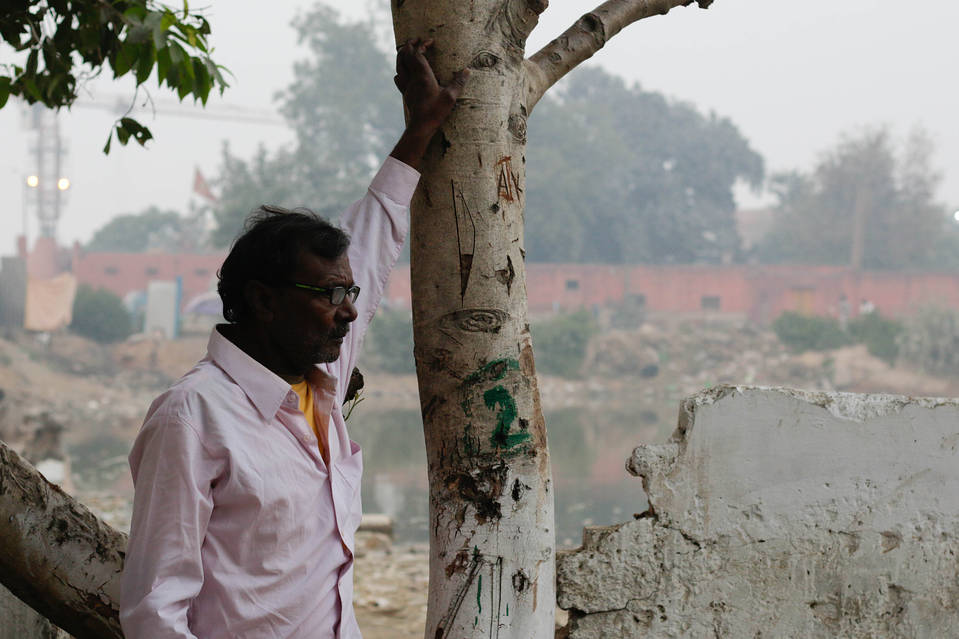
60-year-old Daya Chand leans on the bark of a plum tree where officials tucked the machine to issue receipts for subsidized food in the patchy lanes of New Delhi's Mehram Nagar. PHOTO: KARAN DEEP SINGH/THE WALL STREET JOURNAL

For breaking news, features and analysis from India, follow WSJ India on Facebook.
Share this: http://on.wsj.com/2ijtlr6

10790 - India’s Massive Aadhaar Biometric Identification Program - Wall Street Journal

3:06 AM EST JAN 13, 2017

Karan Deep Singh, Wall Street journal

One of the biggest reasons there are still issues with the biometric IDs–which are already being used widely to distribute subsidies for food and fuel–is the sheer scale of Aadhaar.
Here are a few of the numbers that point to the size of the program which is leading to the problems.

  • 1.1 BILLION The number of Aadhaar cards issued. Enrollment started in 2009, and now the system can process 1.5 million applications a day. That still leaves out about 150 million Indians without cards.

  • 86% The percentage of all Indians who hold Aadhaar cards. For those older than 18 the percentage is 99.5%. Most of those left out are infants, because fingerprint recognition isn’t reliable until a certain age. Still the government has already started to assigning numbers to newborns.

  • 15 MILLION The number of transactions per day involving Aadhaar. That is a five-fold rise from a year ago when there were 3 million a day.

  • 4 BILLION The total number of times the Aadhaar system has been used so far for authentication and identification.

  • 377 MILLION Number of Aadhaar number linked to bank accounts. Going forward, the connection to bank accounts will make transactions smoother and allow bank clients to move funds just by using their fingertips.

Friday, March 25, 2016

9635 - What Nandan Nilekani Needs to Learn - WSJ


By DHANYA ANN THOPPIL
Mar 12, 2014 2:59 pm IST

Chairman and founder member of Infosys, Nandan Nilekani. MANJUNATH KIRAN/AGENCE FRANCE-PRESSE/GETTY IMAGES

Nandan Nilekani once had access to more information about Indian’s billion-plus citizens than possibly anybody else in the country as the head of the ambitious biometric identification card system.

Before that, he helped set up India’s software and outsourcing giant, Infosys. Now, the techie-turned-bureaucrat is turning to politics.

How will his previous experience in the country’s I.T. hub and at the heart of a major national government program, translate into politics and help him win Bangalore south for the ruling Congress party?

Mr. Nilekani has certainly made a savvy move in his choice of constituency. If Bangalore is the I.T. capital of India, the south of the city is its heart: a magnet for the country’s technology professionals because of its proximity to the big I.T. firms.
His record at Infosys, where he was instrumental in the meteoric rise of the company while chief executive officer for five years from 2002, will likely appeal to those residents. During Mr. Nilekani’s tenure, Infosys saw a four-fold jump in annual revenue to $3.1 billion.

Suresh Babu Modi, a software professional with a U.S.-based multinational I.T. firm, who lives in Bangalore south has switched allegiance from the Bharatiya Janata Party because Mr. Nilekani is in the race.

MORE IN ELECTIONS-2014
“Nandan Nilekani is really an iconic figure in the IT sector,” Mr. Modi said.  “Irrespective of the company I work for, or the software service I offer, or the party that Nilekani belongs to, I support him.”

Still, others say his lack of political experience in the face of a formidable opponent in Ananth Kumar, a five-time member of Parliament for the principal opposition BJP, may prove a serious challenge.

Mr. Nilekani will need to build a connection with the common people, something that might not come as easily to him as forming a client  relationship at Infosys, some say.
“Nilekani’s expertise at Infosys lies in building business-to-business relationships, not business-to-consumer ties,” said Ruthvik Ganjur, a project engineer with software exporter Wipro.

In politics, he will have to develop the skills to directly deal with consumers, or rather voters, said Mr. Ganjur, who will also be voting in the seat Mr. Nilekani coverts.

But Mr. Ganjur adds, Mr. Nilekani’s experience might help him connect with the aspirational tech-savvy younger generation.
His time overseeing the Aadhar system of issuing a 12-digit unique I.D. number to every citizen of India, a program which has been criticized recently by the BJP for threatening national security could count against him, others say.
“For the last few years, we have seen how Aadhaar issue has been going on. It’s not much of a success,” said Aabha Gopal, a project manager with a U.S.-based software company.
Aadhar is designed to help those who have no other form of portable I.D., such as a passport or driving license, to enable them to access banking and government services.
But India’s Supreme Court ruled last year that it is not mandatory for access to benefits such as subsidized gas cylinders, fertilizer, or food grain, leading many to question the point behind it.
Mr. Nilekani’s candidature for the Congress party itself might also be a drawback considering the allegations of corruption that the party faces, Mr. Gopal added.
Another executive with a U.S.-based software firm, who is also a resident of south Bangalore agreed. “Nilekani is the right person in the wrong party,” the executive said.
Mr. Nilekani’s “magic touch” with Infosys might just be limited to the corporate world, “it’s a different ballgame to run a company of 150,000 employees” and overseeing a larger set of the population, the executive said, adding that employees can be hand-picked, voters cannot.

Follow Dhanya and India Real Time on Twitter @DhanyaThoppil and @WSJIndia

Saturday, May 2, 2015

7887 - How Banking Is Coming to India’s Countryside - Wall Street Journal


By GABRIELE PARUSSINI


Radha is a widow living in Jharkhand, one of India’s poorest states. Paolo Bosonin/The Wall Street Journal

One of the ways that Indian Prime Minister Modi is trying to get more Indians into the financial system is by delivering state support straight into bank accounts of those who need it rather than via costly price subsidies.

The government says that since the launch of a program in August to increase the amount of bank accounts in the country, well over 100 million new accounts have been opened; it claims that now virtually every household in the country has one. However, it has also acknowledged that especially in the early days of the campaign, many of the new accounts were opened by people who already had banks.

To rule out duplicate accounts and to more easily reach those it wants to sweep into the banking realm, the government wants each Indian to have a so-called Aadhaar number, a 12-digit identifier linked to biometric data. The Aadhaar, enrollment for which started in 2009, can also be used to prove whether a person is entitled to subsidies. In the bank-account push, a bit more than a third of the new accounts were linked to Aadhaar numbers.


It isn’t immediately clear how subsidies will reach those who have trouble opening a bank account or getting an Aadhaar ID. Finance Ministry officials say those with issues can call widely advertised helpline numbers, and say such problems aren’t common. The government plans to give every citizen an Aadhaar number by the end of the year, but India’s Supreme Court has ruled that having one can’t be made mandatory.

Sunday, October 13, 2013

4813 - India’s ID Program: An Aadhaar Explainer - The Wall Street Journal


Confused by the legal tussle over India’s national identification program? Wondering whether you need an ID number? Here’s a quick guide to Aadhaar.

By Vibhuti Agarwal

A man worked on a computer during registration for Aadhaar cards in Amritsar, Punjab, May 24, 2011. Narinder Nanu/Agence France-Presse/Getty Images

So why bother?
India’s government is looking for ways to make its large welfare programs more targeted ahead of national polls due by May and making ID cards mandatory for the receipt of some services is one way it wants to do this.

The government asked the Supreme Court to reverse its September decision that ID numbers should not be required to access benefits and subsidies in the government’s 29 welfare programs. On Tuesday the court said its September ruling would stand until it hears the case again on Oct. 22.

Previous attempts by the government to make it a legal requirement to have a unique ID number have come unstuck. A Parliamentary standing committee rejected the proposal, citing concerns about the security of the data, issuance of numbers of non-citizens and identity theft, among other issues.

Is the government going to keep trying to make it necessary to have an ID to access some services?
Yes. Also on Tuesday, the Cabinet cleared a bill, which gives legal and legislative backing to the ID program and allows service providers including government agencies to make an ID number mandatory for accessing particular services. A previous version of the bill was introduced in the upper house of Parliament in Dec. 2010.

The bill, which is an amendment of a previous version introduced in Parliament in Dec. 2010, must be passed by lawmakers and will likely come up for discussion during the winter session of Parliament, which is expected to begin next month.

If passed, then residents wishing to marry or access government benefits would need an ID number only if the service provider involved requires it.

How many people have a number?
The UIDAI, which began the program in 2010, hopes to have issued 600 million numbers by March 2014.
Around 449,203,772 people have been issued with a number to date,  a spokesman for UIDAI said.

Follow us on Twitter @WSJIndia.