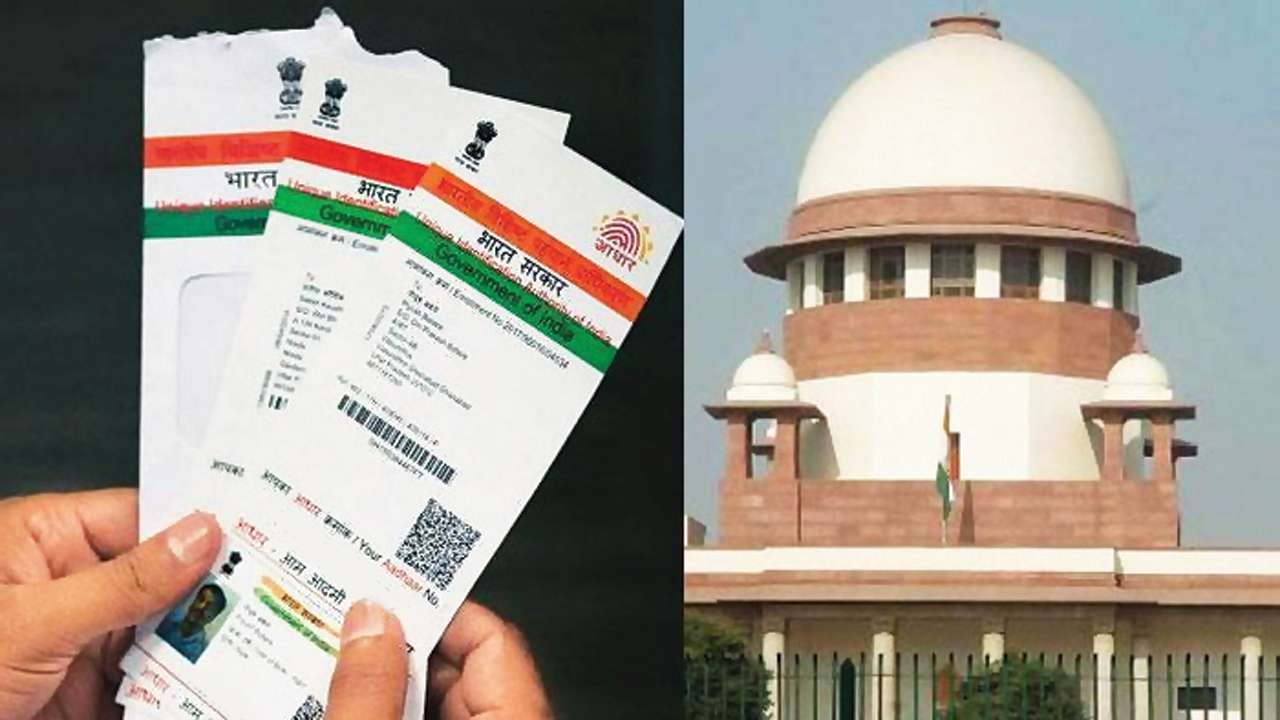
In 2009, I became extremely concerned with the concept of Unique Identity for various reasons. Connected with many like minded highly educated people who were all concerned.
On 18th May 2010, I started this Blog to capture anything and everything I came across on the topic. This blog with its million hits is a testament to my concerns about loss of privacy and fear of the ID being misused and possible Criminal activities it could lead to.
In 2017 the Supreme Court of India gave its verdict after one of the longest hearings on any issue. I did my bit and appealed to the Supreme Court Judges too through an On Line Petition.
In 2019 the Aadhaar Legislation has been revised and passed by the two houses of the Parliament of India making it Legal. I am no Legal Eagle so my Opinion carries no weight except with people opposed to the very concept.
In 2019, this Blog now just captures on a Daily Basis list of Articles Published on anything to do with Aadhaar as obtained from Daily Google Searches and nothing more. Cannot burn the midnight candle any longer.
"In Matters of Conscience, the Law of Majority has no place"- Mahatma Gandhi
Ram Krishnaswamy
Sydney, Australia.

Aadhaar

The UIDAI has taken two successive governments in India and the entire world for a ride. It identifies nothing. It is not unique. The entire UID data has never been verified and audited. The UID cannot be used for governance, financial databases or anything. It’s use is the biggest threat to national security since independence. – Anupam Saraph 2018

When I opposed Aadhaar in 2010 , I was called a BJP stooge. In 2016 I am still opposing Aadhaar for the same reasons and I am told I am a Congress die hard. No one wants to see why I oppose Aadhaar as it is too difficult. Plus Aadhaar is FREE so why not get one ? Ram Krishnaswamy

First they ignore you, then they laugh at you, then they fight you, then you win.-Mahatma Gandhi

In matters of conscience, the law of the majority has no place.Mahatma Gandhi

“The invasion of privacy is of no consequence because privacy is not a fundamental right and has no meaning under Article 21. The right to privacy is not a guaranteed under the constitution, because privacy is not a fundamental right.” Article 21 of the Indian constitution refers to the right to life and liberty -Attorney General Mukul Rohatgi

“There is merit in the complaints. You are unwittingly allowing snooping, harassment and commercial exploitation. The information about an individual obtained by the UIDAI while issuing an Aadhaar card shall not be used for any other purpose, save as above, except as may be directed by a court for the purpose of criminal investigation.”-A three judge bench headed by Justice J Chelameswar said in an interim order.

Legal scholar Usha Ramanathan describes UID as an inverse of sunshine laws like the Right to Information. While the RTI makes the state transparent to the citizen, the UID does the inverse: it makes the citizen transparent to the state, she says.

Good idea gone bad
I have written earlier that UID/Aadhaar was a poorly designed, unreliable and expensive solution to the really good idea of providing national identification for over a billion Indians. My petition contends that UID in its current form violates the right to privacy of a citizen, guaranteed under Article 21 of the Constitution. This is because sensitive biometric and demographic information of citizens are with enrolment agencies, registrars and sub-registrars who have no legal liability for any misuse of this data. This petition has opened up the larger discussion on privacy rights for Indians. The current Article 21 interpretation by the Supreme Court was done decades ago, before the advent of internet and today’s technology and all the new privacy challenges that have arisen as a consequence.

Rajeev Chandrasekhar, MP Rajya Sabha

“What is Aadhaar? There is enormous confusion. That Aadhaar will identify people who are entitled for subsidy. No. Aadhaar doesn’t determine who is eligible and who isn’t,” Jairam Ramesh

But Aadhaar has been mythologised during the previous government by its creators into some technology super force that will transform governance in a miraculous manner. I even read an article recently that compared Aadhaar to some revolution and quoted a 1930s historian, Will Durant.Rajeev Chandrasekhar, Rajya Sabha MP

“I know you will say that it is not mandatory. But, it is compulsorily mandatorily voluntary,” Jairam Ramesh, Rajya Saba April 2017.

August 24, 2017: The nine-judge Constitution Bench rules that right to privacy is “intrinsic to life and liberty”and is inherently protected under the various fundamental freedoms enshrined under Part III of the Indian Constitution

"Never doubt that a small group of thoughtful, committed citizens can change the World; indeed it's the only thing that ever has"

“Arguing that you don’t care about the right to privacy because you have nothing to hide is no different than saying you don’t care about free speech because you have nothing to say.” -Edward Snowden

In the Supreme Court, Meenakshi Arora, one of the senior counsel in the case, compared it to living under a general, perpetual, nation-wide criminal warrant.

Had never thought of it that way, but living in the Aadhaar universe is like living in a prison. All of us are treated like criminals with barely any rights or recourse and gatekeepers have absolute power on you and your life.

Announcing the launch of the # BreakAadhaarChainscampaign, culminating with events in multiple cities on 12th Jan. This is the last opportunity to make your voice heard before the Supreme Court hearings start on 17th Jan 2018. In collaboration with @no2uidand@rozi_roti.

UIDAI's security seems to be founded on four time tested pillars of security idiocy

1) Denial

2) Issue fiats and point finger

3) Shoot messenger

4) Bury head in sand.

God Save India

Showing posts with label Attorney General KK Venugopal. Show all posts

Friday, May 4, 2018

13456 - Aadhaar: Centre quotes SC order on seeding of mobile SIMs - The Hindu


NEW DELHI, MAY 03, 2018 21:58 IST

A-G insists that earlier move for seeding of mobile SIMs with Aadhaar was based on court directive

The Centre insisted on Thursday that its earlier move for mandatory seeding of mobile phone SIMs with Aadhaar was based on the Supreme Court’s initiative.

Recently, the Aadhaar Constitution Bench, led by Chief Justice of India Dipak Misra, had questioned the government’s line that its efforts to mandatorily link SIMs with Aadhaar was based on a February 6, 2017 order of the Supreme Court.

In response, Attorney-General K.K. Venugopal read out the February 6 order of a Bench of then Chief Justice J.S. Khehar and Justice N.V. Ramana. This order was based on a PIL petition filed by Lok Niti Foundation, highlighting the need for a “definite mobile phone subscriber verification scheme, to ensure 100% verification of the subscriber.” The petitioner had argued that such a scheme was necessary to prevent the use of unverified mobile phone SIMs in domestic crime and terror acts.
Mr. Venugopal said the February 6 order had the Bench “congratulating” Lok Niti Foundation for raising such a “commendable cause.” Mr. Venugopal said the court had realised the grave security risk posed by the casual distribution of SIMs to all and sundry without proper verification.
Demographic data

To buttress his point, Mr. Venugopal read out portions of the order which records the government’s response to Lok Niti Foundation. He said the order recorded that the government had launched the “Aadhaar based E-KYC for issuing mobile connections” on August 16, 2016 wherein the customer as well as Point of Sale (PoS) Agent would be authenticated from Unique Identification Authority of India (UIDAI) based on their biometrics and their demographic data received from UIDAI.
Mr. Venugopal said the government had also conveyed to the court that the Aadhaar-based e-KYC process would nullify the chances of delivery of SIMs to wrong persons and ensure “traceability” of the customer to a large extent.

But Justice A.K. Sikri, on the Constitution Bench, responded by saying that the February 6 order only records the plea of Lok Niti Foundation and the government’s response to it. There was no positive order from the Supreme Court, directing the government to seed SIMs with Aadhaar.

On this, Mr. Venugopal drew the court’s attention to the concluding paragraphs of the two-page order.

Existing subscribers
Here, he pointed out that the court had described the Aadhaar e-KYC process as an “effective’ one for new mobile phone subscribers. It had also further expressed “hope and expectation” that a “similar verification” would be completed in the case of existing subscribers soon, possibly within a year.
At this point, Justice D.Y. Chandrachud, on the Bench, asked why then did the government come out with a recent statement to telecom companies to not insist on Aadhaar from subscribers.
Mr. Venugopal said this was done in response to the recent statements from the Constitution Bench and the government has now decided to wait till the final judgment of the court on the validity of the Aadhaar scheme.

The Attorney-General concluded his rejoinder arguments by dismissing allegations of mass State surveillance and “conspiracy” using Aadhaar data. He said it was preposterous to allege that a democratically-elected government would “collude” with Aadhaar officers to mount surveillance on the doings of other political parties in order to “prevent them from going into a coalition.”

Mr. Venugopal said he strongly objected to terms like “concentration camp,” “totalitarian regime” and “electronic leash” used by senior advocate Shyam Divan and advocate Vipin Nair, in relation to the Aadhaar scheme.


“No single person can be put on electronic leash… leash is a word used for dogs. I strongly object,” Mr. Venugopal concluded for the Centre.

13453 - Aadhaar Bill a money bill: AG says Speaker’s decision final - TNN


Dhananjay Mahapatra | TNN | May 4, 2018, 02:39 IST

NEW DELHI: The Centre on Thursday sought dismissal of Congress leader Jairam Ramesh’s petition challenging the Lok Sabha Speaker’s decision to categorise the Aadhaar Bill as a money bill by arguing that the Speaker’s decision was final and not open to judicial scrutiny. 

Ramesh’s counsel P Chidambaram had said the Speaker arbitrarily decided to categorise the Aadhaar Bill as a money bill to deprive Rajya Sabha, where the ruling NDA did not have majority, from amending the bill. 

“Why should the House of Elders be shut off from suggesting changes in the law? Why should the President be deprived of giving his suggestions by marking Aadhaar as a money bill?” he had asked. Attorney general K K Venugopal met these arguments by citing Article 110(1), which deals with use of Consolidated Fund money, which was utilised to create Aadhaar identity for every Indian and the required infrastructure, and said this warranted the bill to be categorised as a money bill. 

Moreover, constitutional provisions and parliamentary rules and tradition left the categorisation entirely and exclusively to the Speaker, whose decision was final and non-justiciable, the AG argued. However, a bench of CJI Dipak Misra and Justices A K Sikri, A M Khanwilkar, D Y Chandrachud and Ashok Bhushan put a caveat by saying it was open to judicial scrutiny if gross irregularity was pointed out in the procedure to categorise a bill as money bill.

Venugopal said of the estimated expenditure of Rs 13,663 crore for implementation of Aadhaar scheme up to the 2016-17 financial year, a sum of Rs 6,844 crore had been spent for payments towards enrolments, logistic operations, Aadhaar Sampark Kendras, technology infrastructure and operations. Another Rs 408 crore was spent towards establishment cost, he added.

The AG said the petitioners had argued that Aadhaar would be used to launch surveillance on citizens. “What is alleged is that the government would enter into a conspiracy with UIDAI to put political opponents and other prominent citizens under surveillance by committing offence under the Aadhaar Act, which punishes storage of activities or sharing of data following authentication of identification through Aadhaar,” he said.

“It was totally wrong on the part of the petitioners to argue that Aadhaar has made citizens live in a totalitarian regime or in a concentration camp where they are electronically leashed. A dog gets leashed. No one can argue that a democratically elected and constitutionally formed government can violate law to leash its citizens, who are the ultimate holders of power in a democracy,” the AG added.


The Centre and the UIDAI concluded their arguments on Aadhaar and the petitioners will present their reply from Tuesday. 

Thursday, May 3, 2018

13444 - SC questions government's justification for passing Aadhaar Act as Money Bill - The Hindu

SC questions government's justification for passing Aadhaar Act as Money Bill

NEW DELHI, MAY 02, 2018 17:23 IST

MORE-IN

Attorney General says the Act may have several “ancillary provisions”, but taken in its entirety, the Aadhaar Act comes within the ambit of the definition of Money Bill under Article 110 of the Constitution.

The Supreme Court on Wednesday questioned the government's justification for passing the Aadhaar Act as a Money Bill.
Countering the Central government's argument that the sole intent of the Aadhaar Act is to act as a weapon for delivering subsidies to targetted beneficiaries, the Constitution Bench led by Chief Justice of India Dipak Misra pointed to Section 57 of the Act.
This provisions contemplate the use of the Aadhaar card as an identification document not only by the government but also by "any body corporate or person".
"A body corporate? That is as far as you can go away from the concept of a Money Bill," Justice Chandrachud challenged Attorney General K.K. Venugopal.

Section 57 says “nothing contained in this Act [Aadhaar Act] shall prevent the use of Aadhaar number for establishing the identity of an individual for any purpose, whether by the State or any body corporate or person...”

Mr. Venugopal submittted that the Act's Preamble itself encapsulated its objective as a legislative “tool” to provide “good governance, efficient, transparent, and targeted delivery of subsidies, benefits and services”. The expenditure for these welfare activities would be drawn from the Consolidated Fund of India.

Mr. Venugopal said the Act may have several “ancillary provisions”, but taken in its entirety the Aadhaar Act came within the ambit of the definition of Money Bill under Article 110 of the Constitution.

The Attorney General countered that the Act contemplated the plight of 300 million people in the country living below the poverty line. “Money has to come necessarily from the Consolidated Fund of India to cover the expenditure of the delivery of targetted subsidies. Not a single provision in the Act is unneccessary or unrelated to the main purpose/pith and substance of the Act, which is giving subsidies,” he argued.
Jairam Ramesh's petition

Mr. Venugopal was countering arguments raised in a petition by Rajya Sabha member Jairam Ramesh that the Aadhaar Act of 2016 was passed as a Money Bill to “bypass the scrutiny of the Rajya Sabha.”

Mr. Ramesh, represented by senior advocate P. Chidambaram, had argued that a Bill is declared as a Money Bill only in six specific circumstances or matters incidental to them as enumerated in Article 110. The Aadhaar law does not relate to any of these circumstances. The petition had termed the passage of the Aadhaar law a “constitutional fraud”.

On March 11, the Aadhaar Bill was passed by the Lok Sabha after the Speaker ruled it as a 'MoneyBill'. It was then passed to the Rajya Sabha which, on March 16, returned the Bill with five amendments moved by Mr. Ramesh. These recommendations were rejected by the Lok Sabha, which passed the law called Aadhaar (Targeted Delivery of Financial and other Subsidies, Benefits and Services) Act, 2016.

Mr. Venugopal referred to Sections 7, 24 and 25 of the Aadhaar Act to show how closely the objective of the statute is linked to the Consolidated Fund. Section 7 says that the Centre or a State may use Aadhaar card to establish the identity of a person to provide him subsidy, benefit or service for which the expenditure is incurred from the Consolidated Fund.


Section 24 says that Centre could make grants of money to the authorities under the Act for the purpose of providing subsidies. Section 25 says that fees or revenue collected by the authority under the Aadhaar Act should be credited to the Consolidated Fund.

13443 - SC does not seem to agree with Aadhaar law being termed a Money Bill - TNN


PTI | Updated: May 2, 2018, 21:09 IST

NEW DELHI: The Supreme Court on Wednesday did not seem to agree with the government's contention that the Aadhaar law was correctly termed as a Money Bill by the Lok Sabha Speaker as it dealt with "targeted delivery of subsidies" for which funds come from the Consolidated Fund of India. 

A five-judge constitution bench headed by Dipak Misra referred to Section 57 of the Aadhaar Act which says that "State or any body corporate or person" can use Aadhaar number "for establishing identity of an individual for any purpose". 

"The problem arises with regard to section 57 (of the Aadhaar Act). Section 57 snapped the link with section 7 and the targeted delivery of subsidies, benefits and services," the bench, also comprising Justices A K Sikri, A M Khanwilkar, D Y Chandrachud and Ashok Bhushan, said. 

The bench said allowing "any body corporate or person" to use Aadhaar for establishing identity for any purpose "snaps the link with Consolidated Fund of India", indicating that the Aadhaar legislation cannot be called a Money Bill. 

The remarks came when Attorney General K K Venugopal was advancing arguments in response to submissions of lawyers including senior advocate P Chidambaram that Aadhaar, by no standard, could have been certified as a Money Bill by Lok Sabha Speaker as it did not meet the conditions of Article 110 (definition of Money Bill) of the Constitution. 

Venugopal referred to the preamble and several provisions of the Aadhaar (Targeted Delivery of Financial and Other Subsidies, Benefits and Services) Act, 2016 and said the term "targeted delivery of subsidies" contemplated the expenditure of funds. 

"The expenditure has to go into thousands of crores of rupees from the Consolidated Fund of India. This itself brings it (law) into the ambit of Money Bill under Article 110 of the Constitution," he said. 

Responding to bench's observation on allowing even private bodies to use the Aadhaar architecture, Venugopal said even though the law has ancillary provisions, the main object was delivery of subsidies, services and benefits. 

"Not a single provision in the Act is unnecessary or unrelated to the main purpose or the pith and substance of the Act which is giving subsidies, services and benefits," the top law officer said. 

He said as of now, no such contract with private entities with UIDAI was before the court and when such issues are placed before the bench, then only it can be examined. 

However, the bench stuck to its observations on Section 57 and said "there is no distribution of benefits and subsidies under section 57." 

Venugopal also referred to Article 110 (1) (g) of the Constitution and said it contained words "any matter" and the Aadhaar Law fell under this definition and was rightly held as a Money Bill. 

His arguments remained inconclusive and will resume tomorrow before the bench, which is hearing a clutch of petitions challenging Aadhaar and its enabling 2016 law. 

Senior Congress leader and Rajya Sabhja MP Jairam Ramesh, represented by Chidambaram, had moved the apex court challenging the decision to treat Aadhaar bill as a money bill, which was passed during Budget Session in March 2016, overruling amendments moved in the Rajya Sabha. 

Earlier in the day, advocate Zoheb Hossain, appearing for the Maharashtra government, referred to international charters and covenants on harmonisation of socio-economic and civil political rights. 

The bench said the Directive Principles of State Policy (DPSP) of the Constitution was essential for good governance and a guarantee of reasonableness of a law. It said though DPSP was "justiciable", it has been read into Article 21 (Right to life and liberty). 

Dealing with data protection, Hossain said that framing a law on the subject was a positive obligation cast on the State and the Aadhaar scheme would ensure socio-economic rights of citizens and prevention of leakages of funds. 

Referring to judgements, he said when a law conferred discretionary powers to the executive, the validity of the statute cannot be judged by assuming that the executive would exercise its powers arbitrarily. 

Hossain referred to the UN General Assembly resolution which says that ideal of freedom can only be achieved if conditions are created so that everyone can enjoy socio-economic and civil political rights. 


He contended that right to privacy was an individual and personal right and its alleged infringement cannot be raised in a PIL by unconnected NGOs.


The lawyer then gave an example of Aadhaar being used for obtaining SIM card, opening bank account and getting PDS benefits and said the telecom companies will not know the details of a citizen's bank account or information about PDS.

"Similarly, the bank will not have information about the telecom and PDS details of the citizen. The UIDAI would not be have any of the three details," he said, adding there was no possibility of surveillance.

Earlier, lawyer Gopal Sankaranarayanan had opposed the seeding of Aadhaar with the Permanent Account Number (PAN) for income tax in the Supreme Court, saying in no way does it help in preventing financial frauds or curb black money. 

13441 - AG: Aadhaar Bill rightly categorised as Money Bill - TNN


Dhananjay Mahapatra | TNN | May 3, 2018, 03:16 IST

HIGHLIGHTS
  • "The Bill was rightly categorised as ‘Money Bill” under Article 110(1) (c),(d)(e) and (f) of the Constitution," AG said
  • The AG said a law cannot be complete without providing for ancillary issues to achieve the objective behind spending huge sums from the consolidated fund
NEW DELHI": The Centre on Wednesday told the Supreme Court that provisions of Article 110 of the Constitution were adhered to while categorising Aadhaar as a Money Bill, which had enabled the NDA government to avoid the legislation being scuttled in Rajya Sabha where it lacked a majority. 

With Aadhaar (Targeted Delivery of Financial and Other. Subsidies, Benefits and Services) Bill being termed as a Money Bill by Lok Sabha Speaker Sumitra Mahajan, its passage in the lower House cleared the way for its coming into force as amendments proposed by Rajya Sabha became advisory in nature. Appearing for Congress MP Jairam Ramesh, who had questioned categorisation of Aadhaar as a Money Bill, former finance minister P Chidamabaram had argued that this was a trick played by the NDA government to rob Rajya Sabha and the President from having a say on the Bill and make amendments to strengthen it. 

Attorney general K K Venugopal said since the Centre was to spend Rs 55,000 crore from the Consolidated Fund of India for providing subsidies, benefits and services to a targeted section of population, the Bill was rightly categorised as ‘Money Bill” under Article 110(1) (c),(d)(e) and (f) of the Constitution.

However, a bench of CJI Dipak Misra and Justices A K Sikri, A M Khanwilkar, D Y Chandrachud and Ashok Bhushan drew the AG’s attention to the definition of ‘Money Bill” in Article 110(1) which said the Bill must contain “only provisions dealing with all or any of the following matters”. The bench said the Aadhaar Act, apart from containing the reference to the source of funds from the CFI, had a host of provisions on ancillary issues.

TOP COMMENT
Then why did you enforce aadhar for buying sim cards?
Why this flip flop all the time?
Asharaf Syedali

The AG said a law cannot be complete without providing for ancillary issues to achieve the objective behind spending huge sums from the consolidated fund. Appearing for UIDAI and Centre, advocate Zoheb Hossain said linking Aadhaar with PAN has helped authorities detect Rs 33,000 crore, which would have otherwise gone down as an undisclosed amount.


“Apart from this additional benefit, the Aadhaar linkage with PAN has helped the authorities to track down shell companies with dummy directors, who were playing havoc with banking system,” he said. He said, “No person shall be tracked or profiled through use of Aadhaar. Sharing or disclosing Aadhaar data is a punishable offence and that requesting agencies cannot store transaction that followed authentication through Aadhaar.” Arguments by AG would continue on Thursday.


Sunday, April 29, 2018

13396 - Aadhaar Hearing: The Government’s Arguments So Far - Quint

Aadhaar Hearing: The Government’s Arguments So Far

Arpan Chaturvedi @arpanc_
28 April 2018, 4:30 PM28 April 2018, 4:30 PM

SUBSCRIBE to Bloomberg | Quint
The Daily Newsletter

The central and certain state governments and the Aadhaar-issuing body UIDAI continued to maintain that the biometric identification is voluntary and does not violate the right to privacy.

Attorney General of India KK Venugopal, Additional Solicitor General of India Tushar Mehta, senior advocates Rakesh Dwivedi, Jayant Bhushan, NK Kaul and other lawyers argued on behalf of the government in favour of the Aadhaar programme and the Aadhaar Act, 2016. Petitioners in the matter have completed their arguments, highlighting concerns about possible citizen profiling, state control, denial of public services and hasty passage of the Aadhaar Act.

A five-judge Constitution bench headed by Chief Justice of India Dipak Misra is hearing the matter that will decide the fate of the world’s largest biometric identification programme. Another Constitutional bench, in a verdict stemming from the Aadhaar matter, had earlier ruled that privacy is a fundamental right.

Here are the key arguments made for Aadhaar by the government and UIDAI’s counsels:

Right To Privacy Not An Absolute Right
The right to privacy is not absolute. There can be instances when this right can be curtailed and the Aadhaar programme is one such instance.
The Aadhaar programme satisfies the three conditions when right to privacy can be curtailed as laid down by the nine-judge bench. These include existence of a law, compelling state interest/larger public interest and test of proportionality.
There must be a balance between protecting right to privacy and ensuring right to a dignified life for all the citizens.
The Aadhaar programme ensures the right to dignified life for citizens by plugging leakages in distribution of subsidies.
The right to life is also a fundamental right under Article 21 of the Constitution.
Each of the subsidies provided under the Aadhaar Act is traceable to Article 21, ensuring a right to a dignified life and therefore it is a constitutionally valid scheme.


Also Read: Is Aadhaar Likely To Pass The Privacy Test?

Minimum Invasion Of Privacy In Aadhaar

Aadhaar does not violate the fundamental right to privacy, the Attorney General of India argued.
Data collected as part of the scheme is minimum.
If the top court feels any data should not have been taken, the government will delete that data and stop using it in the Aadhaar programme.

It requires only the bare demographic particulars while eschewing most other demographic particulars. It further requires the bare biometric factors, namely photograph, fingerprints and iris.KK Venugopal, Attorney General of India

Aadhaar-Mobile SIM Card Linkage

The government till now had said that mobile phone connections were being linked with Aadhaar on the directions of the Supreme Court in the Lokniti Foundation’s petition seeking verification of every user.
During the hearing, Justice DY Chandrachud said that the Supreme made no such direction in the Lokniti case.

In fact there was no such direction from the Supreme Court, but you took it and used it as a tool to make Aadhaar mandatory for mobile users. Justice DY Chandrachud (PTI Report Citing Court Proceedings)

The central government maintained there has no violation of any interim orders passed by the top court ever since the challenge to the Aadhaar was first heard.
It said before the Aadhaar Act was introduced, “obtaining an Aadhaar number or an enrollment number was voluntary, especially because of the interim orders passed by this court”.

UIDAI CEO’s Presentation

The UIDAI gets minimum information when transactions are carried out using Aadhaar authentication.
UIDAI does not get to know the purpose and details of those transactions, its Chief Executive Officer Ajay Bhushan Pandey said.
The e-KYC data is not shared with anyone except with the Aadhaar holder who does the transaction using Aadhaar authentication.
To counter petitioners’ argument of Aadhaar data leaks, Pandey said there has not been a single instance of any data leak from the UIDAI database.
The Attorney General also said the Aadhaar database has strong security features.


Also Read: India Cites Height of Database Center Wall as ID Leak Shield
BloombergQuint
Stay Updated With Law & Policy News On BloombergQuint

Monday, April 16, 2018

13294 - Aadhaar and Welfare: A Sceptical Note - Main Stream

Home > 2018 > 

Mainstream, VOL LVI No 17 New Delhi April 14, 2018

Saturday 14 April 2018, by Arup Kumar Sen

In the Supreme Court hearing on Aadhaar, before a two-judge Bench, in May 2017, the then Attorney General, Mukul Rohatgi, while countering the petitioners’ objections to the government’s move, said that their “arguments on so-called privacy and bodily intrusions are bogus”. He also offered pro-welfare, anti-corruption and anti-terrorist arguments in favour of Aadhaar: “It is an effective tool to check terror financing and black money. It ensures that money meant for poor people reaches them.”

The present Attorney General, K.K. Venugopal, said, before a five-judge Constitution Bench in the final hearings on the Aadhaar project, in March 2018, that there was a need to balance the right of 300 million poor people to live with dignity and without starvation as against the privacy rights of others. But, Justice Chandrachud stated that this argument would go against the spirit of the Supreme Court’s privacy judgement. He clarified: “It is not that privacy is for one section of population and economic right for another.”

In his recent interview carried in India Today (April 9), the Union Minister for Information Technology, Ravi Shankar Prasad, offered his arguments in defence of Aadhaar: “There is a lot of misconception about Aadhaar. Its biggest opponents are those who introduced the Right to Information. The poor have no objection... Privacy cannot and should not become the shield of the corrupt and the terrorists.”

We are fortunate that the Supreme Court was not convinced by the argument that the right to privacy is an elitist affair, and that the poor people are not concerned about it. In July 2017, a nine-judge Constitution Bench of the Supreme Court declared the Right to Privacy to be a fundamental right. Not accepting Attorney General Venugopal’s characterisation of the right to privacy as an “elitist” argument, the Bench reportedly told him: “Your argument that the Right to Privacy applies to the elite alone is wrong, it applies to the poor people as well.”

The government’s contention that Aadhaar is an “effective tool” of delivering welfare benefits to people has been contested by activist scholars. To put it in the words of one such scholar, Reetika Khera: “Aadhaar is a direct assault on the ‘right to life’ of many in the sense that pre-existing benefits (rations, pensions etc.) have now become contingent upon Aadhaar. Our research and government data suggest that the number of affected people is in hundreds of thousands... It is bizarre that while Aadhaar in fact harms the poor, it is positioned by the government as a tool that ‘empowers’ them.”


We are seriously concerned about the possibility that Aadhaar information, rather than empowering the poor, maybe used as an additional weapon of social control at the micro and macro levels in our “strange times”.

Wednesday, April 11, 2018

13264 - Aadhaar linkages case: AG says safeguards have built into the act - India Legal Live

April 10, 2018


The Supreme Court Constitution Bench of Chief Justice Dipak Misra and Justices AK Sikri, AM Khanwilkar, DY Chandrachud and Ashok Bhushan, hearing Aadhaar and related linkages issue (petitions saying that it was unconstitutional), was told by Attorney general K K Venugopal on Tuesday (April 10) that Section 59 of the Aadhaar Act seeks to provide a safeguard to all the actions done previously since the Act came into existence.

He said that Section 59 further protects all the notifications issued. He said that this section has a retrospective effect.
Justice Chandrachud asked: “Section 59 protects the notification of April 29, 2009. But does it cover the entirety of the Aadhaar?” Venugopal said yes.

The AG pointed at two things: money and data sharing. He said that there is no charge for form for Aadhaar enrollment. He also said that there should be no problem in sharing of Aadhaar number (and information) with, say, the bank account, because minimal demographic information gathered.

He also said that no person should suffer just because he or she did not enroll for Aadhaar.

Another issue of forms came up. It was said that the first two forms did not talk of detailed biometrics, because it was planned and prepared with no more than one crore people in mind.
Then came the third form, from where biometrics were made mandatory. Senior counsel Rakesh Dwivedi pointed out that Aadhaar will not be available to anyone without biometrics. It was found that basically the second form (which also did not want biometrics) was never used, as pointed out by Justice Sikri.

The first two forms did not have any reference to biometrics. It was only inserted in the third form. That was where the state argued that the first two forms were hardly used because the government had only mandated enrollment of one crore individuals (who would be eligible for the government the subsidies, for which Aadhaar was designed in the first place).
It has also been said that biometrics of a person cannot be obtained without consent. However, the CBI had gone to the Bombay High Court to obtain the biometrics of an accused in a rape case. After the UIDAI refused to give the details.
The CJI said that there has been minimal intrusion under this Act. “It does not mean that it has the protection of section 59. Just because section 59 exists to protect it, doesn’t mean that the entire procedure has been followed.”
As an example the CJI said: “For example, in the form, in the gender section, it says transgenders. It means inclusion.”

Starting his submissions, Additional Solicitor General Tushar Mehta compared section 139AA of the Income Tax Act and Right to Privacy under article 21. He said that right to privacy is not absolute. It is subject to certain limitations. He said that a legislation has to pass all four tests to be valid. Talking about section 139AA’s importance he said it was important for the linking of PAN card under the Income Tax Act.

He said that in case of registration of sale deed, even for a literate person, thumb impression is mandatory, and it is stored as well.
“Those who have already taken PAN do not have any legitimate interest in withholding information that they have already provided for obtaining PAN. Aadhaar will prevent duplicate PAN,” he said.
He said fake PAN cards have led to the increase in the number of shell companies. He said that on many instances more than one PAN had been issued to one person or one PAN number to several individuals.
Tushar Mehta will continue tomorrow.


—India Legal Bureau

Sunday, April 8, 2018

13224 - Attorney General Venugopal Claims Aadhaar Can Shield India From Bank Frauds, Terror Attacks - INC42


KK Venugopal Told The Five-Judge Bench Hearing Petitions Challenging The Aadhaar Act, 2016
April 7, 2018 3 min read
INC42 STAFF

In the latest development over Aadhaar episode, the central government in India has claimed in the Supreme Court that Aadhaar would prevent bank frauds. The Attorney General (AG) KK Venugopal also said that Aadhaar would aid the government in shutting down telecom connectivity to terrorists.
“Aadhaar will prevent bank frauds,” Attorney General KK Venugopal told a five-judge bench testing the constitutional validity of a host of petitions that have challenged the Aadhaar Act, 2016. “It would prevent the creation of multiple benami accounts,” he explained.

Insinuating the benefits of Aadhaar, the AG suggested that since terrorists often hold multiple SIM cards, Internet connectivity could be cut off for the cell phones belonging to the terrorists.

RELATED STORIES:

However, the bench comprising CJI Dipak Misra and Justices AK Sikri, AM Khanwilkar, DY Chandrachud and Ashok Bhushan, has shown their skepticism over his claims.

In reply to the suggestions by KK Venugopal, some of the points the Justices raised were:
  • Bank frauds don’t happen because of multiple identities. Banks do due diligence every time they give out loans. Frauds can’t happen unless bank employees are hand in glove.
  • Terrorists don’t apply for Aadhaar. They don’t apply for SIMs. They acquire them.

Apart from the data breach and data security issues, the government is also fighting the Aadhar war on the ‘consent’ front.

According to the senior-most law officer of the court, the Aadhaar data pre-dating the 2016 law was valid under the law as it was “voluntarily” ceded. Not only did the officer urged the court to refrain from ruling that the Aadhaar had been collected unconstitutionally and hence must be destroyed but also “that would be an exercise in futility. We will have to re-enrol these people.”

Relentless with his argument, the AG said about the availability of the biometrics of the Aadhaar in the public domain that, “The biometrics are bare minimum. Everything is available about a person in Wikipedia these days”.

The more appalling part of this entire argument was when the AG, at one point, insisted that the miniscule of the people opposed to Aadhaar cannot insist that their right to privacy weigh more than the right to food and life of the teeming poor — estimated at over 400 Mn people.

The Case In Point
In January, the Aadhaar system was hacked by a self-proclaimed French cybersecurity expert who goes by the alias Elliot Alderson. Soon after, a leakage was reported after an unidentified group on WhatsApp shared links containing the login and the password details which enabled access to 1 Bn Indian citizens.

Also, a harsh rebuttal to the UIDAI’s claims of the Aadhaar security surfaced when a report claimed that “a data leak on a system run by a state-owned utility company Indane allowed anyone to download private information on all Aadhaar holders, exposing their names, their unique 12-digit identity numbers, and information about services they are connected to, such as their bank details and other private information”.
In unity, the essence from the bench was “Aadhaar is not a catch-all for all frauds”.

Conceding to the rebuttal by the Supreme Court, the central government has already informed the Supreme Court that it will draft the data protection bill to support the right of privacy. The ongoing arguments at the apex court is interesting and vital for any ruling on the Aadhaar case and hopefully, India will make up its mind to protect its data and aim at preventing a Facebook faux pas in India post data leakages and breaches. This is of supreme importance to India especially since it’s the largest democracy in the world.


Note: We at Inc42 take our ethics very seriously. More information about it can be found here.

Saturday, April 7, 2018

13211 - Is Aadhaar Proportional in Curbing Terrorism - News Click

Is Aadhaar Proportional in Curbing Terrorism - News Click

Vivan Eyben 06 Apr 2018

On day 25 of the Aadhaar hearings the Attorney General (AG) continued his submissions. The AG responded to the issues raised by the Supreme Court as well as petitioners. The first pertained to the open and wide definition accorded to ‘biometric information’ under section 2(g) of the Aadhaar Act. The second was on the right to privacy. The Court also questioned some of the submissions made by the respondents regarding bank fraud and terrorism.

The Supreme Court had questioned how far the UIDAI intended to go in collecting biometric information. Section 2(g) of the Act states that ““biometric information” means photograph, finger print, Iris scan, or such other biological attributes of an individual as may be specified by regulations”. The problematic aspect is that the latter part of the definition leaves specifying the extent of what biometric information is collected to ‘regulations’. Unlike a legislation passed by Parliament, regulations are framed by departments and have the same force of law. The Court had earlier questioned whether in future the biometric information could even include blood, sweat and urine.

The AG responded by citing a US case where a similar question had arisen. The court in that case stated that the present facts did not pertain to any actual misuse of biometric information, but rather the fear of future misuse. In that regard the petition was dismissed with the court commenting that court would be available in the future if such situations arise.

On the issue of privacy, the AG referred to Mr. ‘X’ v. Hospital ‘Z’ a 1998 decision of the Supreme Court which limited an individual’s privacy in the interest of the greater public good. This decision arose when Mr. ‘X’ a HIV positive person sued Hospital ‘Z’ for violating his privacy by disclosing his HIV status to his soon to be wife Ms. ‘Y’. This action resulted in the marriage being called off. The Court however, upheld the action of the Hospital, since it had been done out of concern for Ms. ‘Y’ who could have contracted HIV, meaning that her consent to marriage was not informed consent. The other aspect is that such a marriage would have affected her right to live a healthy life as a part of Article 21.

However, the Court dismissed the submission that Aadhaar would avert bank fraud. As the Court rightly pointed out, Aadhaar can only help in the event the defrauder was an individual. In the case of frauds involving shell companies and multiple commercial entities controlled by a single person or group of persons, Aadhaar would have no effect. The Court further added that at the most Aadhaar would root out fraud in subsidies, benefits and services covered under section 7 of the Act.


The Court further questioned the proportionality of the Act referring to the submission that Aadhaar would help in curbing terrorism. The Court questioned whether the government sought to treat all citizens as if they were terrorists? This is a separate aspect of the submissions made by the respondents. On the question of proportionality of an anti-terror legislation the issue that must be kept in mind is whether the curbs on freedom outweigh the benefits. The AG mentioned the instance of suspending internet regarding the stone-pelters in Kashmir. Thus, they were unable to effectively coordinate. However, clubbing several supposed benefits of Aadhaar together displays an incoherent idea of what Aadhaar is meant to achieve. It is nothing more than a shotgun strategy, at least one pellet should find its mark.

Friday, April 6, 2018

13194 - Aadhaar scheme approved by experts: Centre tells Supreme Court - Times of India


PTI | Apr 4, 2018, 20:31 IST

NEW DELHI: The Centre on Wednesday told the Supreme Court that its Aadhaar scheme has been approved by experts and was not open to judicial review as it was a policy decision. 

The government told a five-judge constitution bench headed by Chief Justice Dipak Misra which is examining the validity of Aadhaar scheme and its enabling 2016 law that in a digital era, Aadhaar is the best way to prevent "money laundering and deliver subsidies and benefits". 

"The policy decisions of the government approved by experts are not subject to judicial review," Attorney General K K Venugopal told the bench which also comprised justices A K Sikri, A M Khanwilkar, D Y Chandrachud and Ashok Bhushan. 

Venugopal, in his day-long arguments, also referred to various reports including that of World Bank and said that they acknowledged that India has taken a step to give an identity to the "poorest of poor", which would finally help in achieving the task of financial inclusion of all. 

The top law officer said that that the development will slow down if there was judicial review of every state action and "courts should not interfere in matters of technical expertise". 

The only duty of the court is to expound the language of the law and it may not decide whether a particular policy decision is fair or not, he said. 

The bench asked Venugopal that the people, opposed to the scheme, say that it violated the doctrine of proportionality. 

The Aadhaar scheme satisfies the test of proportionality by showing a rational nexus between the means and the goal, he said, adding that all subsidies were part of right to life with dignity and would prevail over the right to privacy. 

The State has a legitimate state interest in rolling out Aadhaar, he said. 

On the issue of 16-digit virtual Aadhaar ID, Venugopal said that it is an excellent safety measure. 

Is it the onus on the individual to generate and get a virtual ID, the bench then asked. 

As Venugopal replied in affirmative, the bench asked as to whether 1.2 billion citizens can do it and said the Aadhaar may pass the test of "legitimate State interest", but the doctrine of proportionality has to be satisfied. 

The bench said "biological attributes" are open ended and the authorities may expand and include some more biometric features in the Aadhaar scheme in future and asked whether it would not amount to "excessive delegation of powers" by Parliament. 

Blood, urine, DNA may be added, but that will be be subject to examination by the courts, just like right now the court is examining whether collection of fingerprints and Iris scans are a violation of privacy, Venugopal said. 

The power of UIDAI to decide what is 'biological attributes" and the method of collecting it has to meet the test of proportionality, the bench said. 

Venugopal said that Aadhaar has helped in curbing the leakages in the disbursal of benefits under welfare schemes. 

The legitimate State interest runs through the entire Aadhaar Act and it has helped in dissipation of subsides, prevention of black money and money laundering by linking it with bank accounts, he said. 

He referred to several judgements of the American Supreme Court which have upheld the fingerprint imaging for social security card. 

However, the bench observed that the position taken by the European courts including by the German court was diametrically different to the position taken by US courts. 

Would it be better not to refer to foreign court judgements as they may cause confusion, the bench asked.

The advancing of arguments remained inconclusive and would continue tomorrow.

Earlier, the Centre had said that the Aadhaar Act was a "fair and reasonable law" which complied with the tests prescribed by the historic verdict on the right to privacy.

TOP COMMENT
Why Aadhaar is compulsory for those of citizens who are not beneficiaries of any of the Govt schemes? Is there any reason and logic for forcing Aadhaar  On all citizens of India? Is it a control of Govt on its citizens? Why? Does it mean the Govt wants control on all its citizens through Aadhaar? Is it a communist country

Indian

The apex court had refused to pass an interim order extending the deadline of March 31 for linking of Aadhaar with the welfare schemes where benefits are transferred to citizens from the Consolidated Fund of India.

The bench is hearing on clutch of petitions challenging the constitutional validity of Aadhaar and its enabling 2016 law. 


Saturday, March 24, 2018

13085 - Aadhaar safety: Where is UIDAI's 13-feet high, 5-feet thick wall? - Business Today


 BusinessToday.In   New Delhi     Last Updated: March 23, 2018  | 19:11 IST
If you are worried about the security of your Aadhaar data, here is some news for you. Your biometric data is stored in such a system that it will take for a fastest computer in the world more than the life of the universe to hack it; this is what UIDAI CEO Ajay Bhushan Pandey told the Supreme Court on Thursday. That is not all.


The complex where these systems are kept or protected has a 13-feet high and five feet thick walls, Attorney General KK Venugopal told the apex court hearing a number of pleas challenging the constitutional validity of Aadhaar. In last two days, two top government officials - Ajay Bhushan Pandey, KK Venugopal - have explained the technology and structure that have been put in place to protect the sensitive data. Does the UIDAI data centre really have a 13 feet high and five feet thick wall?

UIDAI DATA CENTRES

The UIDAI has two data centres, one at Bengaluru in Karnataka and another at Manesar in Haryana. The Bangalore data centre is the city's first blast, flood and earthquake-proof building. The centre, which was constructed by state-owned Engineers India at a cost of Rs 116 crore, is spread over 6,245 sqm and has a storage capacity of 6 peta bytes with 4,000 servers. The building is blast proof with category 'C' rating. It has a 500-mm-thick wall. The home ministry had sanctioned a 162-member CISF (Central Industrial Security Force) squad to guard the highly sensitive data centre.

The Manesar facility is a state-of-the-art, energy efficient, captive green data centre as per global standards and guidelines, according to former UIDAI DG RS Sharma. The data centre is designed as per seismic zone-IV compliance requirements. The Manesar Data Centre houses a building to accommodate UIDAI Biometric Centre of Competence or UBCC and National Training Facilities of UIDAI. The foundation stone for this Data Centre was laid by former Haryana Chief Minister Bhupinder Singh Hooda in 2013.

AADHAAR SECURITY

The Supreme Court on Thursday allowed the UIDAI CEO to give presentation to explain the Aadhaar security system. The Court asked the Aadhaar CEO to address concerns such as surveillance, data security and exclusion of some people from receiving government benefits in case of authentication. The petitioners, challenging the Aadhaar, had earlier argued that the biometric collection from 2010 to 2016 was illegal and invalid.

Explaining the security system of the Aadhaar, UIDAI CEO said that the entire data gets encrypted, even the fastest system in the world can't breach it. However, the bench said that it gets encrypted when it reaches you, but what about the collection centre where it could be captured by a private party. On this point, AB Pandey said that UIDAI did not share biometric details with anyone and the moment 'the resident presses the save key, entire data gets encrypted by the 2048-bit key'.

On authentication and foreign developed software, the UIDAI chief told the court that the agency has bought data matching software from the world's top three companies and stored on UIDAI's servers. The details saved on these servers are not shared with the software-providers, claimed AB Pandey. To make his point, Pandey said that even banks use such software but they don't share their details with software developers.

13066 - Aadhaar Hearing Day 20: Aadhaar is not a fly-by-night scheme, but a serious effort to insulate deserving beneficiaries from the effects of corruption claims Attorney General - Indian Jurist


Aadhaar Hearing Day 20: Aadhaar is not a fly-by-night 

Attorney General began the case for the Union by saying that there are many technical aspects in this case involving security, storage of information, steps taken to prevent leakages etc. He stated that an enormous effort have been put in to ensure security. “There have been sixty committees since 2006″AG claimed. He stated that these committees had also examined alternatives like smart card. He argued that Aadhaar is not a fly-by-night scheme, but a serious effort to insulate deserving beneficiaries from the effects of corruption.

“Many countries have adopted a unique identification system. The World Bank has looked into every aspect in a report called Identification for Development. The World Bank has referred to Aadhaar as well in that report. We will explain how security is protected at every step from enrolment to CIDR. The CEO of UIDAI has prepared a power point presentation and he can also explain it to the Court.” Attroney General  explained before the bench. He read out the qualifications of the CEO of UIDAI and told before the bench that the CEO could make a technical presentation tomorrow afternoon at 2 30pm.

To which CJI remarked, “first you make the legal contentions.”CJI stated that the petitioners have argued on privacy, anonymity, dignity, surveillance, aggregation, presumptive criminality, unconstitutional conditions, absence of a law, security. He asked the AG to respond to those.

AG replied that many doubts and fears that had been raised would be clarified by the presentation. He said that there was also a four minute video showing the thirteen foot wall around the CIDR. Chandrachud J responded that the petitioners had also begun with a factual superstructure, so the AG’s request might be a fair one.

Moving ahead the AG argued that the core effort of the Aadhaar Act is to protect the huge amounts of money spent to bridge the gap between rich and poor. “When the British left, poverty was 66% and illiteracy was 87% . Now both are down to 27% But in absolute terms it is higher. The money being diverted is more than 1000 crore. Middleman and public servants are diverting funds. Corruption is massive. Even China is less corrupt than us according to Privacy International. So something had to be done. The Act was framed to take into account every fear, and have the least possible invasion of privacy.” AG alleged. He stated that under the architecture of the Act, the invasion of privacy is at the lowest possible level.

“Before the Act, the Court had ordered that Aadhaar be voluntary. So there should be no question of fundamental rights violations. If it was voluntary, how could there be violation? The Indian SC has said that the right to life is not a right to a mere animal existence, but a right to live with dignity.” Ag yet again argued.

Sikri J remarked that it was an interesting question when two rights clash – such as right to privacy and right to life. He added that in this case both sides are invoking the right to dignity. CJI interrupted saying that the AG’s argument seemed to be that the individual right to privacy must give way to the right to distributive justice. AG responded by saying that in this country, if you are poor, you become invisible.

“This argument must be dealt with in the context of exclusion” Sikri J said. To which AG said that lots of NGOs have said there is exclusion, but the Court hadn’t heard from any affected person.  Chandrachud J yet again intervened saying that it cannot be said that individual rights are subordinate to distributive justice. He then gave the example of the Bengal Famine. After which some discussion between the AG and the Bench took place on the causes of the Bengal famine.

Coming back to the case AG questioned about the fundamental Rights of poor people to exist without hunger and lying on the pavement would prevail over the right to privacy. Bhushan J responded by saying that the poor have an equal right to privacy. Their rights can’t be violated any more than the rights of the rich. AG argued that this was a question of balancing rights and not a question of violation. He repeated the point that there can be no question of violation of fundamental rights before 2016, because it was voluntary.

Chandrachud J said that it was not so simple. “When people agreed to obtain Aadhaar, they did not accept a surrender of their data, or commercialisation. Besides, the safeguards of the Act didn’t exist back then. “ he pondered. AG replied that the poor people who were the beneficiaries between 2009 and 2016 have not complained. Hearing this Sikri commented that it was not limited to that class – that is, the class of section 7 beneficiaries.

AG argued  that as far as bank accounts, income tax and phones were concerned, one would deal with them separately. AG repeated that the fundamental question in this case was one of balancing. He stated that Aadhaar was an enabler for millions of residents. It enabled their right to food, livelihood and pensions.

“ A handful of petitioners want it to be struck down on grounds of privacy. Object of the Act is targeted delivery for genuine beneficiaries. It furthers the Article 21 right of the poor people of India, and advances the Directive Principles.”the AG alleged. He then read out the statement of objects and reasons of the Aadhaar Act.

Moving further AG read out various reports on inclusiveness and the right to food. He referred to the SC’s PUCL right to food case, which had made specific references to the DP Wadhwa Report, and recommending computerisation of PDS. He also read out the extract from the PDS judgment that asked Nandan Nilekani to suggest ways of computerising the PDS. AG stated that Nilekani had conceptualised the UIDAI. He referred to the part of the PUCL judgment approving issuance of Aadhaar and linking to PDS.

Thereafter the bench rose for lunch and resumed hearing at 2 30pm.

AG continued the case for the Union. He stated that Section 12 of the National Food Security Act envisages the use of Aadhaar for better targeting and computerisation, and for unique identification.AG read out the SC’s judgment on Aadhaar/PAN (from last June), and argued that in that case, the objectives of Aadhaar had been endorsed by a bench of Justices Sikri and Bhushan. H referred to the part of the Aadhaar/PAN judgment that cited Jean Dreze and Amartya Sen on the need of sustainable development. And further read out the part of the Aadhaar/PAN judgment that spoke about ghosts in the system, and cited Rajeev Gandhi’s aphorism that out of 100 rupees of welfare, only 15 reach the intended beneficiary. He then explained before the Court,the part of the Aadhaar/PAN judgment that spoke about cracking down on black money and money laundering, and the problem of multiple PAN numbers, and the benefits of centralised systems like the UIDAI to combat this, as well as combat terrorism and also the part of the Aadhaar/PAN judgment that says that Aadhaar is the most robust way to achieve deduplication. AG pointed towards the part of the Aadhaar/PAN judgment that rejected the Article 14 challenge.

Sikri J questioned as to how pensions fall within section 7 of the Aadhaar Act, since pension is a right. To which AG responded that there are fake pension cards. Sikri J remarked that this becomes relevant in the context of exclusion. AG yet again repeated that nobody who has been excluded has come to the Court. Chandrachud J intervened and said that some of the rough edges of the Law may need to be softened, to avoid exclusion. AG stated that they could deal with a specific case if someone complains, but nobody had complained.He cited a World Bank Report saying they UID should be universal and everybody should have it. Chandrachud J asked as to how “subsidies, benefits and services” should be understood.

AG argued that poverty was a violation of human rights  He cited Roosevelt, Nelson Mandela and the UN. “On one side you have the human rights of 300 million poor people. On the other side you have a state of mind. This Court can see where the balance lies” AG alleged. He further stated that there are mechanisms under the regulations to ensure seamless delivery of benefits. “Until the point an individual gets an Aadhaar, he is allowed to use alternative forms of ID. If biometric fails, then an individual shall be given the benefit on showing Aadhaar no.” he alleged. He then read out various other handling mechanisms such as doorstep delivery and notifications from the Ministry of Food. He argued that this was an ongoing process

“After the World Bank Report, there cannot be a second thought about the benefits of Aadhaar” AG claimed. He handed over the report titled Identification for Development and then read out the Foreword of the World Bank Report which said that official identification is more than a convenience, it is a fundamental human right. He also read out the part of the World Bank Report that says that a lack of identification specifically affects women and children adversely. He referred to the part of the Report that talks about delivery of services to the poor and making everyone count by delivering an identity.”The World Bank has stated that this would help development and that it should be a universal.” AG alleged.

Sikri J enquired,”if your only goal is identification, what is the need for centralisation and aggregation? “ He questioned as to whether this was proportionate or not and took the example of Singapore, where the data remains on the card. AG however told the bench that all this would be explained by the CEO of UIDAI in his presentation tomorrow. AG claimed that aggregation was not possible with Aadhaar and that the CIDR does not have the purpose of the transaction.
Further some discussion on the presentation to be made by the CEO took place. CJI told the AG that first the presentation be given to the bench in word format.

However Advocate KV Viswanathan on behalf of the petitioners argued that if there will be  a presentation, then there must be a right to cross examination  by the Petitioners To which Chandrachud J said that there could not be a freewheeling cross examination. Questions could only be placed through the CJI and further all this would be decided tomorrow.

Thereafter the Bench rose for the day. Hearing to continue tomorrow at 11 30 am.

print

Friday, March 23, 2018

13059 - What is the necessity of storing Aadhaar-linked data, SC asks _ New Minute Centre -


"Why you want to store data when you want the identity of a person to be established?" the SC asked.
  • IANS
    Thursday, March 22, 2018 - 08:21 
The Supreme Court on Wednesday asked the Central government that if Aadhaar was an instrument of establishing the identity of a person, then what was need for storing data in a centralised repository and linking the unique identification with everything.

"Why you want to store data when you want the identity of a person to be established... in Singapore, everyone has a unique identification card and all information is stored in a chip card and is not with the state," said Justice AK Sikri.

Telling that the government could come with less invasive ways of confirming the identity of a person, he asked what was the necessity of centralising and aggregating the data for ever, citing the doctrine of proportionality between the object sought to achieved and what was being actually done.

A five judge constitution bench of Chief Justice Dipak Misra and Justice Sikri, Justice AM Khanwilkar, Justice DY Chandrachud and Justice Ashok Bhushan is hearing a batch of petitions challenging the constitutional validity of Aadhaar Act on the touchstone of the fundamental right to privacy.

The poser from the bench came as Attorney General KK Venugopal commenced arguments for the Central government, presenting Aadhaar as a panacea for "enormous" governance-related ills including corruption, leakages and pilferage of benefits under the welfare schemes meant for vulnerable sections of society and eliminating fake beneficiaries.

Contrasting the right to privacy espoused by the petitioners challenging the Aadhaar with that of the right to physical existence without hunger or living on pavements, he said that every right has two aspects.

At this Justice Chandrachud said: "So is privacy not a fundamental right for the poor?"

Both the rights - right to privacy and right to physical existence without hunger - are rooted in the Constitution's Article 21 guaranteeing right to life and needed to be balanced, he added.

Telling the court that data in the centralised repository was well protected as the building had a 13-feet-high and five-feet-thick wall, Venugopal said that from 2009 to 2016 when the Aadhaar Act was passed by the parliament, people voluntarily parted with their biometric data. 

Asking whether it was an informed consent, Justice Chandrachud said that people did not surrender their personality or personal data for commercialisation.

Pointing to the saving of Rs 45,000 crore that government made by linking different welfare schemes with Aadhaar, the Attorney General quoted former Prime Minister Rajiv Gandhi's admission that out of every Re 1 allotted by the government, only 15 paise reached the poor.

As he cited the plugging of leakages and eliminating fake beneficiaries of welfare schemes including pension, Justice Chandrachud said that pension is an entitlement that a person or his family (in form of family pension) gets after rendering certain service to the government and the money released under it goes to an individual's account which can't be operated by any other person.

Pointing out that the pension is not a subsidy, benefit or service being given by the state requiring its linking with Aadhaar, he cited the example of his family when after his father's passing away, his mother started getting family pension.

Referring to the Cabinet Secretary's instruction that people who don't have Aadhaar should not be deprived of the benefits, Justice Chandrachud asked the Attorney General to tell what steps the government was taking to address the issue of economic exclusion of vulnerable sections.

Telling the court that Aadhaar was well considered legislation, Venugopal said that 61 committees were set up before the law was brought in. He said that before bringing the law, serious attempts were made to plug the corruption and pilferages in the disbursal of benefits under welfare schemes.

He told the court that they wanted to make a power presentation by the Unique Identification Authority of India, CEO on the working of Aadhaar scheme.

As senior counsel KV Vishwanathan urged the court to ask the CEO to say whatever he wants to say in an affidavit, the court said that they have certain queries to ask and he too may also have some questions, but made it clear that it would not be like a cross-examination.

Hearing will continue on Thursday.
  

Thursday, November 30, 2017

12436 - Constitution Bench likely to take up petitions challenging Aadhaar-linkage schemes - The Hindu


NEW DELHI, NOVEMBER 27, 2017 11:35 IST


Venugopal had said a Constitution Bench may be set up to decide all the Aadhaar issues once and for all.

Chief Justice of India (CJI) Dipak Misra on Monday said he will consider listing soon the clutch of petitions challenging the Aadhaar scheme before a Constitution Bench.
Both senior advocate Shyam Divan and Attorney General K.K. Venugopal made a joint mention to the Chief Justice Bench in the morning.
On October 30, the CJI had indicated that a Constitution Bench would hear the petitions against the validity of Aadhaar scheme from November last week. The petitions have been hanging in limbo in the Supreme Court since 2014.

A five-judge Constitution Bench is currently hearing a batch of petitions on the Centre-Delhi government power tussle over the administration of the National Capital. It is probable that the Aadhaar cases may be listed after the hearing in these petitions are wrapped up, probably next week.

The deadline for Aadhaar-bank account linking is drawing close on December 31. The Aadhaar-mobile phone linking is due on February 6, 2018. Both notifications have been challenged as a violation of fundamental right to privacy.

In October, the Centre had joined forces with Mr. Divan for an early hearing of the Aadhaar cases. Mr. Venugopal had said that Bench falsehoods have been spread about Aadhaar linking, including how Aadhaar is a must for CBSE students to appear in Class 10 and 12 exams.

Mr. Venugopal had said a Constitution Bench may be set up to decide all the Aadhaar issues once and for all.

The decision to set up a five-judge Bench has come despite Justice Rohinton Nariman's separate judgment in the nine-judge Bench declaring right to privacy as a fundamental right. Justice Nariman's judgment had directed the Aadhaar petitions to be posted for hearing before the “original” three-judge Bench.
This 'original' Bench led by Justice J. Chelameswar had referred the petitions for hearing before a five-judge Bench. The five-judge had found it necessary to first decide whether privacy was a fundamental right or not before hearing the Aadhaar petitions. It had referred the legal question to a nine-judge Bench, which came out with the historic judgment in favour of the common man's fundamental right to privacy against State intrusions.
The nine-judge Bench verdict has a crucial bearing in the Aadhaar petitions, which have argued that Aadhaar's use of biometric details like fingerprints and iris scans violate bodily and informational privacy.

The petitioners argue that mandatory requirement of Aadhaar for these schemes “constrict rights and freedoms which a citizen has long been enjoying unless and until they part with their personal biometric information to the government”.
The petitions have termed the Aadhaar Act of 2016 as unconstitutional and contrary to concept of limited and accountable governance.

Sunday, November 5, 2017

12266 - How the triple talaq case may make the Centre rethink making Aadhaar mandatory for mobile phones - Scroll.In


It may fail the test of arbitrariness devised by the Supreme Court in the case, making the entire unique ID project vulnerable to be struck down.

Published Oct 29, 2017 · 10:30 am

                                 Noah Seelam/AFP

The Supreme Court’s judgement in August affirming the fundamental right to privacy elicited euphoric responses as it widened the scope of Article 21 of the Constitution, which guarantees Indians the right to life with dignity.

The immediate effect of the judgement, it was believed, would be on Aadhaar, the 12-digit biometric unique identification number that the government wants every citizen to have. If a person has the right to privacy, the argument went, how can the state insist on compulsorily obtaining her biometric information? The validity of Aadhaar will now be determined by a Constitution Bench of the Supreme Court.

But it is not just the test of right to privacy that Aadhaar must pass. An equally significant test has come up as a consequence of the apex court striking down the Muslim practice of triple talaq, or instant divorce. In its order, the court asserted the long-held constitutional norm that arbitrariness in lawmaking is a valid reason for striking down the law. 

In articulating what constituted arbitrariness, Justice Rohinton Nariman, who was on the nine-judge bench, struck down a previous order of the court partly upholding the validity of Section 139 AA of the Income Tax Act, which made it mandatory to link Aadhaar with the Permanent Account Number for filing income tax returns.

On October 25, Binoy Viswam, a Communist Party of India parliamentarian, went to the Supreme Court with a fresh challenge to Section 139 AA, armed with the triple talaq judgement.

Media reports over the past week suggested that the central government was rethinking its directive to link mobile phone numbers to Aadhaar. Could this be because the government has finally realised that widening Aadhaar’s scope beyond the primary objective of saving subsidy leakage was making it susceptible to judicial intervention?

Question of compulsion
In June, a two-judge bench of the Supreme Court upheld the constitutionality of Section 139 AA of the Income Tax Act. The provision made it mandatory to link PAN with Aadhaar, failing which the PAN will be invalidated. Viswam challenged this provision, passed by the Parliament through the Finance Act to circumvent the Rajya Sabha, where the ruling Bharatiya Janata Party lacks the numbers to pass legislation.

Although the bench upheld the constitutionality of the provision, it partly stayed the order requiring everyone with a PAN to immediately link it with their Aadhaar. It also read down part of the provision stating that failure to comply would mean the person had never obtained PAN.

For linking mobile numbers with Aadhaar, the government used a Supreme Court order delivered on February 6, 2017 as justification. However, its reading of the judgement was wrong: the court had merely recorded the Centre’s attempts to complete the linkage and hoped it would be done within a year as per the government’s undertaking. The Centre made it sound as though it was the Supreme Court’s instruction.

Last week, the petitioners challenging the validity of Aadhaar mentioned the mobile number problem before a bench led by Chief Justice Deepak Misra. They asked for the government to give an undertaking that it would not deny benefits to anyone for want of Aadhaar until the court decides on the biometric number’s constitutionality. Attorney General KK Venugopal sought time until October 30 to get instructions from the Centre. The government’s response would indicate whether the Aadhaar linking deadline would be extended to March 31, 2018 from the current December 31, 2017.

Potent weapon
Unlike the previous challenge to Section 139 AA that was decided in June, the petitioners this time have a more potent weapon to strike at Aadhaar.

While delivering the verdict on triple talaq, Nariman delved deep into the question of arbitrariness in lawmaking as a reason for declaring a statue unconstitutional. He had to do this as contradictory judgements over the years had muddled the question. Can arbitrariness alone be the basis for declaring a law ultra vires Constitution? Some judgements said yes, others said no.

In State of Andhra Pradesh vs McDowell and Co, the Supreme Court held that some or the other constitutional infirmity over and above arbitrariness was required to nullify a law. This, Nariman reasoned, went against past judgements by larger benches and concluded that “arbitrariness in legislation is very much a facet of unreasonableness in Article 19(2) to (6), as has been laid down in several judgments”. Article 19 (2) enables the Parliament to enact laws that reasonably restrict fundamental rights. Anything not reasonable cannot be allowed. Arbitrariness is a crucial part of the test of unreasonableness.
In fact, Nariman expressly struck down the June order, which used the McDowell case to positively argue for Section 139 AA.

Stepping back
It is thus curious that the Centre, according to the Times of India, is now reconsidering its attempt to make citizens link their mobile numbers with Aadhaar. The report quoting official sources said the Union government is considering allowing other identification documents for mobile numbers. However, such a verification process already exits. Therefore, the Centre is simply trying to sustain the status quo while sounding magnanimous by not insisting on Aadhaar.

But given the triple talaq and the right to privacy judgements, not insisting on Aadhaar for mobile numbers could be a strategic move by the Centre. Despite the courts accommodating national security as an important element in policymaking, linking mobile number and PAN with Aadhaar has been difficult for the Centre to justify as activists have argued that the problem of duplication or fake documentation could be solved without Aadhaar. A stronger verification process could do the trick.

By stepping back on mobile number-Aadhaar linking, the government may thus be trying to circumvent the test of arbitrariness and, thereby, seeking to save Aadhaar from being struck down in its entirety.

We welcome your comments at letters@scroll.in.

Monday, July 31, 2017

11675 - Supreme Court hearing Aadhaar case: If top court accepts Centre's approach to privacy, ruling may be very restricted - First Post


IndiaAsheeta RegidiJul, 28 2017 15:44:41 IST
Comment 0

The arguments on behalf of the Centre are in progress before the 9-judge bench at the Supreme Court. As expected, the arguments are against the recognition of privacy as a fundamental right. In a partly positive development, the counsels for the Centre, who include current Attorney General KK Venugopal, have conceded that some aspects of privacy are a fundamental right. However, it is being sought to restrict privacy to existing fundamental rights, and to deny a general fundamental right to privacy.

At this stage, in view of the concession of the Centre and the various questions posed by the bench to the counsels, the court appears to be leaning towards recognising a right to privacy. However, if the court accepts the Centre's approach, the right to privacy granted will be very restricted.

The arguments will resume on Tuesday. Here is a look at the arguments made so far against privacy.

Is privacy relevant to developing countries?
One of the surprising arguments made against privacy is that this is a claim better suited to developed countries. Privacy, it was argued, is not suitable for a developing country like India where the majority of the masses don't even have access to basic services. For this reason also, judgments and laws established in other countries like America have no applicability in India, where the reality is very different.

Laudatory Aadhaar Act cannot be questioned on privacy claims
For the same reasons, it was argued, a laudatory act like the Aadhaar Act, designed for enabling better delivery of public welfare and social services to the masses, could not be defeated on privacy claims. Several recent Supreme Court judgments supporting the use of Aadhaar, such as those directing the use of Aadhaar for admissions, linking with mobile numbers, etc., were cited in support of this contention.

SC observes privacy not an elitist concern
Both these arguments were not accepted by the Bench. The Bench in this case pointed out that privacy is not an elitist concern, but was of equal concern to the masses. The Bench cited the example of forced sterilization of slum dwellers for population control, a state act which could be controlled perhaps only through a claim of privacy. Further, the bench noted that if privacy was not a fundamental right, then there would be a blanket sanction on anything the state can do.

In fact, even in previous landmark judgments, the Supreme Court had held that privacy was as relevant to an Indian home as to an American one.

Legitimate versus Compelling state interest

A debate also ensued on the extent of validity of state actions which could not be questioned on claims of privacy. The counsels for the Centre suggested the lighter standard of legitimate interest, or a legal or lawful act of the state, as opposed a compelling interest. The Court was not happy with this argument, pointing out that most acts of the state were out of legitimate interest, such as the state controlling crime, but restrictions on the state's power remained, such as an accused's rights under Article 20 (eg.: right against self-incrimination).

Only some aspects of privacy are a fundamental right
Another argument was that privacy is not a homogenous right, and all of its aspects could not be a fundamental right. The Supreme Court responded to this that the issue before it was whether any, even one aspect of privacy could amount to a fundamental right. Moreover, even existing fundamental rights were not without restrictions, so why was privacy any different?

To this, the attorney general conceded that some aspects do deserve protection as a fundamental right. However, this is restricted to those aspects of privacy which can be derived from fundamental rights. For example, the right to bodily integrity which stems from the right to life may be accepted on those grounds, and not as a facet of a right to privacy. Privacy as an independent fundamental right does not exist.

Data given for passports, voter cards, is in the public domain?
On being questioned by the bench on which aspects of privacy deserved protection, it was stated that informational privacy, for example, is not a constitutional guarantee. It was argued that there can be no right to privacy for information already in the public domain. Examples cited were the data disclosed by citizens for voter registration, biometrics for passports, and for property registration.

This is a troubling argument, which seems to consider data given to the government as being in the public domain. For example, people provide their addresses for acquiring a voter card, but this does not thereby mean that the address is in the public domain and can be published on, say the internet.

Similarly, looking at the property registrar, the registrar is open to the public. However, if a data broker preparing a file on an individual for commercial purposes accesses and includes data from such a registrar, it will be a violation of privacy. These are issues which need to be looked into.

Need for robust mechanism to protect Aadhaar like databases
On this, reference was made to census laws, for example, which contain confidentiality provisions. The privacy provisions in the Aadhaar Act were pointed to, but the Judges pointed to their insufficiency. For example, while biometric data is protected, information like medical histories and mobile numbers were not. The judges pointed to the need for a robust mechanism to protect the privacy of such huge databases from persons like commercial service providers, who were likely to spam people with messages and advertisements.

Kharak Singh and MP Sharma cases
On these cases, the main argument made was that they had specifically denied the right to privacy. Moreover, Constituent Assembly while framing the Constitution had denied privacy as a fundamental right. To this, the bench observed that much had changed since the times the Constituent Assembly debated and rejected the right to privacy.

Will privacy be held to be an independent fundamental right?
On the whole, the apex Court appears to be reluctant to completely reject privacy as a fundamental right. If upheld, the main question that will remain will be its recognition as an independent fundamental right or as a right restricted to the protected facets under existing fundamental rights.

(Sources of the arguments- Written Submissions of the counsels at Live Law and live coverage of the case on Twitter handles of Prasanna S and SFLC).


Published Date: Jul 28, 2017 03:44 pm | Updated Date: Jul 28, 2017 03:44 pm