In 2009, I became extremely concerned with the concept of Unique Identity for various reasons. Connected with many like minded highly educated people who were all concerned.
On 18th May 2010, I started this Blog to capture anything and everything I came across on the topic. This blog with its million hits is a testament to my concerns about loss of privacy and fear of the ID being misused and possible Criminal activities it could lead to.
In 2017 the Supreme Court of India gave its verdict after one of the longest hearings on any issue. I did my bit and appealed to the Supreme Court Judges too through an On Line Petition.
In 2019 the Aadhaar Legislation has been revised and passed by the two houses of the Parliament of India making it Legal. I am no Legal Eagle so my Opinion carries no weight except with people opposed to the very concept.
In 2019, this Blog now just captures on a Daily Basis list of Articles Published on anything to do with Aadhaar as obtained from Daily Google Searches and nothing more. Cannot burn the midnight candle any longer.
"In Matters of Conscience, the Law of Majority has no place"- Mahatma Gandhi
Ram Krishnaswamy
Sydney, Australia.

Aadhaar

The UIDAI has taken two successive governments in India and the entire world for a ride. It identifies nothing. It is not unique. The entire UID data has never been verified and audited. The UID cannot be used for governance, financial databases or anything. It’s use is the biggest threat to national security since independence. – Anupam Saraph 2018

When I opposed Aadhaar in 2010 , I was called a BJP stooge. In 2016 I am still opposing Aadhaar for the same reasons and I am told I am a Congress die hard. No one wants to see why I oppose Aadhaar as it is too difficult. Plus Aadhaar is FREE so why not get one ? Ram Krishnaswamy

First they ignore you, then they laugh at you, then they fight you, then you win.-Mahatma Gandhi

In matters of conscience, the law of the majority has no place.Mahatma Gandhi

“The invasion of privacy is of no consequence because privacy is not a fundamental right and has no meaning under Article 21. The right to privacy is not a guaranteed under the constitution, because privacy is not a fundamental right.” Article 21 of the Indian constitution refers to the right to life and liberty -Attorney General Mukul Rohatgi

“There is merit in the complaints. You are unwittingly allowing snooping, harassment and commercial exploitation. The information about an individual obtained by the UIDAI while issuing an Aadhaar card shall not be used for any other purpose, save as above, except as may be directed by a court for the purpose of criminal investigation.”-A three judge bench headed by Justice J Chelameswar said in an interim order.

Legal scholar Usha Ramanathan describes UID as an inverse of sunshine laws like the Right to Information. While the RTI makes the state transparent to the citizen, the UID does the inverse: it makes the citizen transparent to the state, she says.

Good idea gone bad
I have written earlier that UID/Aadhaar was a poorly designed, unreliable and expensive solution to the really good idea of providing national identification for over a billion Indians. My petition contends that UID in its current form violates the right to privacy of a citizen, guaranteed under Article 21 of the Constitution. This is because sensitive biometric and demographic information of citizens are with enrolment agencies, registrars and sub-registrars who have no legal liability for any misuse of this data. This petition has opened up the larger discussion on privacy rights for Indians. The current Article 21 interpretation by the Supreme Court was done decades ago, before the advent of internet and today’s technology and all the new privacy challenges that have arisen as a consequence.

Rajeev Chandrasekhar, MP Rajya Sabha

“What is Aadhaar? There is enormous confusion. That Aadhaar will identify people who are entitled for subsidy. No. Aadhaar doesn’t determine who is eligible and who isn’t,” Jairam Ramesh

But Aadhaar has been mythologised during the previous government by its creators into some technology super force that will transform governance in a miraculous manner. I even read an article recently that compared Aadhaar to some revolution and quoted a 1930s historian, Will Durant.Rajeev Chandrasekhar, Rajya Sabha MP

“I know you will say that it is not mandatory. But, it is compulsorily mandatorily voluntary,” Jairam Ramesh, Rajya Saba April 2017.

August 24, 2017: The nine-judge Constitution Bench rules that right to privacy is “intrinsic to life and liberty”and is inherently protected under the various fundamental freedoms enshrined under Part III of the Indian Constitution

"Never doubt that a small group of thoughtful, committed citizens can change the World; indeed it's the only thing that ever has"

“Arguing that you don’t care about the right to privacy because you have nothing to hide is no different than saying you don’t care about free speech because you have nothing to say.” -Edward Snowden

In the Supreme Court, Meenakshi Arora, one of the senior counsel in the case, compared it to living under a general, perpetual, nation-wide criminal warrant.

Had never thought of it that way, but living in the Aadhaar universe is like living in a prison. All of us are treated like criminals with barely any rights or recourse and gatekeepers have absolute power on you and your life.

Announcing the launch of the # BreakAadhaarChainscampaign, culminating with events in multiple cities on 12th Jan. This is the last opportunity to make your voice heard before the Supreme Court hearings start on 17th Jan 2018. In collaboration with @no2uidand@rozi_roti.

UIDAI's security seems to be founded on four time tested pillars of security idiocy

1) Denial

2) Issue fiats and point finger

3) Shoot messenger

4) Bury head in sand.

God Save India

Showing posts with label Human DNA Profiling. Show all posts

Thursday, July 12, 2018

13768 - Union Cabinet clears Bill for creating special DNA profile databanks - APN Live


Union Cabinet clears Bill for creating special DNA profile databanks
July 5, 2018


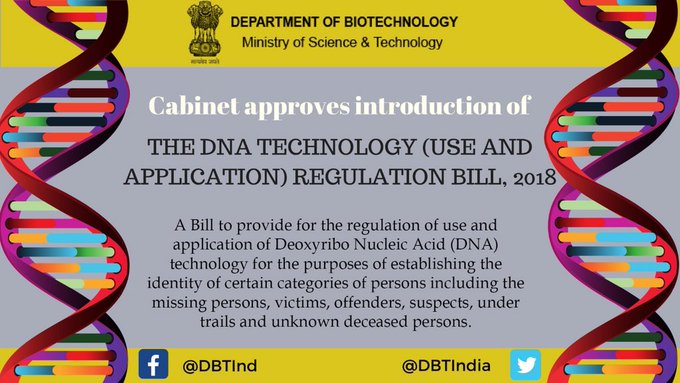
The Union Cabinet has cleared the contentious DNA Technology (Use and Application) regulation bill 2018 that seeks to create DNA data banks across India to store profiles for forensic-criminal investigations.

The proposed Bill also provides for a jail term of up to three years to those who leak the information stored in such facilities.

“The primary intended purpose for enactment of “The DNA Technology (Use and Application) Regulation Bill” is for expanding the application of DNA-based forensic technologies to support and strengthen the justice delivery system of the country,” said the government statement on the Cabinet decision.

This is the latest version of a Bill that originated as a DNA “profiling” Bill, framed by the Department of Biotechnology, reported The Hindu. The aim of that draft legislation was to set up an institutional mechanism to collect and deploy DNA technologies to identify persons based on samples collected from crime scenes or for identifying missing persons.

However there was opposition, in that some activists argued that the manner in which DNA information was to be collected and the way they were to be stored by forensic laboratories constituted a violation of privacy.

A senior official familiar with the Bill said that several clauses of the Bill were tightened to make it stronger and immune to data abuse.


“This doesn’t aim to create a database of DNA profiles…The databanks can only store information related to criminal investigations and the DNA details of suspects will be deleted,” said Renu Swarup, Secretary, Department of Biotechnology, according to The Hindu.

The Bill creates a DNA Profiling Board that would be the final authority that would authorise the creation of State-level DNA databanks, approve the methods of collection and analysis of DNA-technologies.

The bill’s provision would enable cross-matching between persons who have been reported missing and unidentified dead bodies found in various parts of the country on the other.

It would also help to establish the identity of victims in mass disasters, says a press note issued by the Cabinet.

The most important application of the legislation would be in the criminal justice system as it would allow the government to maintain a DNA database for the criminals convicted of heinous crimes.

Over a period of time, the database is expected to lead to better justice delivery and improve conviction rate, which currently stands at 30%. In addition, the bill provides for mandatory accreditation and regulation of DNA laboratories, preventing non-accredited laboratories to test DNA samples.


The statement issued by the government said forensic DNA profiling is of proven value in solving cases involving offences that are categorized as affecting the human body (such as murder, rape, human trafficking, or grievous hurt), and those against property (including theft, burglary, and dacoity).

The aggregate incidence of such crimes in the country, as per the statistics of the National Crime Records Bureau (NCRB) for 2016, is in excess of 3 lakhs per year. Of these, only a very small proportion is being subjected to DNA testing at present, said the statement.

It is expected that the expanded use of this technology in these categories of cases would result not only in speedier justice delivery but also in increased conviction rates, which at present is only around 30%, as per the NCRB Statistics for 2016.

The Bill will be introduced in Parliament during the Monsoon Session beginning July 18, said media reports quoting government sources.

The bill, based on the one prepared by the Law Commission recently, says that national and regional DNA data banks will be set up for maintaining a national database for identification of victims, suspects in cases, undertrials, missing persons and unidentified human remains.

Those leaking the DNA profile information to people or entities who are not entitled to have it, will be punished with a jail term of up to three years and a fine of up to Rs. 1 lakh. Similar punishment has also been provided for those who seek the information on DNA profiles illegally.


Minister for Science Dr Harsh Vardhan, tweeting about the Cabinet decision, said: “Cabinet approved a bill for use & regulation of #DNATechnology. It seeks appln of DNA based #ForensicTechnologies to support & strengthen justice delivery system, devmt of uniform code of practices in all labs & scientific upgradation & streamlining of #DNA_Testing. @DBTIndia”

View image on Twitter


Dr. Harsh Vardhan
✔@drharshvardhan


Cabinet approved a bill for use & regulation of #DNATechnology. It seeks appln of DNA based #ForensicTechnologies to support & strengthen justice delivery system, devmt of uniform code of practices in all labs & scientific upgradation & streamlining of #DNA_Testing. @DBTIndia
8:52 PM - Jul 4, 2018
130
87 people are talking about this
Twitter Ads info and privacy


The Congress criticized it as an assault on fundamental right to privacy. Congress spokesperson Manish Tewari tweeted: “DNA Technology(Use and Application) Regulation bill 2018 cleared by Union Cabinet yesterday is a direct assault on fundamental right to privacy. Seeks to legitimise DNA profiling in name of criminal investigations. It is bio-technology version of NATGRID. Needs to be opposed”


Manish Tewari
✔@ManishTewari


DNA Technology(Use and Application) Regulation bill 2018 cleared by Union Cabinet yesterday is a direct assault on fundamental right to privacy. Seeks to legitimise DNA profiling in name of criminal investigations. It is bio-technology version of NATGRID. Needs to be opposed

Tuesday, September 12, 2017

12022 - The discovery of DNA fingerprinting - The Hindu


SEPTEMBER 11, 2017 11:13 IST


On September 10, 1984, Alec Jeffreys, while studying how inherited illnesses pass through families, made an accidental discovery. And that has advanced our understanding of genetics. A.S.Ganesh revisits Jeffreys’ Eureka moment...

Are you aware that DNA, like fingerprints, can be used to uniquely identify individuals? If your answer is no, then it’s worth knowing that this technology was discovered only in 1984. If you answered yes, then it might interest you to find out more about DNA or genetic fingerprinting.

Working in a genetics lab at Leicester University, Alec Jeffreys was studying how inherited illnesses pass through families. As part of this work, Jeffreys had to look for patterns in the repeated DNA segments carried by all humans.

In the summer of 1984, Jeffreys set up an experiment to help his research. As part of this experiment, cells were broken open, their DNA extracted and this DNA was attached to photographic films. Radioactive probes were added to identify the repeated sections of DNA and the entire set-up was placed in a photographic developing tank.

Blessing in disguise
Left over the weekend of September 8-9, 1984, Jeffreys hoped to find something that would be useful for his research on that Monday morning. But instead, his first reaction on September 10 as he removed an X-ray film from the developing tank was that it was a complete mess.

Moments later, Jeffreys had a flash of brilliance. He realised that the results at hand were completely futile with respect to their current research, but he did not fail to recognise their value. The sequence of bars in each film represented different number of DNA repeats among the individuals and animals involved in the experiment.

Jeffreys realised that he was onto something and that the different bar codes, when mapped the other way, could uniquely identify individuals. Like fingerprints, DNA could be used to precisely zero down on individuals, except in the case of identical twins or likewise. Furthermore, it was also evident that half of an individual’s DNA came from their mother, and the other half from their father.

Jeffreys got his staff together and they brainstormed to find potential uses of this serendipitous discovery. By the end of the day, they had a growing list which included establishing biological kinship in paternity cases and aiding detective work to figure out criminals.

Put to use
While the initial years saw a flood of immigration cases settled by determining lineage, it was soon used in forensics as well. With the lab kept extremely busy owing to a deluge of requests from around the world, the technique was commercialised and came into effect in labs everywhere in 1987.

There is a growing concern that this technology intrudes on an individual’s right to privacy like never before, but there are plenty of other positives stemming out of the work as well. Biologists use it to study genetics not only in humans, but also in other species. 

Anthropologists use DNA fingerprinting to study evolution in humans and their current global variation through millions of years. 

A discovery that took Jeffreys just an instant is helping us trace back through our own history.

Friday, August 25, 2017

11847 - Right to Privacy Ruled Fundamental Right: How Supreme Court Verdict Will Affect Other Cases - NEWS18


Whether it is the Aadhaar validity case or the Naz foundation verdict on Section 377, Thursday’s ruling will not only define the contours of privacy in India but will also make its effect felt on other important cases.
Updated:August 24, 2017, 11:12 AM IST

New Delhi: Right to privacy is a fundamental right guaranteed under Article 21 of the Indian Constitution, a nine-judge Constitution bench of the Supreme Court said on Thursday in a historic ruling. This judgment will now have an impact on the Aadhaar validity case and on Section 377 which criminalises homosexuality.

The Right to Privacy verdict now means intimate details regarding marriage, sexuality and relation with family are protected. Private details such as parting of personal data by use of credit card, social network platforms, I-T declarations are protected. All public details, where privacy protection requires minimal regulation, are also protected.

Aadhaar – The Supreme Court had made a deliberate attempt to divorce the issue of fundamental right to privacy from the constitutional challenge to Aadhaar, but the ruling on whether Right to Privacy is a fundamental right under Article 21 or not will still have a direct bearing on the Aadhaar case. 

Firstly, the contention of the petitioners that when a citizen gives his biometrics and personal details to the government and when in turn it is used by commercial organizations, it is a breach of privacy. 

The landmark verdict has bolstered the proposition of the petitioners. Petitioners had also apprised the court during the hearings about the leak of Aadhaar numbers and how fingerprints can be easily reproduced which may enable theft, etc. However, since this case has no relation to the Aadhaar case, an independent verdict on Right to Privacy will weigh in heavily to determine whether at all Aadhaar stands the test of constitutional scrutiny or not. 

The Constitution bench on Thursday did not say anything categorical on biometrics for Aadhaar.

Naz Foundation verdict – The top court in this case had held that Section 377 of the Indian Penal Code discriminated against a particular section of individuals in the society on the basis of sexual orientation and condemned Section 377. However, it did not strike down the provision and stated that it was not the role of judiciary to do so and was the job of the Parliament. 

In this case, the apex court laid down three categories under which the term ‘privacy’ must fall for an individual to avail the said right. The court stated that the personal liberty of a person must satisfy a triple test which is:

(i) It must prescribe a procedure;

(ii) The procedure must withstand a test of one or more of the fundamental rights conferred under Article 19 which may be applicable in a given situation; and

(iii) It must also be liable to be tested with reference to Article 14. 

Now that Right to Privacy is upheld, the verdict on LGBT rights will be susceptible to being challenged.

DNA Profiling Bill – The first DNA Profiling Bill was prepared in 2007 and has since then undergone a lot of changes. The latest is the “Use and Regulation of DNA Based Technology Bill, 2017.”

The biggest concern regarding this bill is that it has left the task of defining of privacy and security safeguards to regulation which includes implementation and sufficiency of protection, appropriate use and dissemination of DNA information, accuracy, security and confidentiality of DNA information, timely removal and deletion of obsolete or inaccurate DNA information, and other steps as necessary.


DNA is not foolproof and false matches can take place for multiple reasons. Here, the privacy concerns arise and now that the Supreme Court has upheld Right to Privacy, chances of the bill being shelved is high unless all privacy and safety regulations are taken into account. Especially, when something concerns a bodily right such as the DNA of an individual, he would reserve the ultimate to invoke the breach of right to privacy as a fundamental right.

Sunday, August 6, 2017

11718 - FB Live: Apar Gupta on Dangers of Proposed DNA Profiling Law - The Quint

FB Live: Apar Gupta on Dangers of Proposed DNA Profiling Law


While the Supreme Court decides whether Indian citizens have a right to privacy or not, the Government is pressing ahead with controversial plans to introduce a DNA Profiling Bill, to regulate DNA technology and set up a DNA Profiling Authority.
Previous versions of this law have been criticised on privacy grounds, but the Law Commission on 26 July 2017 published their own take on the Bill, ostensibly with provisions to protect people’s privacy. The new draft law includes provisions to establish DNA data banks, from DNA samples recovered from crime scenes, people who have committed serious crimes, and unidentified bodies.
We asked Apar Gupta, a Delhi-based advocate with significant experience in technology laws, to help us understand this new legislation. Watch the video to learn why the Law Commission’s recommendations are not sufficient to deal with security and privacy concerns relating to DNA profiling, and how this ties into the broader debate on the right to privacy.

Friday, July 31, 2015

8401 - Dangerous profiling - Business Standard

DNA profiling Bill needs major changes to protect privacy


Business Standard Editorial Comment  |  New Delhi  July 29, 2015 Last Updated at 21:40 IST

The draft of the Human DNA Profiling Bill is scheduled to be presented in Parliament during the ongoing monsoon session. While a law to regulate the collection, storage and use of the human genetic code is long overdue, this draft has faced strong criticism from civil liberties experts. The act of profiling DNA (or deoxyribonucleic acid) is intrusive in nature. In the absence of a specific privacy law, this draft has substantial scope to violate the privacy of individuals. The draft could also open a political can of worms in that DNA may be used to try and determine caste and religious markers. Ideally, a privacy law that adheres to the recommendations of the A P Shah Commission on Privacy should have been passed before presenting the DNA Bill - and indeed, before rolling out the Aadhaar system, which collects biometric data. However, the government is obviously reluctant to move on the privacy front. Indeed, the Attorney General recently argued that there was no fundamental right to privacy in a recent submission to the Supreme Court. Whatever may be its legal merit or demerit, this is a dangerous and illiberal position to take, and the government should reconsider.

DNA profiling is useful in many criminal cases, to identify bodies in the aftermath of accidents and disasters, and in civil paternity and maternity suits. DNA analysis can also help pinpoint susceptibility to conditions like asthma and diabetes. Medical institutions collect DNA. Inexpensive do-it-yourself kits are also available for DNA collection. In many countries, law enforcement agencies maintain a digital database of the DNA of convicted criminals, and of DNA collected from the scene of unsolved crimes. But any DNA data can also be obfuscated, tampered with, or they can suffer from contamination, or from simple filing error. DNA can be tied to sensitive information such as caste and religion, since criminals and accused in the Indian penal system are automatically classified by caste and religion. For example, the CDFD (Centre for DNA Fingerprinting & Diagnostics) states that it will create DNA marker databases of different caste populations. The framework and utility of this are not in the least clear. Conversely, the possibility of abuse is obvious. DNA can be combined with biometric information and financial attributes like the permanent account number or PAN, medical insurance data, etc, to create a repository of private information about a large number of individuals. These dangers must be guarded against.

The collection, digital storage and use of DNA must be regulated, with best practices mandated and penalties imposed for illegal collection and use. It must also be clearly defined when informed consent is required, and where DNA may be collected without consent. Individuals should be allowed access to their own DNA data. There is also a need to establish norms for deletion, and for control of access to such databases. Most of this is ignored in the draft, which just suggests the establishment of a board to set norms. There must also be clear external oversight of such a DNA Board to ensure that sweeping regulatory powers don't lead to over-reach. Again, this is ignored in the draft. Given the omission of safeguards and the lack of clearly defined regulatory checks and balances, the privacy of both individuals and communities could be at risk if the draft is passed in its current format. If the government is unwilling to first draft and pass an overarching privacy law, these gaps in the proposed DNA Bill must be addressed in detail.