In 2009, I became extremely concerned with the concept of Unique Identity for various reasons. Connected with many like minded highly educated people who were all concerned.
On 18th May 2010, I started this Blog to capture anything and everything I came across on the topic. This blog with its million hits is a testament to my concerns about loss of privacy and fear of the ID being misused and possible Criminal activities it could lead to.
In 2017 the Supreme Court of India gave its verdict after one of the longest hearings on any issue. I did my bit and appealed to the Supreme Court Judges too through an On Line Petition.
In 2019 the Aadhaar Legislation has been revised and passed by the two houses of the Parliament of India making it Legal. I am no Legal Eagle so my Opinion carries no weight except with people opposed to the very concept.
In 2019, this Blog now just captures on a Daily Basis list of Articles Published on anything to do with Aadhaar as obtained from Daily Google Searches and nothing more. Cannot burn the midnight candle any longer.
"In Matters of Conscience, the Law of Majority has no place"- Mahatma Gandhi
Ram Krishnaswamy
Sydney, Australia.

Aadhaar

The UIDAI has taken two successive governments in India and the entire world for a ride. It identifies nothing. It is not unique. The entire UID data has never been verified and audited. The UID cannot be used for governance, financial databases or anything. It’s use is the biggest threat to national security since independence. – Anupam Saraph 2018

When I opposed Aadhaar in 2010 , I was called a BJP stooge. In 2016 I am still opposing Aadhaar for the same reasons and I am told I am a Congress die hard. No one wants to see why I oppose Aadhaar as it is too difficult. Plus Aadhaar is FREE so why not get one ? Ram Krishnaswamy

First they ignore you, then they laugh at you, then they fight you, then you win.-Mahatma Gandhi

In matters of conscience, the law of the majority has no place.Mahatma Gandhi

“The invasion of privacy is of no consequence because privacy is not a fundamental right and has no meaning under Article 21. The right to privacy is not a guaranteed under the constitution, because privacy is not a fundamental right.” Article 21 of the Indian constitution refers to the right to life and liberty -Attorney General Mukul Rohatgi

“There is merit in the complaints. You are unwittingly allowing snooping, harassment and commercial exploitation. The information about an individual obtained by the UIDAI while issuing an Aadhaar card shall not be used for any other purpose, save as above, except as may be directed by a court for the purpose of criminal investigation.”-A three judge bench headed by Justice J Chelameswar said in an interim order.

Legal scholar Usha Ramanathan describes UID as an inverse of sunshine laws like the Right to Information. While the RTI makes the state transparent to the citizen, the UID does the inverse: it makes the citizen transparent to the state, she says.

Good idea gone bad
I have written earlier that UID/Aadhaar was a poorly designed, unreliable and expensive solution to the really good idea of providing national identification for over a billion Indians. My petition contends that UID in its current form violates the right to privacy of a citizen, guaranteed under Article 21 of the Constitution. This is because sensitive biometric and demographic information of citizens are with enrolment agencies, registrars and sub-registrars who have no legal liability for any misuse of this data. This petition has opened up the larger discussion on privacy rights for Indians. The current Article 21 interpretation by the Supreme Court was done decades ago, before the advent of internet and today’s technology and all the new privacy challenges that have arisen as a consequence.

Rajeev Chandrasekhar, MP Rajya Sabha

“What is Aadhaar? There is enormous confusion. That Aadhaar will identify people who are entitled for subsidy. No. Aadhaar doesn’t determine who is eligible and who isn’t,” Jairam Ramesh

But Aadhaar has been mythologised during the previous government by its creators into some technology super force that will transform governance in a miraculous manner. I even read an article recently that compared Aadhaar to some revolution and quoted a 1930s historian, Will Durant.Rajeev Chandrasekhar, Rajya Sabha MP

“I know you will say that it is not mandatory. But, it is compulsorily mandatorily voluntary,” Jairam Ramesh, Rajya Saba April 2017.

August 24, 2017: The nine-judge Constitution Bench rules that right to privacy is “intrinsic to life and liberty”and is inherently protected under the various fundamental freedoms enshrined under Part III of the Indian Constitution

"Never doubt that a small group of thoughtful, committed citizens can change the World; indeed it's the only thing that ever has"

“Arguing that you don’t care about the right to privacy because you have nothing to hide is no different than saying you don’t care about free speech because you have nothing to say.” -Edward Snowden

In the Supreme Court, Meenakshi Arora, one of the senior counsel in the case, compared it to living under a general, perpetual, nation-wide criminal warrant.

Had never thought of it that way, but living in the Aadhaar universe is like living in a prison. All of us are treated like criminals with barely any rights or recourse and gatekeepers have absolute power on you and your life.

Announcing the launch of the # BreakAadhaarChainscampaign, culminating with events in multiple cities on 12th Jan. This is the last opportunity to make your voice heard before the Supreme Court hearings start on 17th Jan 2018. In collaboration with @no2uidand@rozi_roti.

UIDAI's security seems to be founded on four time tested pillars of security idiocy

1) Denial

2) Issue fiats and point finger

3) Shoot messenger

4) Bury head in sand.

God Save India

Showing posts with label CIA. Show all posts

Wednesday, September 6, 2017

11988 - Fingerprint security on smartphones presents the biggest hacking threat - India Legal Live

September 2, 2017

Ex-Union home secretary Rajiv Mehrishi told a parliamentary standing committee that data of 40 percent of all smartphone users are accessible by the CIA

Advanced security features themselves can often become your biggest source of insecurity. Take fingerprint locking systems, for example, especially on your smartphone, that collects and stores one’s critical biometric data that ensures no one else can access your phone. There is also iris recognition software available for locking and unlocking laptops and other such devices, even door locks.

Many of these devices are often hotwired to the internet—the Internet of Things (IoT) assures all-round seamless security prospects, a huge thing today around the world. These are also the biggest threats to privacy. According to a report in The Indian Express, this is potentially more damning and a bigger threat than all the biometric data collected for Aadhaar cards by the Unique Identification Authority of India (UIDAI).

This has been revealed by no less than India’s former union home secretary Rajiv Mehrishi, who has now been appointed as the Comptroller and Auditor General of India (CAG). According to him, says the report, this data has already been stolen from 40 percent of people using smartphones and those who have the fingerprint identification soft inbuilt or have added such a software later.

Who has this stolen data? According to Mehrishi, the Central Intelligence Agency (CIA) of the US has it. This was not an off-the-cuff comment, but a comment made on July 21 before the Parliamentary standing committee on home affairs. That adds gravity to the comment.

The seriousness of the situation has come to light in the backdrop of a Wikileaks release in March which said that the CIA has been hacking into smart devices. The software targeted by the hacking tools included Apple’s iOS and Google’s Android.

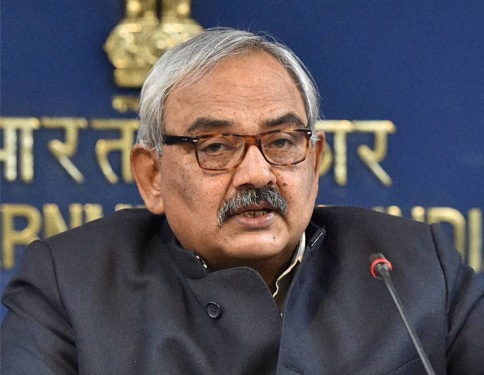
Former union home secretary Rajiv Mehrishi

India’s smartphone makers, including global brands such as Apple and Samsung and Chinese manufacturers, such as Oppo, Vivo, Xiaomi, Lenovo and Gionee, as well as India’s Micromax have been asked to provide security details. These include security practices, architecture, frameworks, guidelines and standards.

This will form part of the overall cyber security standards that the government is trying to set up.

The problem of using many apps is that they ask for a plethora of personal data before firing up and before being activated. If one wants to avail of the facilities provided by the free app, the trade-off is providing personal data. The report refers to a recent study by IMDEA Networks Institute of Spain which says that over 70 per cent of smartphone apps are reporting personal data to third-party companies like Google and Facebook.

Google, Facebook, Whatsapp and some others have come in for court scrutiny in India regarding privacy issues where companies have been sharing data gathered through third-party intervention. Whatsapp, for example, is one app that is humongously popular in India. When it was bought over by Facebook for an incredible $22 billion, it took along with it all the data and instantly stared sharing them with Facebook, without acquiring the consent of the user. This has been an issue that the court wants to settle.

Meanwhile, while the court battles the problem of unwarranted data sharing between two companies, all that data has been living in your smartphones and unwittingly, these have been open to hacking. Mehrishi’s comment also means that any data within a smartphone can be accessed by smart hackers, be he/she with the CIA, or the National Security Agency (NSA) of the US or even India’s own National Investigation Agency (NIA), which has been crying for more data collection facilities like the NSA.

Technically, a person’s entire life and particulars can, in was more than one, be accessed through his/her smartphone and through the several apps used and several websites that the person has accessed.

What the agencies would do with such data is not clear, but individual hackers might be able to access your bank account, for example, if you have been using your bank’s app for transactions. Today, it is possible to open fixed deposits, transfer funds and make all sorts of realignments from within your phone, using the app. These are at risk.

The security atmosphere of the world has just gotten murkier.

India Legal Bureau

Monday, March 30, 2015

7689 - THE CIA HAS A PROBLEM WITH - Next Gov


Julia Tim/Shutterstock.com
December 22, 2014 

Some tactics CIA operatives use to avoid blowing their cover at airports could be foiled by one of the spy agency’s best surveillance tools: biometric identification.

The growing use of digital fingerprint matching at European airports troubles Langley, according to January 2012 CIA guidelines for using fake IDs that Wikileaks released Sunday.

The agency’s discontent could present an awkward situation for the Department of Homeland Security. DHS is assisting with the rollout of biometric screening at borders worldwide, including in Europe.

The region of concern, called the Schengen area, covers most of the European Union, along with Iceland, Norway, Switzerland and Liechtenstein.

Right now, according to “CIA Advice for US Government Operatives Infiltrating Schengen," the region's travel system presents minor obstacles, because unofficial persons are not required to carry visas.
But that is expected to change.

In 2015, a new entry-exit system that mandates fingerprint identification is scheduled to go live, the guidelines note: "The European Commission is considering requiring travelers who do not require visas to provide biometric data at their first place of entry into the Schengen area, which would increase the identity threat level for all U.S. travelers” – spies included.

In October, border control stations at Zurich Airport were outfitted with fingerprint readers to screen visitors. The project "rigorously implements the current requirements of the Schengen Borders Code and is equipped to meet future standards," Heinz Lusti, a project leader with the airport division of the Zurich Cantonal Police, said in a statement.

Russia recently announced a similar fingerprint directive for foreigners, in response to Europe’s policy.

Some U.S. national security experts say the CIA just has to deal.  

“It contradicts what at least should be U.S. policy in supporting more secure borders around the world by saying -- for our very, very narrow purposes and to the exclusion of the rest of the world, we don’t want biometrics in the Schengen area,” said Janice Kephart, border counsel to the 9/11 Commission. “It’s extremely narrow-minded.”

Those checkpoint upgrades will provide biometric data on tourists that is valuable to both the CIA and Schengen partners, she said.

Operatives already have learned techniques to circumvent biometric ID rules in other countries, Kephart added, declining to go into specifics for national security reasons.

“So they really don’t have anything to complain about,” she said. “It will affect their operations in the Schengen area, but they’ve already been dealing with this in other countries so they can basically just adjust.”

The CIA's discomfort with biometric-based screening abroad is unlikely to interfere with DHS’ plans to expand the technology, said Kephart, now CEO of the Secure Identity & Biometrics Association.

“Biometrics has changed their operational intelligence dramatically in the field for the better, being able to learn -- often in close to real-time -- who it is they are really dealing with. The CIA knows this better than anyone," she said.
Foreign spies entering the United States are subject to the same fingerprint test. By law, almost all international visitors to the U.S. are required to submit their prints for entry.

CIA officials declined to comment on the Wikileaks disclosures or the expanded use of biometric identification abroad. 
DHS officials were not able to comment immediately. 

Saturday, May 14, 2011

1297 - The trouble with big brother’s eye - Source - Tehelka

From Tehelka Magazine, Vol 8, Issue 20, Dated 21 May 2011

CURRENT AFFAIRS        
UID PROJECT

The company that will provide biometric solutions for the UID project employs former US intelligence officials. What does this mean for our security, asks Baba Umar

LAST YEAR, Tembhali, a hamlet of around 1,500 villagers in Maharashtra’s Nandurbar district, suddenly received a facelift — paved roads, painted walls and uninterrupted power supply. Not much was known about the village until 29 September when Prime Minister Manmohan Singh and Congress supremo Sonia Gandhi landed here to launch the world’s largest unique identity programme.

The idea was to create unique biometric identification cards for more than 1.2 billion Indians that will contain basic information such as name, a photograph, gender and date of birth plus a microchip to link the card to a biometric database that will have the cardholder’s fingerprints, iris scan, digital face image and address.

The project, which has already cost around Rs 3,170 crore, is slated to help the poor get access to welfare schemes and rid the PDS of grain diversion and the Mahatma Gandhi National Rural Employment Guarantee Act (MGNREGA) of pilferage.
Eye spy? 
A Delhi resident has his iris scanned
Photo: Shailendra Pandey

“The UID can be leveraged at various points in welfare schemes to improve the delivery systems by making them transparent and cost-effective,” says Unique Identification Authority of India (UIDAI) Director-General Ram Sewak Sharma.

However, for those working on issues of food security, migration, MGNREGA, civil liberties and human rights, the UID is an invasion of privacy, through which personal information will be stored in a database that could be used for profiling, tracking and surveillance.

And the involvement of companies such as American defence contractor L-1 Identity Solutions — which has names associated with the CIA and other US defence organisations in its top management — together with US-based Ernst & Young and Accenture raises queries about how much access they will have over Indian data.

“Can the government or the UIDAI assure the people that their details will not be shared with business enterprises, companies and political outfits?” asks Gopal Krishna of the Citizens Forum for Civil Liberties. Krishna, who has been aggressively campaigning against the UID, says the Nazi Party had hired IBM to profile people “leading to the Holocaust”. He says IBM was and remains in census business and is currently part of World Bank’s e-Transform Initiative of the developing world of which the UID scheme is a component.

Related
Why Nandan wants to tag You
UID is an Identity Crisis in the Making by Usha Ramanathan-Tehelka
Falling Between The Barcodes-Tehelka

The three foreign companies will be implementing biometric solutions for UIDAI that includes designing, supplying, installing, commissioning, maintaining and supporting the multi-modal automatic biometric identification subsystem.

AMONG THE names associated with L-1 Identity Solutions are former CIA director George Tenet and former Homeland Security deputy secretary Adm James Loy, also on the board of Lockheed Martin. The company’s links with the US military establishment is underscored by the fact that its board of directors include former Army Technology Science Board member BG Beck, former chairperson for the Secretary of the Army’s National Science Centre Advisory Board Milton Cooper.

It’s feared that the database can be used as a bulwark against India because all US based firms are subject to the Patriot Act that obligates American companies to share their data with Washington.

L-1 also mentions on its website its experience with Pakistan’s unique identity agency NADRA (National Database & Registration Authority), which, Krishna says ‘appears to be created on the same business model that is packed by people with intelligence and military links’.

“The UIDAI feared to have linked CIDR with the National Intelligence Grid — created to connect 21 existing databases with Central and state government agencies — and National Population Register and L-1 and Accenture who work in close affinity with US intelligence agencies,” he adds.

 Most Christian and Muslim Dalits are probably worse 
off than so-called Hindu Dalits

Defence experts opposed to the UID, claim that the PMO, defence sites, and more than a thousand government sites were attacked 4,000 times by China in 2010 alone “and things seem no different in this case”.

“The UIDAI has been foolish in its approach towards setting up the UID database,” says Mathew Thomas, former army officer and a vehement critic. “In this programme, fingerprint technology is provided by a US-based company whose directors are former CIA and FBI officers. The database is set up by Accenture. The database is to be linked to other databases like banks, phone companies, etc. Once a person hacks into the UID database, s/he can gain access to any other database. We are handing over data to anyone who would like to take it.”

“Did you hear about the incident in which 77 million Sony Playstation accounts were hacked? That’s why a London School of Economics report warned that such a central database would be a potential target for terrorists. If the purpose is to reduce corruption in welfare schemes, then why create a database of all people? This is where the government and the UIDAI are telling lies. It’s because if they talk about the real purposes of the UID, people would start resisting. It is meant to track and target people,” adds Thomas.

However, contrary to Thomas, others like Brig (retd) Rumel Dahiya of the Institute for Defence Studies and Analysis don’t find anything wrong with the involvement of foreign firms. “I am not discounting that certain amount of pilferage will take place,” he says. “However, the UIDAI has to make sure that the data being processed isn’t linked to servers abroad and it remains within an Indian system. Information of sensitive nature is protected, vetting of all machines from microchips is done, and physical check is ensured when people are working on a database.”

HOWEVER, UIDAI’S Sharma fends off all this criticism by saying that the “data collected for Aadhaar enrolment will be held by the UIDAI and will not be accessible by outside agencies. Any violation will invoke penalties and legal action. Profiling and tracking info and transaction data will not be collected. The UIDAI will not reveal personal information from the database.”

One of the strongest resistances to the UID comes from legal experts who have been questioning UIDAI’s constitutional validity. According to them, many issues including profiling, privacy safeguards, civil liberties protection, and e-surveillance have been totally neglected from the Bill.

“The UIDAI should have been preceded by a constitutionally-sound legal framework and parliamentary oversight. Both of these are missing, making it an unconstitutional project,” says Supreme Court lawyer Praveen Dalal. “Constitutionally, preparation of a legislation/Bill is the duty of the Indian government and it must be passed by Parliament. But in this case, an authority like UIDAI is suggesting the Bill which is itself devoid of any constitutional validity,” says Dalal, adding the enrolment procedures and the exercise of taking biometric details too is “unconstitutional”.

Noted Supreme Court lawyer Rajeev Dhawan believes that internally displaced and refugees “are likely to be harassed”. “If the UID carries with it any other info that is kept in the government databases, it would be an invitation to big brother governance,” he explains. In an earlier interview to TEHELKA (Why Nandan Wants To Tag You 6 November 2010), UID Chairman Nandan Nilekani had himself argued that India needs a well-debated and pervasive privacy law, not restricted to UID.

Still in control UIDAI Director-General Ram Sewak Sharma 
has rubbished fears of data loss
Photo: Shailendra Pandey

Many critics argue that the UID is mainly a security project. And as far as socio-economic benefits of the UID are concerned, the UIDAI itself has stated that it is only in the identity business and the responsibility of tracking beneficiaries and the governance of service delivery will remain with the respective agencies.

“The UID cannot address the bulk of the delivery problems in two of the biggest social sector programmes like MGNREGA and PDS,” says writer and activist Ruchika Gupta. Coupled with technological challenges, the fact that only about half the villages in the country have the mobile connectivity required for UID to work, that biometric readers are error prone, susceptible to damage — linking UID with social sector legislation is completely baseless.

“Without assessing the relationship between an individual and the State, the programme was advertised with the name that corruption is the fundamental problem, but they are handing over all the details to those very people who we are accusing of corruption,” says independent law researcher Usha Ramanathan.

Then there is a strong criticism of the credibility of the UIDAI’s claims in the field of social policy too. “Scrutinising the UIDAI’s documents reveals their poor understanding of how PDS and MGNREGA leakages occur and little evidence of creative thinking on plugging them,” says Reetika Khera, a development economist and assistant professor at IIT, Delhi. She has been critical of the UIDAI’s assertions that the scheme is voluntary. “The UIDAI is eager to enrol people. Till enrolment remains voluntary, people are likely to come in a trickle. To encourage them, government departments will make it a pre-requisite, by linking issue of new job cards to UID enrolment.”

Data collected for Aadhaar enrolment won’t be 
accessible to outside agencies,’ says UIDAI’s 
Sharma

Khera has a point. Because recently the district administrations in Mysore and Bengaluru initiated steps making UID numbers compulsory at various levels in state government offices. The move leaves no chance to stay away from the scheme.

Similarly, India’s national payment gateway, National Payments Corporation of India (NPCI) aims to link Rupay, its soon to- be-launched domestic payment gateway on the pattern of Visa and MasterCard, with the UID programme. The move will allow customers to use their UID numbers as their banking passwords. All this makes UID a compulsory card that will link with it a person’s other information too which is contrary to UIDAI’s policy.

Even as Rajana Sonawane of Tembhali, the first Indian to receive the UID card wonders what benefits the card will offer him, the arguments continue elsewhere about the efficacy of this unique project.

Baba Umar is a Correspondent with Tehelka.
babaumar@tehelka.com