In 2009, I became extremely concerned with the concept of Unique Identity for various reasons. Connected with many like minded highly educated people who were all concerned.
On 18th May 2010, I started this Blog to capture anything and everything I came across on the topic. This blog with its million hits is a testament to my concerns about loss of privacy and fear of the ID being misused and possible Criminal activities it could lead to.
In 2017 the Supreme Court of India gave its verdict after one of the longest hearings on any issue. I did my bit and appealed to the Supreme Court Judges too through an On Line Petition.
In 2019 the Aadhaar Legislation has been revised and passed by the two houses of the Parliament of India making it Legal. I am no Legal Eagle so my Opinion carries no weight except with people opposed to the very concept.
In 2019, this Blog now just captures on a Daily Basis list of Articles Published on anything to do with Aadhaar as obtained from Daily Google Searches and nothing more. Cannot burn the midnight candle any longer.
"In Matters of Conscience, the Law of Majority has no place"- Mahatma Gandhi
Ram Krishnaswamy
Sydney, Australia.

Aadhaar

The UIDAI has taken two successive governments in India and the entire world for a ride. It identifies nothing. It is not unique. The entire UID data has never been verified and audited. The UID cannot be used for governance, financial databases or anything. It’s use is the biggest threat to national security since independence. – Anupam Saraph 2018

When I opposed Aadhaar in 2010 , I was called a BJP stooge. In 2016 I am still opposing Aadhaar for the same reasons and I am told I am a Congress die hard. No one wants to see why I oppose Aadhaar as it is too difficult. Plus Aadhaar is FREE so why not get one ? Ram Krishnaswamy

First they ignore you, then they laugh at you, then they fight you, then you win.-Mahatma Gandhi

In matters of conscience, the law of the majority has no place.Mahatma Gandhi

“The invasion of privacy is of no consequence because privacy is not a fundamental right and has no meaning under Article 21. The right to privacy is not a guaranteed under the constitution, because privacy is not a fundamental right.” Article 21 of the Indian constitution refers to the right to life and liberty -Attorney General Mukul Rohatgi

“There is merit in the complaints. You are unwittingly allowing snooping, harassment and commercial exploitation. The information about an individual obtained by the UIDAI while issuing an Aadhaar card shall not be used for any other purpose, save as above, except as may be directed by a court for the purpose of criminal investigation.”-A three judge bench headed by Justice J Chelameswar said in an interim order.

Legal scholar Usha Ramanathan describes UID as an inverse of sunshine laws like the Right to Information. While the RTI makes the state transparent to the citizen, the UID does the inverse: it makes the citizen transparent to the state, she says.

Good idea gone bad
I have written earlier that UID/Aadhaar was a poorly designed, unreliable and expensive solution to the really good idea of providing national identification for over a billion Indians. My petition contends that UID in its current form violates the right to privacy of a citizen, guaranteed under Article 21 of the Constitution. This is because sensitive biometric and demographic information of citizens are with enrolment agencies, registrars and sub-registrars who have no legal liability for any misuse of this data. This petition has opened up the larger discussion on privacy rights for Indians. The current Article 21 interpretation by the Supreme Court was done decades ago, before the advent of internet and today’s technology and all the new privacy challenges that have arisen as a consequence.

Rajeev Chandrasekhar, MP Rajya Sabha

“What is Aadhaar? There is enormous confusion. That Aadhaar will identify people who are entitled for subsidy. No. Aadhaar doesn’t determine who is eligible and who isn’t,” Jairam Ramesh

But Aadhaar has been mythologised during the previous government by its creators into some technology super force that will transform governance in a miraculous manner. I even read an article recently that compared Aadhaar to some revolution and quoted a 1930s historian, Will Durant.Rajeev Chandrasekhar, Rajya Sabha MP

“I know you will say that it is not mandatory. But, it is compulsorily mandatorily voluntary,” Jairam Ramesh, Rajya Saba April 2017.

August 24, 2017: The nine-judge Constitution Bench rules that right to privacy is “intrinsic to life and liberty”and is inherently protected under the various fundamental freedoms enshrined under Part III of the Indian Constitution

"Never doubt that a small group of thoughtful, committed citizens can change the World; indeed it's the only thing that ever has"

“Arguing that you don’t care about the right to privacy because you have nothing to hide is no different than saying you don’t care about free speech because you have nothing to say.” -Edward Snowden

In the Supreme Court, Meenakshi Arora, one of the senior counsel in the case, compared it to living under a general, perpetual, nation-wide criminal warrant.

Had never thought of it that way, but living in the Aadhaar universe is like living in a prison. All of us are treated like criminals with barely any rights or recourse and gatekeepers have absolute power on you and your life.

Announcing the launch of the # BreakAadhaarChainscampaign, culminating with events in multiple cities on 12th Jan. This is the last opportunity to make your voice heard before the Supreme Court hearings start on 17th Jan 2018. In collaboration with @no2uidand@rozi_roti.

UIDAI's security seems to be founded on four time tested pillars of security idiocy

1) Denial

2) Issue fiats and point finger

3) Shoot messenger

4) Bury head in sand.

God Save India

Showing posts with label Cash Transfers. Show all posts

Friday, May 13, 2016

9962 - Govt saves over Rs 27,000 crore through DBT and Aadhaar - Hindu Businessline


OUR BUREAU

A Banking Correspondent makes pension and MNREGA payments to beneficiaries in Dohakatu village in Ramgarh district adjoining Ranchi. Photo-Manob Chowdhury

DELHI, MAY 10:  
The Government is estimated to have saved over ₹27,000 crore by cash transfers for payments to beneficiaries under various welfare schemes in the last two years.
The issue was discussed at a review meeting by Prime Minister Narendra Modi on the progress of Aadhaar and Direct Benefit Transfer (DBT) programmes.
“It has also resulted in weeding out of duplicate beneficiaries,” said an official release on Tuesday.
Over 1.6 crore bogus ration cards have been deleted, resulting in savings of about ₹10,000 crore. Similarly, 3.5 crore duplicate beneficiaries were weeded out in the PAHAL scheme, resulting in savings of over ₹14,000 crore in 2014-15 alone.
In Mahatma Gandhi National Rural Employment Guarantee Scheme (MGNREGS) too, a saving of ₹3,000 crore (roughly 10 per cent) has been estimated in 2015-16.
“Several States and Union Territories too have achieved significant savings through DBT,” said the release.
The Prime Minister was also informed about the progress in Aadhaar and DBT. In 2015-16, fund transfers worth ₹61,000 crore was done through DBT to over 30 crore beneficiaries. This includes over ₹25,000 crore in MGNREGS and over ₹21,000 crore in PAHAL (for cooking gas).

The Government is now also working on a unique identifier for non government organisations (NGOs). Over 71,000 NGOs are now registered with the NGO Darpan portal maintained by NITI Aayog.

The Prime Minister stressed on making the DBT and Aadhaar platform error-free to ensure that targeted beneficiaries receive their benefits in time.

He also cautioned that beneficiaries should not be inconvenienced in the implementation of DBT and Aadhaar for various schemes. Further, officials must test their systems carefully before rolling them out on a large scale.

(This article was published on May 10, 2016

Thursday, April 14, 2016

9845 - Cash transfers: Lost in transactions- Tribune India

Aarushi Kalra

The Centre for Equity Studies, Delhi, conducted a survey to gauge the impact of the switch to cash transfers on the consumption patterns of the poor in Chandigarh. The preference for kind vis-a-vis cash transfers was recorded. Importantly, public opinion found no place in the decision- making process.

Congress workers protest against the closure of fair price shops by the Chandigarh Administration in favour of cash transfers. PTI

Feroza Begum had to make a choice between food security and her children's education. Allow me to rephrase it: Feroza Begum had no choice. Her eight children, studying in classes II to IX, were forced to drop out of school when the Chandigarh Administration discontinued the sale of subsidised foodgrains. 

This family was receiving 30 kg wheat and 20 kg rice from the Public Distribution System (PDS), the market value of which, pegged at the reported prices, is Rs 1,080. A cash equivalent of these rations is promised to each beneficiary of the National Food Security Act (NFSA, 2013), including Feroza Begum. 

However, she has not received the entitlement in her bank account yet. Crisis hit this household as the income from casual labour was far from sufficient to sustain their erstwhile consumption level, made affordable by the PDS. An urgent need for additional income required the children to work for a contractor on a piece-rate basis.  Eight pairs of hands are now engaged in making paperbags (at a meagre net profit of Rs 35 per kg) in the pursuit of one goal: food security. 

In August 2015, the Department of Food and Supplies, Chandigarh, shut the doors of a network of Fair Price Shops (FPS) to give way to cash transfers. This cash-transfer model is set to transfer a sum of money, which by the government's calculation should be sufficient to buy the same quantity of cereals that the households were purchasing from the FPS. The amount, recorded at Rs 94.5 per person per month, is transferred to the Aadhaar-linked bank accounts of the head of the household, who as per the NFSA is the eldest woman in the family. At present, 42,004 households are receiving cash transfers, although 55,917 households are eligible and entitled to the subsidy.

As part of a study by Centre for Equity Studies, Delhi, a team of volunteers conducted a survey to understand the impact of this switch to cash transfers on the consumption patterns of the poor. The preference of kind vis-a-vis cash transfers was also recorded. Based on observations of the investigators, here are key insights with regard to the cash v/s kind debate; where the contention lies in the mode of transferring benefits accrued to the poor. Respondents were asked to state their preference for the medium in which they would like delivery of food subsidy. This preference was recorded on the following parameters, parenthesis indicate the proportion of respondents reporting preference for in-kind transfer: Personal preference (71 per cent), Curtailing corruption (44.5 per cent), Food security (74 per cent).

By and large, the response was in favour of in-kind transfers, despite the fact that affordability accorded by cash transfers is, loosely speaking, preserved at the recorded market price (with a loss of Rs 13 borne by each member of the household). The reasons for such a vote are:

Dissipation of Money: Households were concerned that the policy instrument in question (cash transfers) will not appropriately address the policy objective (ensuring food security) sufficiently. Respondents were convinced that the money could be frittered away not just on alcohol and other vice goods, but also on medicines, clothing or education. This, they argued robustly, would gradually affect their consumption pattern. However, the duality in this argument is worth noting. The fungibility associated with money, treated with suspicion by most, was recognised as a boon by others.  Some households receiving cash entitlement were saving this money for use in cases of emergency and using their erratic stream of income to buy grain in small quantities. 

Declining Quality: The pro-cash side of this debate argues that money would enable people to purchase better quality food grains in the open market. However, respondents complained that they were no longer able to afford better-quality grains that they received at the FPS. The market price of average quality rice was between Rs 30 and Rs 40 per kg and the transfer amount of Rs 94.5 per person per month is insufficient to sustain the average monthly consumption at these prices. A shift towards cheaper and poorer quality of rice was noticed where people were pleased with the quality of rice that the FPS provided. For migrant workers (particularly those from Bihar, chiefly consuming rice in a wheat-consuming belt), the loss of the PDS meant the loss of a good meal.

Accessibility: Although access to the grain market was easily recognised, the FPS invariably beat the market and the bank in terms of distance, travelling cost and travelling time. In-kind transfers were rated above cash transfers on the “convenience” metric. 

Money is not enough: At the current market prices, (recorded to be stable in the implementation phase of the cash transfers), respondents did not perceive the cash entitlement to suffice. Most families reported a surge in credit purchases, indicating that cash entitlement was not enough to stabilise the consumption pattern. The erstwhile APL and BPL families were additionally entitled to 10 kg grain at the rate of Rs 7 per kg from the Chandigarh Administration, over and above their NFSA entitlement stipulated by the Central government. However, the UT Administration does not factor this additional requirement in the computation of cash transfers, as the subsidy is accrued only against the NFSA entitlement. The insufficiency, viewed in this light, was stark. 

Inflation: Respondents were not convinced that the government will keep up with the rate of inflation, given the notorious trend of inflation in pulses. Past experience with social security schemes like old-age pensions, reifies this belief as these transfers are known to be sticky in the face of rising prices.

Mistrust: Respondents were either not receiving their entitlement in the bank accounts they were familiar with, or having received their entitlement, were mindful that their neighbours were not. This bred an environment of mistrust that the government could, at any point, retract assistance entirely. This was accentuated by an absence of their voice in the decision to implement the policy in the first place.

Interdependent Preference: While households with stable and relatively higher incomes found cash transfers to be more convenient, yet their final call, in some cases, was in-kind transfers. A classic response would be along the lines, “We can manage, but where will the poor go?”

The dismantling of the PDS is a direct attack on the living standards that the poor managed on the margins. Officials at the Department of Food and Supplies claimed to have conducted a survey to gauge people's preferences in this matter. Requests to share the results of this poll were greeted with polite refusal. The people know their mind. The Administration is well aware of their call, we suspect. Attempts to suppress this voice must be given up and careful attention must be paid to a resounding vote against cash transfers.


The writer was a part of the study conducted by the Centre for Equity Studies, in Chandigarh.

Monday, November 30, 2015

9097 - Cash transfers: Miracle or mirage? - Live Mint


Photo: Mint

The success of cash transfers will depend on how well the government addresses design bugs

Pramit Bhattacharya

The recent economics conclave hosted by the finance ministry in the capital has rekindled the debate on cash transfers in India. Among the invitees to the conclave was one of the most vocal critics of India’s transition to direct cash transfers, Jean Dreze, a development economist and an advisor to the erstwhile United Progressive Alliance (UPA) government. But the invitation was revoked at the last moment for reasons that are not quite clear (bit.ly/1Okx3Y6).

Dreze, in turn, published a scathing critique of the move towards direct cash transfers, warning, “A single-minded focus on high-tech cash transfers as a foundation for social policy in India is fraught with dangers.” He argued that implementation challenges may hobble the cash transfer programme, which seeks to substitute the myriad subsidies the Indian state provides for direct cash transfers to beneficiaries.

 The cash transfer scheme risks excluding vulnerable groups and poorer people from the ambit of social protection schemes, Dreze wrote. He also warned that cash transfers may dilute people’s entitlements, “become a stepping stone towards state withdrawal from many essential services”, adding that “some influential economists are advocating precisely that”.

Why has cash transfer become such an important policy tool in India? Is it a miracle cure for India’s poorly functioning and leaky social security system, as some of its proponents suggest? Or is it a mirage as Dreze and other critics suggest?

The most powerful case for cash transfers came in a 2008 Economic and Political Weekly (EPW) article by economists Devesh Kapur of the University of Pennsylvania, Partha Mukhopadhyay of the Centre for Policy Research, and Arvind Subramanian, chief economic advisor to the finance ministry.

The trio argued that despite several long-running anti-poverty programmes, India’s record against poverty has been less than stellar because of the leaky nature of many of these interventions. Hence, the time had come to whittle down the number of centrally sponsored schemes, and use up the saved resources to fund a direct cash transfer programme. If the Rs180,000 crore spent on centrally sponsored schemes and food, fertilizer and fuel subsidies in that year were distributed equally to the 70 million poor households, it would mean a monthly transfer of over Rs2,140 per household, enough to pull them out of poverty, they wrote.

Arguing that the poor should be trusted to use these resources as they deem fit, the authors argued for a two-pronged decentralization of state funding: direct cash transfers to individuals, backed by complementary funding to local governments.

In a rebuttal published in the same journal, the former Planning Commission member Mihir Shah argued that channelling all or even a large fraction of development funds directly to beneficiaries would mean ignoring important public infrastructure and rural development projects. Also, expecting weak local governments to implement development projects is a tough ask, Shah argued.

In their reply to Shah, Kapur, Mukhopadhyay and Subramanian pointed out that they did not advocate that the government should stop providing for public goods, such as rural roads, which are needed to complement the effect of direct cash transfers. They also argued that local governments can be expected to reform once they are provided the resources and mandate to undertake development works.

The debate on cash transfers has only intensified since then, with many of the arguments for and against cash transfers, appearing in the pages of the EPW, which published a fantastic special issue on the topic in 2011.

Critics of direct cash transfers agree that cash transfers can be a useful tool for some welfare benefits, such as scholarships and old-age pensions, but do not see a much larger role for cash transfers in India. They make six key arguments.

First, an unconditional direct cash transfer scheme relies heavily on technology and infrastructure, which may not be available in all areas of the country.

Secondly, even if technological constraints are addressed, technological fixes cannot solve the vexed problem of targeting—the problem of identifying beneficiaries correctly. While biometric cards may weed out bogus names from the list of beneficiaries, the government will still need to identify a credible mechanism to identify beneficiaries that does not leave out a large section of the poor.

Thirdly, providing cash to the poor may lead to wasteful consumption (such as on alcohol) rather than on essentials, such as food.

Fourthly, critics argue that the influence of local power brokers, which hamper the delivery of many existing schemes, can also thwart effective implementation of cash transfer programmes. Jawaharlal Nehru University (JNU) economist Jayati Ghosh pointed out in an EPW article that actual payments for the rural employment guarantee scheme are often lower than the sanctioned amount even when they are linked to bank accounts of beneficiaries in some parts of the country. Forcing poor people to receive only a fraction of cash transfers could be possible at least in those areas, Ghosh warned.

Fifthly, critics point out that applying the lessons of Latin America to India is fraught with dangers because countries such as Brazil where cash transfers have succeeded are predominantly urban, unlike India. Rural markets for essentials, such as food items, may often be imperfect, necessitating in-kind transfers by the state, critics argue.

Also, in countries such as Brazil, cash transfers have accompanied a gradual expansion of the state (especially in sectors such as health and education) to provide a demand-side boost. In India, cash transfers are expected to be accompanied by a contraction of the state, and the effects are therefore likely to be different.

Finally, critics point out that replacing subsidies such as those on fertilizers and food with cash transfers may have adverse effects on the food economy. If withdrawal of state support for production of food grains leads to a fall in production, it may lead to expensive imports. Hence, implementing a cash transfer programme without consideration of the impact it would have on food security is fraught with dangers.

Among the objections, the objections about implementation challenges and the use of technology are the weakest. Any reform of welfare programmes involve the use of new technology and teething challenges. Indeed, irrespective of whether one advocates cash transfers or reforms of existing in-kind transfer programmes, such as the public distribution system (PDS), one would necessarily have to rely on several technological fixes. Chhattisgarh, which is widely hailed as a successful PDS reformer, made extensive use of technology to minimize leakages in its distribution system.

As Silvia Masiero of the London School of Economics and Political Science argued in a recent EPW article, the JAM trinity can be used to reform PDS as it can be to roll out cash transfers. Masiero pointed out that both Karnataka and Kerala have used elements of the JAM trinity to reach intended beneficiaries and to monitor delivery of food grains more effectively. JAM trinity refers to the Jan Dhan Yojana bank account number, Aadhaar unique identity number for every resident and a mobile phone number.

Evidence from a UN-sponsored 2011 survey on cash transfers in a Delhi slum suggest that the introduction of cash transfers may not lead to a decline in food consumption, or an increase in wasteful consumption, as some critics fear. The beneficiaries in fact spent more on food, purchasing a more diversified food basket than before.

A widely cited 2013 study on the impact of cash transfers in Kenya also records similar results, with monthly cash transfers leading to improved levels of food security and lower levels of mental stress among beneficiaries.

On the question of targeting, there is a broad consensus among both proponents and opponents of cash transfers that India’s record in targeting the poor has been quite dismal, with many poor people excluded from below-poverty line lists, and many non-deserving households finding their way into those lists. The socioeconomic caste census was supposed to take care of these problems, but large discrepancies in the data raise questions about its credibility.

In the absence of a credible mechanism to identify poor households, most economists recommend a universal social safety net (whether it be in kind, or through cash transfers) or a near-universal programme which provides income transfers to everyone except an easily identifiable set of the affluent (such as income-tax payers, government employees and owners of motor vehicles).

The argument that food markets may not work effectively in all areas of the country, requiring state-led distribution networks to provide in-kind food transfers is acknowledged even by many proponents of cash transfers, who advocate a gradual shift to cash transfers, starting with areas with well-functioning competitive markets. The Shanta Kumar committee report on restructuring India’s food procurement and distribution system, for instance, recommended a shift to cash transfers initially in the large cities.

Some proponents of cash transfers have also underscored the need to think through the question of how cash transfers will impact food and energy security of the country. In another of his EPW articles (bit.ly/1MtSgy6), Kapur, for instance argued that the real promise of cash transfers will bear full fruit only when India is capable of a new strategic vision on food and energy security.

Kapur argued that the government must consider alternative approaches to food security (such as through long-term forward contracts in international markets) and higher levels of agri-investments, if the existing procurement and distribution system is replaced by a cash transfer regime. Merely moving towards piece-meal replacement of subsidies with cash transfers smacked of tactics without a well-thought out strategy, wrote Kapur.

Given that a move towards cash transfers entails a transformation of India’s social contract, it is imperative that the government spell out its broader vision on the pace and sequencing of reforms, and the implications for the wider economy. Rather than shutting out voices of criticism, the government must engage with its critics, and make an honest effort to respond to their concerns.

Ultimately, of course, the debate on cash transfers can only be settled by empirical evidence. The government must invest in statistical systems that can provide a credible picture of the impact of cash transfers across India’s state and districts across time.

One of the big lessons from a Latin American success story in cash transfers, the Oportunidades Program of Mexico, is that big-ticket welfare reform can be politically sustainable, and can withstand shifts in political winds if the aims and objectives are clearly spelled out, and the outcomes carefully measured.

In their analysis of the political economy of Oportunidades for an International Food Policy and Research Institute (IFPRI) publication, Mexican social scientists, Iliana Yaschine and Monica Orozco pointed out that despite bitter polarization within the Mexican polity, there was widespread consensus and unflinching budgetary support for the programme.

“Some of the reasons consensus was built about the positive nature of Oportunidades are related to the impartiality of its targeting method, the effectiveness of its operation, and the positive results from evaluations delivered by external academic institutions using rigorous research methods,” the duo noted.


Economics Express runs weekly, and features interesting reads from the world of economics and finance.

Tuesday, September 8, 2015

8664 - Chhattisgarh's experiment with cash transfers for food rations has been a disaster - Scroll.In


During a pilot project in direct benefits transfers, a fifth of the beneficiary households never received any money, and among those who did 70% got it after much delay.

Sulakshana Nandi  · Today · 11:30 am


Chhattisgarh has been lauded for the reforms initiated in 2004 in the public distribution system to ensure that subsidised foodgrains meant for the poor actually reached them. Over the last decade, the state’s network of food ration shops expanded to reach 85% of the population. It became the first state to implement a food security law in 2012 and was highlighted in numerous studies as a model state for the public distribution system.

Such was the pride that the Bharatiya Janata Party government led by Raman Singh took in the efficacy of its public distribution system that it consistently opposed the idea proposed by the United Progressive Alliance government at the Centre of giving beneficiaries cash instead of food. In December 2012, the Chhattisgarh Legislative Assembly passed a resolution emphasising that the state should be kept out of any initiatives that involved such cash transfers.

But the state government reversed this position after the Narendra Modi government came to power at the Centre last year. From June 2014, cuts were effected in the public distribution system: 15% of ration cards were cancelled while entitlements of rice and pulses were reduced. Based on unwritten orders of the food department, beneficiaries were compelled to get Aadhaar cards and open bank accounts under the threat of their rations being discontinued.

The Chhattisgarh government then started preparations to link the public distribution system with Aadhaar, the central biometrics-based identification programme, and to conduct pilot projects in direct benefits transfers in food.

Pilot projects

According to the procedure laid down for the direct benefit transfer, a cash subsidy of Rs 25 per kilo of entitled grain would be deposited into the beneficiary’s account. They could then withdraw the funds and buy grain from the ration shop. Under the previous system, though they would have had to pay Re 1 per kilogram of entitled grain.

The pilot was started in April 2015 in six shops across three cities – Raipur, Dhamtari and Mungeli. In a state with an effective public distribution system, the news of such major changes provoked worries among the poor. Protests resulted in the pilot project being shifted away from one of the selected ration shops in Raipur.  In Dhamtari town, the project had to be stopped mid-way.

A study conducted in August proved that their fears may not have been unfounded.

The study

Designed by non-profits related to the Right to Food Campaign, the study focussed on two ration shops in Raipur that had been selected for the pilot project. The aim was to understand the experience of the beneficiaries in accessing and using the public distribution system  after the introduction of direct benefit transfers.

A total of 103 households with ration cards were interviewed– 42% of them belonging to the Scheduled Castes, 37% to the Other Backward Classes and 20% to the general category. The salespersons of the two public distribution shops, and community leaders were also interviewed. The findings were startling:

* Twenty per cent of the households never received the money in their bank accounts during the four-month pilot (April-July 2015).

* Out of the households that did receive money in their bank accounts, 70% said the money reached their bank accounts with significant delays. Beneficiaries had to go repeatedly to the bank for withdrawal of money, which was time-consuming and tiring.

* The worst impact was on access to food itself. In April, 56% of households could not get their quota of rice. This went down to 20% in May, but rose to 27% in June.

Old system was better

In August, the direct benefit transfer scheme was stopped in Raipur and the previous system was reinstated. The survey showed that 96% of the surveyed households were able to get their quota of rice in August, a dramatic improvement over the preceding four months. This mirrors the situation in the pre-cash subsidy phase wherein the survey found that in February, before the direct benefit transfer started, 91% households had taken their entitled grain.

This clearly showed the system was working much better without the direct benefit transfers and the four-month period of the pilot project was the worst.

Among the households surveyed, 43% faced financial distress in trying to buy public distribution system rice during the pilot. Thirty seven per cent of the households had to take a loan from somewhere in order to buy public distribution system rice, while six households had to sell household items to buy rice, as they had not received the money in their accounts. In one case, the lady of the house said she had to sell her utensils to get money to buy rice.

Nearly one-third of the households said they faced problems in making an Aadhaar card or opening a bank account, or withdrawing money from the bank. A 65-year-old woman who lived alone did not have a bank account. No one helped her get one. As a result, she was unable to buy rice from the ration shop. She bought rice from a private shop with great financial difficulty. In another case, a woman produced all the required documents at the special camp organised by the government to introduce the new system, but her bank account was not opened and neither did she receive her Aadhaar card.

As many as 96% of the surveyed beneficiaries said they preferred the old system. In May, nearly 70 people had filed a complaint with the District Food Inspector regarding money not being credited to their account.

The study shows that the entire purpose of the public distribution system – ensuring food security support to families – has suffered immensely with the introduction of direct benefit transfers. Chhattisgarh had created a well-running public distribution system through painstaking efforts over a decade and yet cash transfers managed to disrupt it within a few months.

The author is a researcher associated with the Right to Food campaign in Chhattisgarh.

We welcome your comments at letters@scroll.in

Wednesday, August 19, 2015

8544 - SC order on Aadhaar sweetens cash-for-grain initiatives

SC order on Aadhaar sweetens cash-for-grain initiatives

Arup Roychoudhury  |  New Delhi 
August 18, 2015 Last Updated at 00:50 IST


The Supreme Court order last week on the use of Aadhaar card only for the direct benefit transfer (DBT) and public distribution scheme (PDS) is set to provide a boost to these programmes, with the government planning to speed up implementation of cash transfers for foodgrain subsidy nationwide.

Business Standard has learnt from senior government sources that the scheme to transfer subsidy in cash directly to beneficiaries' accounts, instead of selling them subsidised grain, will finally be launched in Pondicherry, Chandigarh, and Dadra & Nagar Haveli next month.

The scheme might be launched in multiple districts in each state, sources informed. This is clearly a step-up from the earlier plan to launch the scheme in one district per state on a pilot basis.

GRAIN OF TRUTH
  • Direct cash transfer in lieu of food subsidy to be rolled out in 3 UTs in September
  • Govt planning to launch scheme in multiple districts across states
  • Earlier plan in June was to launch scheme in one district per state
  • Launch of scheme was deferred pending Supreme Court decision on Aadhaar
  • SC order means DBT is now the most preferable route for future kerosene subsidy reforms
  • Schemes apart from DBT and PDS might see a slowdown in implementation

"The Supreme Court's order gives legal stamp of approval to PDS and DBT. It now provides validity to the Centre and the states to link Aadhaar with the bank accounts and ration cards," said a senior official.

Last week, the Supreme Court had observed: "The Unique Identification Number or the Aadhaar card will not be used by respondents for any purpose other than PDS and, in particular, for the purpose of distribution of foodgrain and cooking fuel such as kerosene. The Aadhaar card may also be used for the purpose of LPG distribution."

Business Standard had reported earlier that by June this year, about 330,000 ration card holders in Puducherry would have received Rs 300-400 a month each in their bank accounts in lieu of their monthly quota of rice, after which the schemes would be launched in other union territories (UTs) and one district per state initially.

However, the government deferred the launch of the scheme pending the Supreme Court judgement. Post the apex court's order, the scheme is set to be launched next month and will be expanded at a faster-than-earlier anticipated pace.

The official quoted earlier said that the order also means that DBT will become the most preferred route for the government to bring down kerosene subsidies. However, officials concede that the other schemes where the government was proceeding with linking of Aadhaar, including the Mahatma Gandhi National Rural Employment Guarantee Act (MGNREGA), will witness a slowdown in the process.

"There is now lack of clarity on what this means for other schemes, the ones where Aadhaar was being used in some way or the other, but now the Supreme Court has stated that that is not mandatory. We will meet with the Attorney General to get greater understanding of the judgement," said a second official, adding, "The officials in-charge of DBT in the finance ministry are in touch with the prime minister's office (PMO) and the Attorney General Mukul Rohatgi's office to come up with plans on how best to proceed."

Sunday, August 16, 2015

8534 - Ten Facts That Set the Record Straight on Cash Transfers - The Wire

Ten Facts That Set the Record Straight on Cash Transfers


The cash transfer debates are apparently back in vogue. But unfortunately cash is repeatedly pitched against subsidized foodgrains. Sarath Davala’s ‘Another Kind of Welfare’, for example, as a rebuttal to Rakshita Swamy’s ‘A State only in Name’ is riddled with unpalatable contrasts.

So here are 10 quickly digestible facts to set the record straight:

1. Almost half of rural homes purchase rice each month from ration shops
The number of families that depend on food rations has doubled in the seven years between 2004-5 and 2011-12. At last count, 46% of rural homes purchased rice and 34% wheat from fair price shops.

There has been an impressive revival of the PDS especially in the poorest states. Even before the enactment of the National Food Security Act in 2013, 67% of rural household in Chhattisgarh, 54% in Odisha and 45% in Bihar purchased subsidised rice from ration shops.
The presence of the public distribution system in the four Southern states is ubiquitous. There routinely more than 75% of rural households buy their rice from fair price shops.

Click on Link above to see full article

Source: National Sample Survey (2015), Public Distribution System and Other Sources of Household Consumption, 2011-12, Report 565

2. Leakages in the PDS have declined in seven years, especially in Bihar
Davala’s assertion that “the national average of pilferage in the PDS system is 48 per cent” is patently untrue. Economists Jean Drèze and Reetika Khera have calculated from the National Sample Survey (NSS) that PDS leakages fell from 54 to 42 per cent between 2004-05 and 2011-12. In Bihar, for example, leakages plummeted within two short years from 75% to 24%.
Click on Link above to read full article with graphs

Source: Drèze and Khera (2015), Understanding Leakages in the Public Distribution System, Economic and Political Weekly, L(7) based on NSSO 2004-5 and 2011-12

In the seven years, the India Human Development Survey (IHDS) reports an even greater decline from 49% to 32%.
Go to main article to see graphs

Source: Drèze and Khera (2015) Understanding Leakages in the Public Distribution System, Economic and Political Weekly, L(7)

3. Universal cash transfers could cost 8 per cent of India’s GDP
Back-of-the-envelope calculations show that Unconditional Basic Income (UBIs) to every Indian equivalent to the international poverty line could cost as much as 8 per cent of GDP.

SHOW 102550100 ENTRIES
SEARCH:

Estimate
Assumption
Source
International Poverty Line (USD PPP)
1.25

World Bank
India's population (billions)
1.2

Census 2011
UBI (USD PPP; billions)
552
Every Indian receives USD PPP 1.25 for 365 days

India's GNI, 2014 (USD PPP; billions)
7302

World Development Indicators
UBI as a % of India's GNI
8


Showing 1 to 5 of 5 entries
PreviousNext

Of course as Davala contends cash transfers, “need not replace the existing welfare system altogether”. So it is utterly unfortunate that they are usually pitched against subsidised foodgrains. After all, subsidised foodgrains are not strictly comparable as they do not have universal coverage and currently cost the exchequer around 1 per cent of GDP.
While UBIs may become viable in future, miniature pilots also discount inherent fallacies of composition. Expanded to scale, for example, UBIs could trigger runaway inflation.

4. Large-scale cash experiments in Delhi and Puducherry have flopped
It is also important to acknowledge that while the small-scale SEWA study in Madhya Pradesh may have thrown up “quite positive” results, larger ‘live’ interventions have repeatedly failed.
Delhi’s 2012 Anna Shree Yojana launched with much fanfare for one-lakh families in lieu of foodgrains, for example, has been quietly wound up.

This summer, Puducherry too abandoned within two months the largest cash rollout for 3 lakh families. Cash doubled the workload and transaction costs of families – first to trudge to the bank and then to purchase foodgrains.

5. India has 5,00,000 ration shops compared to only 43,000 bank branches
Further bank branches are few and far between. Even Puducherry, despite being a highly urbanised union territory with excellent infrastructure, has more ration shops than bank branches – a reality across large parts of India.
Across India, half a million fair price shops exist in three of every four villages. In comparison, bank branches are present in only 8 per cent and post offices in a quarter of villages. Gujarat, for example, has 1 ration shop for every 3,500 people compared to 1 bank branch for only every 25,000 population.

No. of ration shops v. bank branches per 10,000
population

A
Ration Shops
Bank Branches
Uttarakhand
8.60
0.64
Orissa
6.85
0.44
Himachal Pradesh
6.42
1.07
Punjab
5.18
0.62
Andhra Pradesh
5.15
0.41
Maharashtra
4.50
0.27
Tamil Nadu
4.47
0.38
Jammu & Kashmir
4.38
0.51
Jharkhand
4.37
0.33
Bihar
4.28
0.31
Kerala
4.27
0.44
Chhattisgarh
4.07
0.32
Puducherry
4.00
0.33
Haryana
3.69
0.49
Uttar Pradesh
3.66
0.33
Karnataka
3.35
0.48
Rajasthan
3.33
0.33
Madhya Pradesh
2.85
0.28
Gujarat
2.76
0.36
West Bengal
2.22
0.30


Sources: Ration Shops: GOI (2011), State-wise Number of Fair Price Shops  (As on 30.06.2011), Ministry of Consumer Affairs, Food and Public Distribution, Press Information Bureau. Bank Branches: Reserve Bank of India (2014), Basic Statistical Returns of Scheduled Commercial Banks in India – Volume 43, Table No 1.2

6. The poorest families often get excluded from cash transfers
Any switch from existing subsidies to cash must indeed be implemented as Davala emphasizes, “without hurting any of the stakeholders”. But the 2011 Kotkasim Direct Benefit Transfer (DBT) kerosene experiment revealed that poor families who cannot navigate complicated cash systems invariably get left out.

Their ouster is then heroically projected as cost savings such as the purported `12,000 crore drop in LPG subsidies. But exclusion errors, hidden costs and negative externalities often go under-reported.

7. The international experience of cash transfers is mixed, but the Indian government considers them “Nirvana”

The international experience of cash transfers is distinctly mixed. Across the border alone, for example, Bangladesh’s targeted primary education scholarship unlike its superior female secondary education stipend is whittled by corruption. Similarly Nepal’s universal old age pension is leagues ahead of India’s targeted one.

So, Davala’s dismissal of all skeptics as “ideologically disinclined” is a disservice. On the other hand, the Indian government has repeatedly positioned DBTs as “game changing”? The Indian Economic Survey dedicates an entire chapter touching titled, ‘Wiping every tear from every eye: the JAM (Jan-Dhan, Aadhaar, Mobile) Number Trinity Solution’, which equates cash transfers to no less than “Nirvana”. Recently even the Finance Minister extolled its virtues.

9. The rich rarely #GiveItUp, especially cash
But is it possible in the first place to identify who is poor before dishing out cash?

The Prime Minister’s #GiveItUp campaign to induce the rich to voluntarily relinquish their LPG subsidy speaks volumes of this inherent flaw (and even that hasn’t worked – only 0.35% LPG users enrolled to give up their subsidy).

Aadhaar may be an integral part of the larger JAM trinity, but the Supreme Court has now also unequivocally ruled against Aadhaar numbers being made compulsory for any government service.

10. The Food Act has been illegally postponed thrice
The National Food Security Act promises, two of every three Indians 5 kilos of subsidised foodgrain every month. 

Nevertheless, the government seems intent on eating into the food subsidy of the poor to dole out cash. The NDA government since it assumed power has illegally postponed the law thrice.
When will Indians be able to spread poet Pablo Neruda’s ‘The Great Tablecloth’ and ‘sit down to eat, with all those who haven’t eaten’? Or will we have to keep chewing on cash?

Featured image credit: shankaronline/Flickr, CC BY 2.0.


Saturday, July 25, 2015

8299 - Government urges SC to vacate 2-year stay on usage of Aadhaar cards in social welfare schemes - Econopmic Times

Samanwaya Rautray, ET Bureau Jul 17, 2015, 06.28AM IST


NEW DELHI: The Narendra Modi government has urged the Supreme Court to vacate a two year stay which prevents the Centre from mandatorily using Aadhaar cards to extend social welfare schemes to the citizens, saying the stay is adversely affecting such direct benefit transfer schemes.

The government on Thursday also conveyed its intention to extend the use of Aadhaar identity cards to issuance of passports and PAN cards and in other clearances such as in immigration, railways, telecom and prison management systems.

In a fresh application seeking to vacate the stay, the BJP-led NDA government, which had vehemently protested against its predecessor UPA II's flagship scheme while in Opposition, said that the stay had had an adverse impact on preventing leakages in schemes for the poor and the downtrodden.
Although financial benefits were in the interim being transferred on the basis of bank account numbers, the government was "unable to locate fakes, ghosts and duplications in the system", the application said.

It also said that the Aadhaar scheme has been a "tremendous success" and hence the government wants to extend it to all welfare projects. The government argued that it will take all steps to allay concerns raised against the enrolment undertaken by the Unique Identification Authority. All safeguards will be taken during enrolment, the government said.

Several petitions were filed in the court against the compulsory nature of the scheme.


The petitioners had accused the government of intruding unnecessarily into the citizen's rights and liberties in a democracy without any assurance that such information would not be leaked to undesirable elements. They said that there was no law governing the scheme which had only come up through an executive fiat.

8283 - Socio-Economic & Caste Census to use Jan Dhan Aadhar Mobile number trinity to better target benefeciaries - Indian Express


The Socio-Economic & Caste Census is set to help in better targeting of beneficiaries using Jan Dhan-Aadhar-Mobile number trinity.

Written by Surabhi | Updated: July 14, 2015 11:58 am

Introduction of ‘Pahal’ for cooking gas has already shown that it can help in a significant pruning of the subsidy bill.

In 20014-15, an estimated Rs 12,700 crore were saved in LPG subsidy based on sales and subsidy levels for 2014-15 while this fiscal could yield savings of Rs 6,500 crore, according to Arvind Subramanian the chief economic adviser in the finance ministry.
Of the Rs 15 crore subsidised LPG connections, about 3 crore customers have been weeded out and 12 crore beneficiaries have authenticated their connections under the DBTL by linking their bank accounts.

In 2015-16, the Centre’s subsidy bill is estimated at Rs 2.27 lakh crore as against Rs 2.53 lakh crore last fiscal. Some additional savings are estimated on the back of the lower crude oil prices. Of this, Rs 1.24 lakh crore is budgetted for food subsidies.

State governments, too, are being prodded to identify at least one district where DBT for food and kerosene can be started on a pilot basis.

“It is modeled as a two-option system, whereby states have the choice to either provide cash or food transfers,” said the official, stressing that the ultimate objective it better targeting of subsidies.

According to estimates, while grain surplus districts may opt for cash transfers that would allow them to then consume other items such as proteins or milk, about 90 per cent of the districts would still require PDS.

In order to streamline the process of distribution of civil supplies, all 5.25 lakh fair price and PDS shops in the countries will also soon have biometric identification devices where the identities of beneficiaries are authenticated through their Aadhar cards.

“Initial testing of biometric devices has started and states have been asked to procure these by the end of the year,” said the official, adding that it will help in rolling out DBT for kerosene, which is sold through these shops.

Pilot studies have already shown the efficacy of the move in weeding out ghost beneficiaries. For instance, in Krishna district in Andhra Pradesh 97 per cent of data on all beneficiaries are digitsed, helping in saving Rs 100 crore.

At present, about 89 per cent of data on beneficiaries for PDS has been digitised by states but only about 15 per cent of the data has been seeded with Aadhar numbers. It is expected that by September Aadhar seeding of all beneficiaries would be complete.

States have also been asked to digitise the database of beneficiaries for food subsidies using the software for the National Food Security Act by December this year and further allocations would be decided based on their success in completing the exercise.

Meanwhile, other welfare payments such as scholarships and pensions too are being brought on the e-payment and DBT platform.

While a dozen scholarship schemes are already on the e-portal, allowing for electronic transfer of the funds to the students, the government is planning to put another 27 such schemes on the portal soon.

Efforts are on to also digitise old-age pension schemes but officials point out that problems of first to last mile connectivity continue.

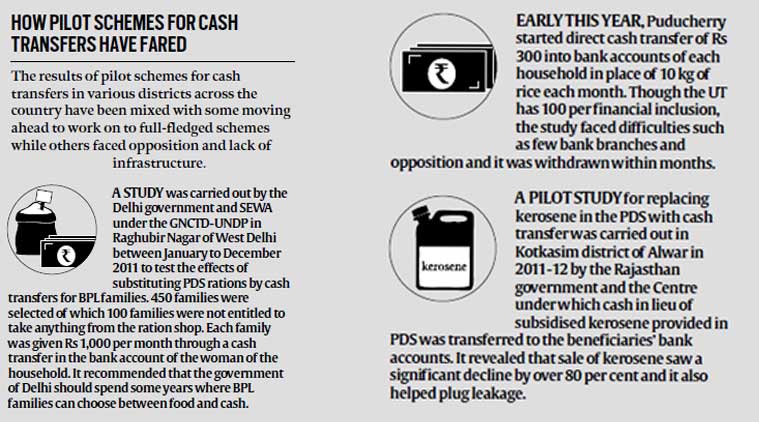
How Pilot Schemes for cash transfers have fared
The results of pilot schemes for cash transfers in various districts across the country have been mixed with some moving ahead to work on to full-fledged schemes while others faced opposition and lack of infrastructure.

A study was carried out by the Delhi government and SEWA under the GNCTD-UNDP in Raghubir Nagar of West Delhi between January to December 2011 to test the effects of substituting PDS rations by cash transfers for BPL families. 450 families were selected of which 100 families were not entitled to take anything from the ration shop. Each family was given Rs 1,000 per month through a cash transfer in the bank account of the woman of the household. It recommended that the government of Delhi should spend some years where BPL families can choose between food and cash.

Early this year, Puducherry started direct cash transfer of Rs 300 into bank accounts of each household in place of 10 kg of rice each month. Though the UT has 100 per financial inclusion, the study faced difficulties such as few bank branches and opposition and it was withdrawn within months.

A pilot study for replacing kerosene in the PDS with cash transfer was carried out in Kotkasim district of Alwar in 2011-12 by the Rajasthan government and the Centre under which cash in lieu of subsidised kerosene provided in PDS was transferred to the beneficiaries’ bank accounts. It revealed that sale of kerosene saw a significant decline by over 80 per cent and it also helped plug leakage.

- See more at: http://indianexpress.com/article/india/india-others/for-better-targetting-jamming-the-subsidies/3/#sthash.nC6izr5S.dpuf


Tuesday, March 3, 2015

7488 - States object to cash transfer of food subsidy - Live Mint


Odisha, MP among those saying the move may compromise food security in some of the nation’s poorest parts 
Sayantan Bera i

A file photo of a ration shop. Photo: Indranil Bhoumik/Mint New 

Delhi: Plans by the centre to initiate cash transfers to poor households under the public distribution system (PDS) may run into trouble, with some states—notably Odisha and Madhya Pradesh—raising objections on the grounds that such a move may compromise food security in some of the poorest parts of the country. 

The states’ objections come in response to recommendations of the high-level committee on Food Corporation of India (FCI)’s restructuring, chaired by former food minister Shanta Kumar. 

The panel has recommended an overhaul of the FCI-managed PDS. Among other things, the panel suggested reducing coverage under the National Food Security Act (NFSA) from 67% to 40% of the population and starting the process of cash transfers in order to check high leakages. The panel estimated that cash transfers could save the exchequer Rs.30,000 crore annually. For 2014-15, the central food subsidy bill is estimated at Rs.1.15 trillion. 

While the centre told Parliament on Tuesday that it has no plans to amend the NFSA or reduce coverage, its earlier communication to states revealed plans to implement direct benefit transfer (DBT) in all union territories and some select districts of states on a pilot basis. In a letter to the states on 10 February, the centre had proposed three models for transferring food subsidies to targeted households. While states can choose between cash transfers and manual disbursal of foodgrains, all beneficiary households will have to be linked with the Aadhaar database, the letter said. However, some state governments have objected to the direct cash transfer recommendations of the FCI panel and may not opt for cash transfers as a way to receive food subsidies. 

Odisha said cash transfer would limit procurement from farmers and therefore threaten food security. “Providing grains in PDS is closely connected with procurement operations in rice and wheat...if government of india decides to go for cash transfer in PDS, it has to gradually reduce procurement operations and stop procurement after sometime,” reads a 9 February letter from the state food secretary to the centre. “When MSP (minimum support price) offered for paddy and wheat are way below the costs incurred by farmers, withdrawing MSP is a sure recipe for creating a food crisis in the future,” the letter said, adding, “In many villages where 65% of our people live, there is hardly any market to cater to the needs of people. 

In Odisha, a quarter of the population belonging to scheduled tribe community lives in remote and far flung areas. Cash transfer will hit them the hardest as they will have no access to food market.” Regarding the Prime Minister Jan Dhan Yojana—the flagship scheme which seeks to ensure a bank account for all households—Odisha said, “It is too early to bank upon its utility as the nearest bank for over 50% of the population is 10-15km away for getting any tangible benefit. Hence this recommendation (cash transfer) does not merit any consideration at this point of time.” 

Responding to the FCI panel’s estimate of 40% to 50% leakage in the PDS, Madhya Pradesh said the calculations are based on old data and that the state does not agree with the numbers. “In recent years, there has been wide-scale use of technology in PDS that has resulted in improvement... New transparent methods/criteria and robust ways to address complaints have helped in reducing leakage,” reads a 9 February letter from Madhya Pradesh food secretary Ashok Barnwal to the centre. 

“Cash transfers in PDS are a debatable issue with opinions in favour and against it. A fallout of cash transfers may be that families may not purchase foodgrains and buy other non-essential items with the transferred cash. Also, cartels of local sellers may create shortages and hike prices in the market. In such cases, food security of poor households may be effected. 

The state government (therefore) does not agree to the cash transfer recommendations,” added the letter. 

Prior to the FCI panel’s report, the Tamil Nadu chief minister too had written to Prime Minister Narendra Modi objecting to cash transfers. “In principle, the government of Tamil Nadu is strongly opposed to any move to monetize and transfer in cash the subsidy element under the PDS, including kerosene and fertilisers, where the issue is not just the quantum of subsidy, the critical concern is access to and timely availability of commodities,” said a 28 November 2014 letter from chief minister O. Panneerselvam. 

It remains unclear if the Bharatiya Janata Party (BJP)-run Chhattisgarh government will continue with its opposition to the cash transfer scheme. In December 2012, the state had passed a food security act with chief minister Raman Singh emphasizing that the state will not implement cash transfers in PDS. 

“In the past few months the state was preparing for pilots of cash transfer, not for food grains, but other PDS benefits like sugar and kerosene. That hasn’t found favour with the ruling politicians and the pilot may have been shelved,” said Samir Garg, a Raipur-based adviser to the commissioners of the Supreme Court in the Right To Food case. 

“The state was the first to initiate PDS reforms—by bringing ration shops under cooperatives and panchayats, computerising godowns, initiating doorstep delivery of grains, and grievance redressal, thereby reducing PDS leakages to 9.3% in 2011-12 (from 91% in 2004-05). Their model is tried and tested; politically, the state may not opt for cash transfers,” Garg added.


Monday, October 14, 2013

4825 - One UID, One EHR: Beyond cash transfers, LPG and vote bank politics - Forbes India

10/10/2013 | 4 c
Seema Singh


Is nuance dead? Do we live in the time of binary debates?

While reporting for the UIDAI story in Forbes India less than a fortnight ago and now looking at the reactions to the story, mostly on Twitter, it seems as a society we are fast losing our taste for nuances. In general, people look at Aadhaar with a black or white lens. As in climate change, GM crops, or as my colleague Rohin Dharmakumar says the birth control debate in the US, issues where people make up their mind about which side of the debate they want to be in and then process information to perpetuate that point of view, Aadhaar has fallen into that category.

When the story How Nandan Nilekani took Aadhaar past the Tipping Point went live on the website, some readers even accused us of “propaganda”.

Propaganda, really? Our editor tweeted on Tuesday: “Am not a fan of Aadhaar, but the Forbes India article shows how Nandan Nilekani overcame the system to get his way on UID.” Then there were four of us reporting on it. What propaganda are people talking about? We went looking for truth and we’ve written what we found.

Just like most innovations, Aadhaar implementation is messy on the ground. To cite just one example, as of August 2013, in one of the pilot districts in Rajasthan, less than 20-25 percent of direct bank transfers for various programmes were happening through Aadhaar seeding. If in some places scanning devices are not present, in others existing devices don’t work. Limited access to bank is a pullback too. In the bargain, a lot of people are given a run around. “The system will be dumped as far as cash transfers are concerned; it might work to track train and airline travelers and bank transactions etc,” says Nikhil Dey of NCPRI, a vocal critic of Aadhaar.

What services will Aadhaar be used for is the real thing, now as well as in future. Yet people are confusing the platform for the end product/service. 

Ashish Rajadhyaksha, a fellow at the Centre for the Study of Culture and Society in Bangalore, who has recently published a book In the Wake of Aadhaar after extensive research in eight Indian states, says there’s lot of confusion in the minds of people. Some think it’ll get them ration; others think it’ll grant them some kind of protection if they get caught in a legal suit.
His book argues that Aadhaar is just a cog, at best a huge cog, in the giant wheel of digital governance in India. He thinks the benevolent, democratic idea of Aadhaar will eventually be shaped by the service (and the ideology of its provider) that is mounted on it. And there lies the caveat. He cites the example of microfinance crisis in Andhra Pradesh. After the MFI Bill of 2010, when the state government cracked down on MFIs in the state, it is now working to establish banking correspondents by primarily using Aadhaar. “It is by no means clear that this will lead to any change in the sort of chronic indebtedness that the MFI explosion had created across several regions of the state,” says Rajadhyaksha.

He raises a valid point but Aadhaar was never meant to be the message; it is the messenger and, as wisdom says, you don’t shoot the messenger if you don’t like the message. Even the cash transfer debate has taken the tone that it has because politicians started to take credit for it even before it was sufficiently widely rolled out and its implementation adequately evaluated.

But going beyond the vote bank politics, there’s one use-case in healthcare which nobody is talking about publicly. (It’s understandable. When time is short and maximum bang for the buck has to be made, why waste time in healthcare where results will show only over time.)

Assuming that the data protection policy comes into effect soon, by linking each UID number to a person’s electronic health record (EHR), India can leapfrog health management. Nobody in India maintains EHR worth its name. However, two months ago the Union health ministry approved the national EHR standards. The idea is to have a country-wide rollout of EHR for all government hospitals. Private hospitals follow some minimal record keeping but most of them don’t lodge patients’ medical records and none provides an EHR which a patient can access remotely. With UID database residing in the cloud, even a rudimentary EHR linked to it and stored in the cloud along with critical information, say, about blood group, allergies, chronic illness, long term medication, etc, can go a long way not only in better healthcare delivery but even gathering epidemiological data.

The Centre for Development of Advanced Computing (C-DAC) in Noida has built a hospital information management system which can be seamlessly linked to UID. In states like Rajasthan and Maharashtra, where the state govt is rolling C-DAC’s HMIS, it is already linked to the UID database. Even if the UID number is not available (forgotten or lost), the HMIS can retrieve the UID number using the patients’ biometrics. Keeping privacy concerns in mind, says executive director BK Murthy, the management system is designed to give roll-based access at every level and no data can be shared without the patient’s and doctor’s consent.

Once the data protection policy is in place, which qualifies what patient rights are, more private companies in healthcare and IT will come forward to implement EHR. Vijaya Verma, founder and chief executive of Yos Technologies, which among other things provides IT solutions connecting care providers and patients, says “privacy is not a big deal” for patients today. 

Patients don’t get it and they sign the consent form even without reading it which ensures that we have the consent but it’s not informed consent, she says. Yos provides electronic medical records to hospitals (to be kept within the hospital) and electronic health records to patients (to be accessible over the cloud) which includes discharge summaries and prescription data.

Verma believes once the National Identification Bill is passed and the data policy comes into effect, UIDAI should use its permanent enrollment centres to update Aadhaar by adding some basic health data about individuals.
But that maybe too ambitious, both in terms of saddling UIDAI with additional work and exacerbating privacy concerns.

I’ve argued earlier why healthcare is not on the election agenda of Indian politicians but I hope the UIDAI and the rest of the bureaucracy find a compelling use-case in EHR.


Thursday, August 15, 2013

4456 - From the granary to the plate - The Hindu

Published: August 1, 2013 

Jean Drèze

Despite its many flaws, the food security bill is an opportunity to end the leakages from the PDS and prevent wastage of public resources

The National Food Security Bill, now an ordinance, has been a target of sustained attacks in the business media in recent weeks. There is nothing wrong, of course, in being critical of the bill, or even opposed to it. Indeed, the bill has many flaws. What is a little troubling, however, is the shrill and ill-informed nature of many of these attacks. Statistical hocus-pocus has been deployed with abandon to produce wildly exaggerated “estimates” of the financial costs of the bill, and no expression seems to be too strong to disparage it. The fact that the food bill could bring some relief in the lives of millions of people who live in conditions of terrifying insecurity seems to count for very little.

Findings
Meanwhile, recent studies shed some useful light on the state of India’s Public Distribution System (PDS) — one of the controversial foundations of the bill. As far as the “below poverty line” (BPL) quota is concerned, there is a clear trend of steady improvement in many States, including some that had a very poor PDS not so long ago. A recent study of the PDS in Koraput, one of Odisha’s poorest districts, found that almost all BPL households were receiving their full monthly quota of 25 kg of rice at the stipulated price. Similar findings emerged from a survey of the PDS in two districts of Uttar Pradesh (Lakhimpur Kheri and Chitrakoot), where most BPL households were getting their due — 35 kg of rice or wheat per month. The main problem was the restrictive nature of the BPL list, which left many households excluded. These surveys confirm earlier findings of a study by the Indian Institute of Technology in 2011 that BPL households in nine sample States received 84 per cent of their PDS entitlements.

It is in the “above poverty line” (APL) quota that embezzlement continues in many States. In Uttar Pradesh (U.P.), APL households are supposed to get 10 kg of wheat per month, but most of the APL quota goes straight to the black market. The gravy flows all the way to the top: the complicity of the then Food Minister, Raja Bhaiya, in this scam was exposed last year by Tehelka, but the “bhaiya” retained his post. Recent investigations suggest that leakages in the APL quota are also very high in Bihar, Jharkhand, and Madhya Pradesh, among other prime offenders.

The main reason for this vulnerability is that the APL quota is treated as a dumping ground for excess foodgrain stocks. In recent years, foodgrain procurement has increased by leaps and bounds, but distribution under the BPL and Antyodaya quotas has remained much the same, since allocations are fixed and lifting is close to 100 per cent. To moderate the accumulation of excess stocks, the Central government has been pushing larger and larger amounts of foodgrain into the APL quota, which is now almost as large as the BPL quota (close to 20 million tonnes of foodgrains in 2012-13). One consequence of this dumping is that the entitlements of APL households are, by nature, unclear and unstable; in fact, they are not entitlements but ad hoc handouts. This gives middlemen a field day, since APL households are often confused as to what they are supposed to get, or whether and when their quota has arrived. The current situation in U.P., where most of the APL quota goes straight to the black market without anyone raising the alarm, is just an extreme example of this situation.

Rectifies PDS defects
The food bill is an opportunity to clean up this mess, and to cure two basic defects of the PDS: large exclusion errors, and the leaky nature of the APL quota. In effect, the bill abolishes the APL quota and gives common entitlements to a majority of the population: 75 per cent in rural areas and 50 per cent in urban areas. These are national coverage ratios, to be adjusted State-wise so that the coverage is higher in the poorer States. In this new framework, people’s entitlements will be much clearer, and there will be greater pressure on the system to work. Indeed, wide coverage and clear entitlements are two pillars of the fairly effective PDS reforms that have been carried out in many States in recent years (other aspects of these reforms include de-privatisation of ration shops, computerisation of records and transparency measures). Seen in this light, the bill can be a good move not only for food security, but also from the point of view of ending a massive waste of public resources under the APL quota.

Cash transfers
The main goal of the PDS is to bring some security in people’s lives, starting with protection from hunger but going well beyond that. A well-functioning PDS liberates people from the constant fear that it might be difficult to make ends meet if crop fails, or if someone falls ill, or if there is no work. The value of this arrangement has been well demonstrated in many States — Tamil Nadu, Chhattisgarh, Odisha, Rajasthan, among others. Whether a system of cash transfers could serve the same purpose at lower cost, and how long it would take to put in place, are issues that need further scrutiny and debate. Meanwhile, the PDS is in place, there is a ration shop in every village, and huge food stocks keep piling up. It seems sensible to use these resources without delay. In any case, the food bill does not preclude a cautious transition to cash transfers if and when they prove more effective than the PDS.

Three problems
Having said this, there are many reasons for concern over the impact of the bill. Three related problems look increasingly serious. First, there is a danger of over-centralisation of the PDS under the bill, at a time when many State governments are making good progress with reforming the PDS on their own. To illustrate, the bill seeks to impose a system of “per-capita entitlements” (e.g. 5 kg of foodgrains per person per month) across the country, as opposed to household entitlements (e.g. 25 kg per household). Per capita entitlements are certainly more equitable and logical than household entitlements. But the transition from the latter to the former is not a simple matter, and could be very disruptive if it is imposed overnight from the top. Just think about how an old widow in Rajasthan, who lives alone and survives on her monthly quota of 25 kg of PDS rice, would feel on being told that her entitlement is being slashed to 5 kg per month.

Political tool
The second danger is excessive haste. As the country gears up for a string of elections, the Central government — and some State governments — are keen to fast track the roll-out of the bill for electoral purposes. A sense of urgency is certainly appropriate as far as food security is concerned, but undue haste could be very counterproductive. For instance, some State governments apparently propose to use the BPL Census of 2002 to identify eligible households, instead of the more recent and reliable Socio-Economic and Caste Census — just to speed things up. This is a disastrous idea. A better way of fast tracking the roll-out of the bill would be to universalise the PDS in the country’s poorest districts or blocks.

Last but not least, the promulgation of an ordinance has turned the bill into a political football. The Congress claims that the bill is a non-partisan initiative, but is also trying to use it as an electoral card. The Bharatiya Janata Party says in the same breath that it supports the bill and that it will not allow Parliament to function. The Samajwadi Party is shedding crocodile tears for farmers, but is unable to explain why the bill is “anti-farmer.” The All India Anna Dravida Munnetra Kazhagam claims that the bill is against Tamil Nadu’s interests, without mentioning that it will enable the Tamil Nadu government to save large amounts of money on rice purchases from the Centre. The real issues are getting lost in these squabbles.

It remains to be seen whether the monsoon session of Parliament will provide an opportunity to repair this damage, and also to consider the much-needed amendments to the bill. The silver lining is that food security has finally become a lively focus of democratic politics in India. Whatever happens to the bill, State governments are under great pressure to reform their PDS and make it work for people rather than for corrupt middlemen and their political masters. This was long overdue.


(Jean Drèze is visiting professor at the Department of Economics, University of Allahabad.)

Saturday, May 4, 2013

3280 - For cash transfer - Live Mint


The govt should continue to spend on public services, but it is time it handed over cash to the desperately poor—the real aam aadmi
Livemint  

          First Published: Wed, May 01 2013. 11 34 PM IST


A third of the 1.4 billion people living on less than $1.25 a day, the global poverty line from the World Bank, live in India. Photo: AFP


Lant Pritchett of Harvard University told The New York Times this week that it will take about $45 billion of cash transfers to eliminate extreme poverty in the world. A similar amount is spent on movie tickets every year.

A third of the 1.4 billion people living on less than $1.25 a day, the global poverty line from the World Bank, live in India. By the Pritchett estimate, it will take around $15 billion—or Rs.80,000 crore—of cash transfers every year to keep these 450 million people above the poverty line.

Is that difficult? The Indian government has spent nearly four times as much on subsidies in fiscal year 2013. It also has an array of ineffective anti-poverty schemes.

Economic growth is still the best antidote against mass poverty. The government should continue to spend on public services. But it is time it handed over cash to the desperately poor, the real aam aadmi.