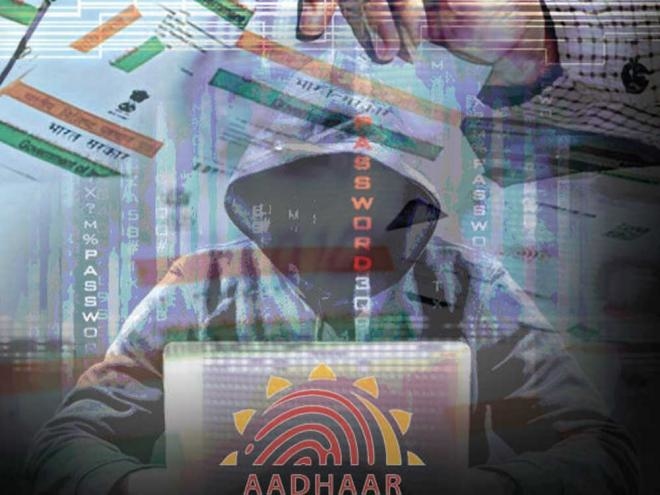
In 2009, I became extremely concerned with the concept of Unique Identity for various reasons. Connected with many like minded highly educated people who were all concerned.
On 18th May 2010, I started this Blog to capture anything and everything I came across on the topic. This blog with its million hits is a testament to my concerns about loss of privacy and fear of the ID being misused and possible Criminal activities it could lead to.
In 2017 the Supreme Court of India gave its verdict after one of the longest hearings on any issue. I did my bit and appealed to the Supreme Court Judges too through an On Line Petition.
In 2019 the Aadhaar Legislation has been revised and passed by the two houses of the Parliament of India making it Legal. I am no Legal Eagle so my Opinion carries no weight except with people opposed to the very concept.
In 2019, this Blog now just captures on a Daily Basis list of Articles Published on anything to do with Aadhaar as obtained from Daily Google Searches and nothing more. Cannot burn the midnight candle any longer.
"In Matters of Conscience, the Law of Majority has no place"- Mahatma Gandhi
Ram Krishnaswamy
Sydney, Australia.

Aadhaar

The UIDAI has taken two successive governments in India and the entire world for a ride. It identifies nothing. It is not unique. The entire UID data has never been verified and audited. The UID cannot be used for governance, financial databases or anything. It’s use is the biggest threat to national security since independence. – Anupam Saraph 2018

When I opposed Aadhaar in 2010 , I was called a BJP stooge. In 2016 I am still opposing Aadhaar for the same reasons and I am told I am a Congress die hard. No one wants to see why I oppose Aadhaar as it is too difficult. Plus Aadhaar is FREE so why not get one ? Ram Krishnaswamy

First they ignore you, then they laugh at you, then they fight you, then you win.-Mahatma Gandhi

In matters of conscience, the law of the majority has no place.Mahatma Gandhi

“The invasion of privacy is of no consequence because privacy is not a fundamental right and has no meaning under Article 21. The right to privacy is not a guaranteed under the constitution, because privacy is not a fundamental right.” Article 21 of the Indian constitution refers to the right to life and liberty -Attorney General Mukul Rohatgi

“There is merit in the complaints. You are unwittingly allowing snooping, harassment and commercial exploitation. The information about an individual obtained by the UIDAI while issuing an Aadhaar card shall not be used for any other purpose, save as above, except as may be directed by a court for the purpose of criminal investigation.”-A three judge bench headed by Justice J Chelameswar said in an interim order.

Legal scholar Usha Ramanathan describes UID as an inverse of sunshine laws like the Right to Information. While the RTI makes the state transparent to the citizen, the UID does the inverse: it makes the citizen transparent to the state, she says.

Good idea gone bad
I have written earlier that UID/Aadhaar was a poorly designed, unreliable and expensive solution to the really good idea of providing national identification for over a billion Indians. My petition contends that UID in its current form violates the right to privacy of a citizen, guaranteed under Article 21 of the Constitution. This is because sensitive biometric and demographic information of citizens are with enrolment agencies, registrars and sub-registrars who have no legal liability for any misuse of this data. This petition has opened up the larger discussion on privacy rights for Indians. The current Article 21 interpretation by the Supreme Court was done decades ago, before the advent of internet and today’s technology and all the new privacy challenges that have arisen as a consequence.

Rajeev Chandrasekhar, MP Rajya Sabha

“What is Aadhaar? There is enormous confusion. That Aadhaar will identify people who are entitled for subsidy. No. Aadhaar doesn’t determine who is eligible and who isn’t,” Jairam Ramesh

But Aadhaar has been mythologised during the previous government by its creators into some technology super force that will transform governance in a miraculous manner. I even read an article recently that compared Aadhaar to some revolution and quoted a 1930s historian, Will Durant.Rajeev Chandrasekhar, Rajya Sabha MP

“I know you will say that it is not mandatory. But, it is compulsorily mandatorily voluntary,” Jairam Ramesh, Rajya Saba April 2017.

August 24, 2017: The nine-judge Constitution Bench rules that right to privacy is “intrinsic to life and liberty”and is inherently protected under the various fundamental freedoms enshrined under Part III of the Indian Constitution

"Never doubt that a small group of thoughtful, committed citizens can change the World; indeed it's the only thing that ever has"

“Arguing that you don’t care about the right to privacy because you have nothing to hide is no different than saying you don’t care about free speech because you have nothing to say.” -Edward Snowden

In the Supreme Court, Meenakshi Arora, one of the senior counsel in the case, compared it to living under a general, perpetual, nation-wide criminal warrant.

Had never thought of it that way, but living in the Aadhaar universe is like living in a prison. All of us are treated like criminals with barely any rights or recourse and gatekeepers have absolute power on you and your life.

Announcing the launch of the # BreakAadhaarChainscampaign, culminating with events in multiple cities on 12th Jan. This is the last opportunity to make your voice heard before the Supreme Court hearings start on 17th Jan 2018. In collaboration with @no2uidand@rozi_roti.

UIDAI's security seems to be founded on four time tested pillars of security idiocy

1) Denial

2) Issue fiats and point finger

3) Shoot messenger

4) Bury head in sand.

God Save India

Showing posts with label Saikat Dutta. Show all posts

Monday, May 7, 2018

13469 - How long can its captain – UIDAI – continue to deny the Aadhaar leaks? - News Click


Newsclick Report 04 May 2018


A few days back, Asia Times and Medium, a popular website reported on security holes in the Aadhaar system. Saikat Datta wrote that a number of people have warned the UID Authority of this hole, without getting any response. Today, the French security expert, who goes by the twitter handle Elliot Alderson @fs0c131y and had earlier exposed a number of security breaches in the Aadhaar and government websites, has tweeted the details of a YouTube video that shows a software that can be used to edit the personal data of anybody enrolled in the Aadhaar system; that too without any security checks! And to add insult to the injury – for UIDAI – the person who posted the video is asking those who liked his video for contributions to his PayTM account.


Is the video fake? If it is, we can heave a sigh of relief. The problem is that very similar complaints have been made by various people to UIDAI without any response, indicating that this software is available for as little as Rs. 500. Anand Venkatanarayanan, in his Medium piece , has also explained why a software – called ECMP (Aadhaar Enrolment Client Multiplatform) software – that resides in the e-Kendra computers, can be hacked more easily. And if it is hacked, it will allow any change in the personal data of the person enrolled in the Aadhaar database. This means the mapping between the biometric and the personal data can be changed.

UIDAI’s contention is that the biometric database cannot be hacked and remains behind secure walls (13 feet high according to the Attorney General). The problem is not that the ridges and whorls of our fingers are safely stored, but whether the name and other details, attached to the fingerprints, are truly mine. If they are not secure and can be changed by buying a Rs 500 software, it means identity theft can occur on a mass scale. And more service providers are added to the Aadhaar system, more potential of holes for such identity thefts. This is the central risk of the Aadhaar system. And our nightmare.

We have been warning the government in our columns and videos, why the Aadhaar system is a poor one and will not lead to any foolproof identity verification system. If biometrics are used, poor connectivity, lack of electricity, apart from at least 10% of biometrics like fingerprints not being verifiable, will defeat the system. If biometrics are dispensed with, the Aadhaar ID proof is as good as self-certification. Why then, are tens of thousands of crores being spent on the system?

The logic of the system lies elsewhere. Yes, Aadhaar system leaks like a sieve. It is capable of being bypassed in various ways. Yes, people who are legitimate beneficiaries of various systems are being denied their dues or rations, as the biometric system does not work properly.

So what is the purpose of Aadhaar? For the government, it provides a method of collecting a huge amount of information of the citizens: religion, caste, geotagging of their houses, collating it with their income and expenditures, etc. This is a surveillance tool that can be used against individuals and communities. For a government that is against a particular section, it can be used to bypass from development in certain areas, where a particular community may be staying. For big Indian capitalists, such as Ambanis, it provides the tool of big data at government expense. Once such big data is available, the capitalists can tap into it in various ways. This is why, from a Nilekani to an Ambani, all of them have lined up behind Aadhaar.

Unfortunately for both the government and big capitalists, the ecosystem of Aadhaar, as engineered and deployed, is so poor that it is likely to fail. Sooner rather than later. Even if the Supreme Court does not strike it down on our privacy violations.

The Aadhaar system is increasingly looking like a ship with a large number  of holes. How long can its captain – UIDAI – continue to deny these leaks? And how long will we pump in good money after the bad?


Wednesday, March 7, 2018

12936 - Easy to recognise 'state-sponsored' malwares: Researchers at Nullcon - Tribune India

Posted at: Mar 3, 2018, 5:49 PM; last updated: Mar 3, 2018, 6:42 PM (IST)


At the 9th annual edition of Nullcon, the international security conference, in Goa. — Tribune photo

Rachna Khaira
Tribune News Service
Goa (Cavelossim), March 3

It is easy to differentiate between an ordinary malware from 'state-sponsored' ones by identifying the patters on the victims, said researchers at the 9th annual edition of the Nullcon, the international security conference, that kicked off in Goa on Friday. 

Leading security researcher Eva Galperin, Director of cyber security, Electronic Frontier Foundation (EFF), who has published research on malware in Syria, Vietnam and Kazakhstan, said if a malware is targeting only activist Ahmed Mansoor in UAE, it is not necessarily a state-sponsored malware.

"However, along with Mansoor, if it is also targeting an activist of Human Rights Watch and somebody in the New York Times who cover the Middle east, then we can draw the conclusion that it is probably a nation-sponsored malware," said Eva, adding that if a particular malware is targeting more activists in a particular region, a conclusion can also be drawn as to which state is sponsoring the malware.

She also spoke on her world-acclaimed research to track down Dark Caracal, a leading espionage programme, which was allegedly found to have been routed from a building in Beirut belonging to the Lebanese General Security Directorate.

Analysis made by EFF showed that devices of military personnel, businesses, journalists, lawyers, educators, and medical professionals were compromised.

In yet another exciting hacking workshop, security researcher Adam Laurie, better known by his hacker name 'Major Malfunction' showed how easy it is to hack credit cards, office keys and even the passports having electronic chip fitted inside them.

He even demonstrated the hacking of his son's British passport and how he changed the facial recognition configuration embedded inside the electronic chip to replace his own picture on it. Laurie claimed that he has informed the British authorities about the cracked software around six years ago but they did not paid heed to it and are using the same technology till date.

This was despite the fact that over 3,000 blank passports having an electronic chip embedded inside were stolen from a van few years ago, Laurie said calling it a grave security concern for UK facing terrorist attacks from the last many years.

In another panel discussion moderated by Saikat Datta, an award-winning journalist whose research papers were published by the Centre for Land warfare studies (CLAWS), centre for Airpower studies (CAPS) and the National Security Guards (NSG), the complexity of regulation and cyber security issues were discussed.

Also, technology entrepreneur Abhinav Srivastava, an MSc graduate from IIT Kharagpur, and also the prime accused in the online Aadhaar data theft in 2017 spoke as to how he astonished the investigators by explaining the shortcuts he used to hack the government website to  get Aadhaar data

The Tribunes report 'Rs 500, 10 minutes and you can have access to a billion Aadhaar details' on Aadhaar data breach published on January 4 this year was also discussed in the session.

The researchers also spoke about how they hacked Google and a workshop on bug hunter methodology was also held.

According to Antriksh Shah, co-founder of Nullcon, more than 1,400 people, including security experts and researchers, are participating in the two-day event. 

The idea of Nullcon came from null, an open security community having presence in over 13 national and international chapters. With everyone leading a digital life everyday, cyber research and security has become a global concern nowadays and to address this concern, the conference is being held every year from the last nine years, said Shah.

In addition to speeches, exhibitions, workshops, hacking competitions and job fairs are also being held at the venue

Thursday, December 14, 2017

12499 - Indian Govt postpones linking bank accounts to digital ID - Asia Times

The announcement on December 12 reverses the requirement for Indians to link their bank accounts to the Aadhaar system. Photo: AFP

A day before the case came up in the Supreme Court, the government postponed the linking of the Aadhaar digital identity scheme to bank accounts

By SAIKAT DATTA DECEMBER 13, 2017 8:17 PM (UTC+8

A public outcry has forced the Indian government to delay plans to roll out a digital identity program on every citizen, linking bank accounts and other financial data.

The mandatory linking of the controversial Aadhaar system with bank accounts and mutual funds has been postponed, according to an announcement issued on December 12 by the Department of Revenue under the Ministry of Finance.

The announcement stated that a new date will be announced later. However, adding to the confusion, the Ministry of Finance issued a press release stating that bank accounts have to be linked by March 31, 2018. It is not clear if this rule applies only to new accounts or existing ones as well.

The Aadhaar project has become one of the most controversial issues in India, raising massive concerns about the government’s ability to carry out surveillance of citizens. While it was started as a “welfare” project to ensure better targeted deliveries of government subsidies, it was essentially a surveillance tool, predicated on the ability to track citizens and profile them.The notification by the federal government came just a day ahead of a hearing in the Supreme Court, challenging the mandatory linking of the digital identity system to bank accounts and other financial products. On June 1, the government of India had issued a notification modifying the Prevention of Money laundering Act (PMLA) mandating that all citizens link their unique digital identity number, also known as Aadhaar, to their bank accounts. A similar order has been issued by the Department of Telecommunications asking citizens to link their Aadhaar number to cell phone numbers.

Avoiding Judicial Scrutiny?
“One thing is clear. The hearing was slated to start from tomorrow and the government doesn’t want the court to look into this. That explains this last minute notification postponing the bank linking indefinitely,” Dr Usha Ramanathan, a legal researcher and one of the country’s biggest privacy advocates, told Asia Times. Ramanathan has been spearheading the move to scrap the Aadhaar project for over seven years and was instrumental in pointing out the various flaws in the project.
Pune-based Dr Anupam Saraph, a noted expert and designer of complex system has been another campaigner who has repeatedly raised concerns about the project over the last year. “The June 1 notification asking citizens to link their bank accounts was clearly illegal since the PMLA has no legal basis to freeze accounts of citizens. The government was aware of this and wanted to scare people into linking their accounts before the case came up for hearing,” he told Asia Times.

Reliable government sources said there was considerable concern over a “backlash from the public” if their bank accounts were frozen after December 31. Officials were worried that if the deadline was not postponed, many citizens would be denied access to their savings, which could lead to financial chaos.

The Indian Government issued a notification on December 12, 2017 postponing the mandatory linking of bank accounts to the Aadhaar number.

Worried over the growing implications of the project, the Supreme Court was asked earlier this year to also examine whether privacy is a fundamental right. A rare, nine-judge bench of the Supreme Court unanimously ruled that privacy is a fundamental right as enshrined in various clauses of the Constitution. “It has been four months since the landmark privacy judgment came out. The government has not done anything and was possibly waiting for the last minute, so that more people signed up, before issuing this notification,” Ramanathan said.

Ironically, the Unique Identification Authority of India (UIDAI) had issued a press release last week stating that the linking was mandatory. The press release was issued in response to a viral video by a lawyer, Aishwarya Bhati, who had pointed out that the linking could not be mandatory since the interim orders of the Supreme Court had specifically mandated it to be used for a few welfare schemes. While UIDAI argued that the law had overtaken the judgment, skeptics like Saraph are not convinced. “If the circumstances have changed, then the UIDAI should have gone to court and sought a clarification. Why did they push it through by threatening citizens?”

A Surveillance Regime
Started by the Congress-led UPA government nearly eight years ago, the plan had seen massive opposition from the Bharatiya Janta Party (BJP). During that phase, the then Chief Minister of Gujarat, Narendra Modi, publicly tweeted that he had met up with the Aadhaar team and expressed his concerns about the security of sensitive personal data. The team was unable to come up with convincing answers to his queries.

However, some time between the meeting and his election as Prime Minister in May 2014, Modi seems to have had a change of heart about the project. It was revealed that Modi, as the Chief Minister had not only required that his state join the project, but also collected data that was not even mandated by the project.

As the BJP-led NDA government took over in May 2014, many had hoped for a roll back of the project. However, the government went ahead and began to promote the project by virtually threatening citizens with disruption of basic services, such as the ability to file income taxes.

Earlier, petitioners to the Supreme Court had challenged the project, by pointing out the massive potential for misuse. As a German diplomat posted in India recently told this correspondent: “Such a scheme is prohibited by law in Germany. We have seen how such a database of citizens’ data can be misused and German law explicitly prohibits it.”
The Supreme Court passed two interim orders. One prohibited the government from expanding the scope of the project while the other specified particular welfare schemes where the project could be deployed. But the Modi government pushed through a ‘Money Bill’ in Parliament in 2016, and did not allow the Opposition an opportunity to block it. It has also  failed to deliver welfare schemes in a targeted manner and has instead excluded thousands of people from marginalized communities from getting their mandatory benefits.

The move ensured that concerns expressed by law makers were not taken into consideration and the government managed to push through the law, enabling surveillance clauses on the grounds of “national security.” This gives the government unfettered access to sensitive personal data for profiling citizens. Due to the lack of privacy laws, this opens up citizens to manipulations by the government, that undermines democratic principles enshrined by the Constitution of India.

Saturday, March 25, 2017

10915 - The end of privacy: Aadhaar is being converted into the world’s biggest surveillance engine - Scroll.In

Privacy is essential to a democracy and the rights of citizens. An undemocratic way is being used to take away this right.

Published Yesterday · 12:30 pm.  

Democracies survive on the delicate balance of power between the ruling class – the executive, generally known as the government – and the citizens. The more power citizens get, the more robust the democracy. As the ruling class accrues more power to itself, it erodes democracy to a point where it ceases to exist.

This axiom has always held true. The fast expanding remit of the Unique Identity number project, Aadhaar, has now taken a giant leap with an amendment to the Finance Bill making it a mandatory requirement for filing Income Tax returns.
The way the move was sought to be pushed in Parliament is part of a trend that is now becoming a clear and present danger to India’s democracy.

Erosion of Parliament
In many ways, the policy decisions around Aadhaar could be seen as illustrative of the erosion of Parliament as an institution. Meghnad S, a policy analyst working with Tathagat Sathpathy, Odisha Member of Parliament from the Biju Janta Dal, brought this out as he live tweeted how the amendments to the Finance Bill making Aadhaar mandatory were introduced in Parliament.
First, the government “cleverly let MPs from major parties give their speeches before they dropped the amendment bomb. Kept it for the last minute,” tweeted Meghnad.

Here are parts of the amendment which will give an idea of what kind of 'control' the central govt will have. (it's a 28 page doc)
4/ pic.twitter.com/KcnFwLh5GQ

The Govt, cleverly, let MPs from major parties give their speeches before they dropped the amendment bomb. Kept it for the last minute.
5/
Second, when Finance Minister Arun Jaitley had introduced the Bill, it had a 150 clauses, Meghnad pointed out. “Yesterday, Jaitley added 33 more without warning. This is unprecedented,” he tweeted, quoting member of Parliament Saugata Roy from the Trinamool Congress.

R Singh: Moody's has mentioned in its report, "Demonetisation = good. Corruption = down. GoI = awesome."

(Moody's? Really? That fraud org?)

S Roy (TMC): When Fin Bill was introduced, it had 150 clauses. Yesterday, Jaitley added 33 more without warning. This is unprecedented.
The members of Parliament as a result had no idea about what these clauses meant, let alone understand the import of the amendments that were eventually passed.

This, however, was not the first time Aadhaar had undermined Parliament. When first introduced by the Congress-led United Progressive Alliance government, the National Identification Authority of India Bill, 2010 had been sent to a Standing Committee of Finance of the 15th Lok Sabha. The all-party Committee was caustic about the project in its report.
For instance, when the Committee referred to the failed identification project in the United Kingdom, the UPA government attributed the failure to the designing of the framework and structure to a “security perspective”.

“The UID scheme is envisaged as a mean to enhance the delivery of welfare benefits and services,” it said in defence. It also said that unlike the UK identification project the Aadhaar project would not be made mandatory. This was the assurance given to Parliament.

The committee also made the following observations:
  • The UID scheme has been conceptualised with no clarity of purpose…and is being implemented in a directionless way.
  • The UID scheme is ladled with serious lacunae.
  • The scheme was being implemented in an “overbearing manner”.
  • The enactment of legislation of a data protection and privacy law was a “pre-requisite” for the Aadhaar scheme. 
  • The Aadhaar numbers were being issued to all residents of India, virtually giving certain rights and benefits to “illegal immigrants” while burdening citizens with new restrictions.
The Chairman of this committee was none other than senior BJP leader Yashwant Sinha, with representation from all parties. But in this session of Parliament, BJP has ignored all the issues flagged by the Standing Committee, while also ensuring that the MPs never had a chance to see and debate the amendments.
Worse, by including the amendments as a Money bill, it has also effectively deprived the Rajya Sabha to stall it and send it back to Lok Sabha for further deliberations.

Parliament has thus been rendered ineffectual by the sheer force of numbers that the government currently enjoys in Lok Sabha, along with a procedure that was deliberately put in place to ensure that MPs did not get the time to read the amendments.


Erosion of the Supreme Court
It is not only Executive and Legislature that have failed Aadhaar.

For months, the Supreme Court has not had the time to set up a Constitutional bench to hear a Aadhaar-related case that will adjudicate whether privacy is a fundamental right or not.
But the Supreme Court has had time to deal with a case related to the Board of Cricket Control of India, and even hold regular hearings.

In October 2015, the Supreme Court made it clear that Aadhaar was voluntary and could not be made mandatory.

“The Aadhaar card scheme is purely voluntary and it cannot be made mandatory till the matter is decided by the Court one way or another,” the order had stated.

In September 2016, the Supreme Court once again reiterated this position. In fact, it sought an explanation from the government and asked it to remove a condition making it mandatory for the students to give their Aadhaar numbers for various scholarship schemes, despite a five-bench order that had restrained the Central government.

Making Aadhaar mandatory to file IT returns ensures that this order is wilfully ignored and in fact seems to hold the Supreme Court’s order in contempt.
This is how it played out in Lok Sabha:

After the Executive has ensured that the Legislature is undermined, will the Judiciary – the Supreme Court – come to the rescue?

How does a citizen, dependant on the three pillars of democracy, interpret this? Particularly when the fourth pillar seems to be abdicating its duty as well?

Erosion of Citizen’s Rights
On April 8, 2014, just a month before he took over as prime minister, Narendra Modi had this to say about Aadhaar:

On Aadhaar, neither the Team that I met nor PM could answer my Qs on security threat it can pose. There is no vision, only political gimmick
Today, under Prime Minister Modi’s government, the rules promulgated under the Aadhaar Act 2016, the Unique Identification Authority of India can file a first information report against any citizen who questions its security. What he called a political gimmick, a scheme without vision, has now become his government’s signature scheme.

The Right to Information Act has been in place for over a decade. It is a right given to citizens to ensure that they can exercise the power of transparency over those they elect to govern. But this is an Act that has been steadily eroded to ensure that governments can act with impunity and not bother about explaining to citizens why they are taking such decisions.

Take the case of demonetisation. A number of RTI applications have been turned down on how or why this decision was taken in the first place. Citizens are expected to accept political statements in lieu of facts. This ensures that the government can and will get away with any decision, as long as it enjoys political might. This is exactly how totalitarian regimes work.

Got it. It is compulsorily mandatory to voluntarily get yourself an Aadhaar card.
Surveillance regime
The Aadhaar scheme has failed spectacularly on all these metrics. Nandan Nilekani, who joined the UPA government as the first chairman of the scheme, seems to have succeeded in creating the world’s biggest surveillance engine, ensuring that any government will have complete access to all the data of the citizen, and can use it to manipulate any one at will. Citizens have no protection against this surveillance any more. Section 32 of the Aadhaar Act ensures that under the guise of “national security”, the government can access any information without providing any explanation to anyone. It does not define what is “national security” so any reason can be used to access and use this data.

In Nazi Germany, this kind of a surveillance regime was used to isolate Jews and other minorities and exterminate them. And this was done with the approval of the majority.

Privacy is essential to a democracy and the rights of citizens. Four arguments underscoring the need for privacy in a democracy were advanced by Professor Alan Westin, whose work has shaped some of the biggest debates on the subject.

Privacy, Westin pointed out, provides for personal autonomy. Without autonomy, individuals cease to exist and lose all productivity. Communist and fascist regimes thrived on depriving citizens of their autonomy.

Privacy gives people an opportunity for emotional release. Without this, citizens will be constantly under watch, unable to express themselves. Such a situation undermines the very basis of a society and leads to perennial conflicts.

There is a need to engage in self evaluation and that is endemic to the need for privacy. Imagine having to constantly be under the gaze, where every action is minutely examined. With the right to self evaluation in private taken away, not only does society break down, it ends productivity, leading to chaos, Westin pointed out.

Finally, the need to share confidence and intimacies is critical for any healthy society to flourish. In the absence of privacy, societies fail to share such intimacies, leading to a social break down that are at the heart of successful and progressive societies.

For a party that promised minimum government and maximum governance, the BJP has done exactly the opposite. Through brute force and guile, it is ensuring an omnipotent and omnipresent government that will have suspicion of its citizens as the default option. This is exactly how democracies come to an end – by giving the ruling oligarchy unbridled power to keep the citizens under watch so that they are rendered incapable of questioning them.


"Adarsh Baalak #Aadhaar Baalak" goes w/ "Every breath u take...I'll be watching you"
We welcome your comments at letters@scroll.in